
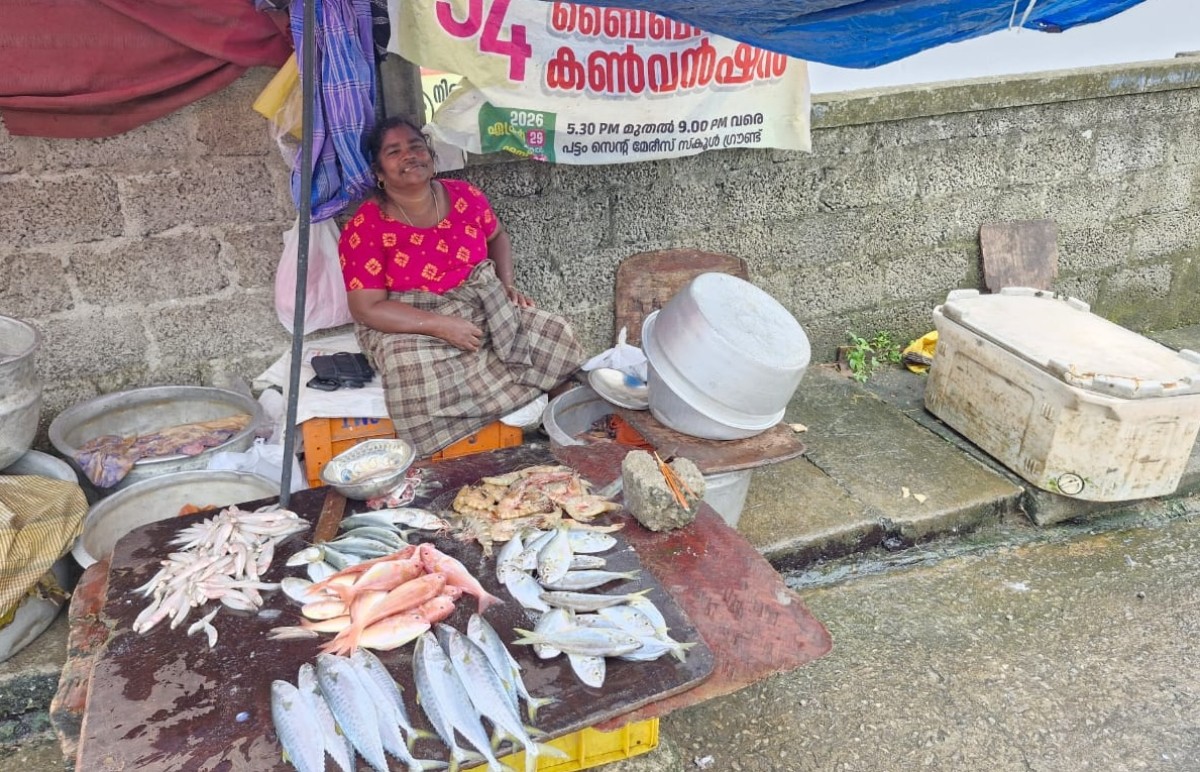
Rajamma is one of the many fish vendors who rely on makeshift stalls every day. Photo: TikTalk News.
 By Hari Kumar, on August 11, 2026
By Hari Kumar, on August 11, 2026
By Hari Kumar, on August 11, 2026
Rajamma leaves her home in Poonthura, on the coastal edge of Trivandrum, before the city has properly woken up. By 11am she has set up her platform in the city centre, fresh fish laid out for the day’s customers. She operates the stall until late at night.
Through all those hours, she sits on an upturned plastic container. It is a common enough sight across Kerala’s towns – vendors perched on whatever will hold their weight, for as long as the day demands. Nobody stops to notice.
When Kavya Vijayan was doing her postgraduate degree in Home Science at College for Women, Trivandrum, she set out to study the working conditions of roadside fish vendors. She collected data from 500 vendors and found that the improvised seating was causing more than just discomfort.
Backache, varicose veins and neuromuscular strain showed up repeatedly. For the women who make up much of this workforce, the absence of toilets, particularly during menstruation, compounded the problem.
What began as a postgraduate research project eventually resulted in a rare event: collaboration between two institutions in Trivandrum – College for Women and College of Engineering – that produced a design patent for a new kind of street-vendor stall to address the problems faced by vendors.
Chain of Connections: It all grew out of Kavya’s discussions with her guide, Dr V Sithara Balan, on what could be done about the problems the vendors faced. Their thinking gradually moved beyond a research paper towards something more ambitious – a stall actually designed around the people using it.
Then came an unlikely connection. Dr Sithara had participated in the Kerala government’s now-defunct FLAIR programme for faculty, where she came into contact with Dr Karthik Mohan of the College of Engineering Trivandrum (CET).
During a casual conversation between the two during a function, the student project also became subject. It turned out that CET’s Architecture department had an street stall design sitting in its files.
A couple of years earlier, Dr Karthik's students had sketched a generic street-vendor stall as a first-year orientation exercise, intended for vendors such as tender coconut sellers and fish sellers.
What followed was something that remains relatively rare in Kerala’s academic ecosystem – two college departments began working together on a problem that existed outside their classrooms.
BArch students Panchami and Adil Jomi, under Dr Karthik’s supervision, started brainstorming with Kavya and developed the design using the data she had collected. They also collected actual physical measurements of the vendors to provide proper ergonomic support and operating space for the users.
More Than a Seat: The result went well beyond replacing a plastic container with a better seat. They also named stall Olam – Malayalam for waves.
Olam has a compartment to reduce spoilage, a separate hygienic waste enclosure that can be taken away, and a covered storage space for the vendor’s belongings, including sanitary products. The design also ensures that products for sale are displayed attractively and hygienically, rather than simply being laid out on an open platform.
There is even scope for advertising panels, potentially giving vendors an additional source of income.
The design also makes provision for mobility, solar power and refrigeration depending on the vendor’s needs. Its blue colour combination is also part of the patented design, giving Olam a visual identity as well as its varied functional features.
The team focused on fish vendors, but the idea could go much further.
Wider Horizon: Thousands of street vendors across India sell fruits and vegetables from makeshift platforms, often leaving their produce exposed to the hot sun. A workstation that provides shade, better hygiene and refrigeration could help reduce spoilage while improving the way produce is displayed and sold.
That matters in a country where food loss remains a significant problem. An Emerson Climate Technologies India estimate cited in a 2025 paper put the annual value of fruits, vegetables and grains wasted in India at 44,000 crore rupees, with fruits and vegetables accounting for the largest share.
It estimated that 18 percent of India’s fruit and vegetable production, worth 13,300 crore rupees, was wasted annually, with inadequate refrigerated transport and cold-storage facilities among the major contributors. The lack of proper facilities at the street-vending level is another contributor – a problem Olam is designed to address.
Plot Twist: The team filed their patent application in August 2025 and, after months of queries and clarifications from the patent office, the design patent was granted in June 2026. It was issued in the names of Kavya Vijayan, Dr V Sithara Balan, Dr Karthik Mohan, and his students Panchami and Adil Jomi.
The media interest that followed was considerable. But somewhere along the way, the story acquired a life of its own. An AI-generated image of the stall appeared in one report, while incorrect information about its pricing and specifications also made its way into the coverage.
The confusion was ironic. Olam had become a media object before it had become a physical object.
Yet the interest was real.
Stalled Progress: The team received enquiries from different quarters, including a request from a reputed institution about acquiring or transferring the patent. There was also interest in getting dozens of stalls.
Then came perhaps the most concrete indication that this was more than a college project. Officials from Uttarakhand contacted the team and asked whether they were ready to deliver the stalls.
They weren’t, because there is still no prototype.
The students who worked on the design have moved on while the patent application went through the process. There is no budget within the college system to bring them all back and develop the design into a physical product. Interest from outside, including potential commercial and CSR support, has so far not translated into a concrete proposal to build one.
There is a further complication as Dr Sithara is among those who hold the patent. As government employees, faculty in Kerala’s government arts and science colleges are governed by state service rules that prohibit government servants from engaging in commercial activities. That makes commercialising this patent far from straightforward, even when there is interest in taking the design forward.
And so Kerala finds itself with an unusually complete innovation story that has somehow stopped just short of becoming a product.
The Wait Continues: There was a problem. PG student Kavya studied and identified it. Two college departments came together to design a solution. A patent was granted. The media celebrated it. People outside Kerala wanted to know if they could get it.
But the ecosystem to turn this into a viable product is absent, even as the state debates the knowledge economy and technology-led development.
Rajamma doesn’t know any of this. She still sets up on her plastic container every morning, in the same spot, for the same hours.
A top target for Kerala AI
Kerala is witnessing a surge in “mini cloudbursts” – short, intense bursts of rainfall that are increasingly replacing the state's traditional, more predictable monsoon pattern. Experts link this shift to rising sea surface temperatures, and the resulting downpours have triggered deadly floods and landslides last week. Meteorologists admit these hyper-localised, sudden weather events remain notoriously hard to forecast, exposing gaps in current early-warning systems. With Kerala home to a strong IT and startup ecosystem, the state's tech sector could play a key role in building the real-time prediction tools this crisis demands.
Meanwhile, Google DeepMind has unveiled WeatherNext Cyclones (WN-C), an AI model detailed in Nature that delivers state-of-the-art ensemble forecasts of cyclone track, intensity and size up to 15 days ahead. Notably, a lighter version, WeatherNext 2-mini, still performs impressively at coarser resolution – a result even researchers don’t fully understand yet – and the model is open source. Given Kerala's unique and increasingly erratic climate, adapting such open-source AI forecasting tools could potentially make Kerala a key global climate-tech centre.
Startup looks to aid rice growers
As rising temperatures and shifting rainfall patterns put Asia's water-intensive rice farming under pressure, climate-tech startup Mitti Labs is building a platform to help farmers cut water use and methane emissions using satellite imagery, AI, and field operations. The New York- and Bengaluru-headquartered company has grown fast, scaling from about 8,000 farmers in its first season in 2024 to over 100,000 this season across several Indian states. To fuel its Asia-wide expansion, the startup has now raised 9.5 million US dollars in a round led by Aramco Ventures, Saudi Aramco's venture arm.
China keeps mining its resources
While India is still exploring ways to establish an academia-industry connect, China has already begun reaping the benefits of such collaboration. The country has unveiled the “Xianglong,” a first-of-its-kind boring and blasting rig that boosts hard-rock tunnel digging speed by 30 percent, co-developed by Tsinghua University and a unit of state-owned China Railway Group. The 4.5-metre-diameter machine rolled off the production line in Wuhan, Hubei province. Once heavily reliant on imported large-diameter machines, China has transformed into the world's leading boring machine manufacturer.
Clues that lead to paper trials
A Vietnamese school found students submitting eerily similar homework, though they hadn’t copied from each other. They had simply asked ChatGPT the same question and, unsurprisingly, most got pretty much the same answer. But teachers used a clever trick – they didn’t assess just the final essay, but also asked for drafts, outlines and edit histories to see how the work had actually been done. A report says teachers in Denmark are also making students defend their homework essays orally, as written papers are increasingly being done with AI. So for many students, the answer is simple: the real exam is explaining what the hell you just submitted.
