
Artificial Intelligence and its impact are major topics of discussion in the world of technology. In this guest column, the Principal of Trinity Engineering College, Arun Surendran, makes the case for Small Language Models as a practical path for developing countries like India. Arun completed his Master’s and PhD in Aerospace Engineering from Texas A&M University after his BTech from IIT Bombay and has decades of experience in engineering innovation, entrepreneurship and education as a mentor, adviser and investor.
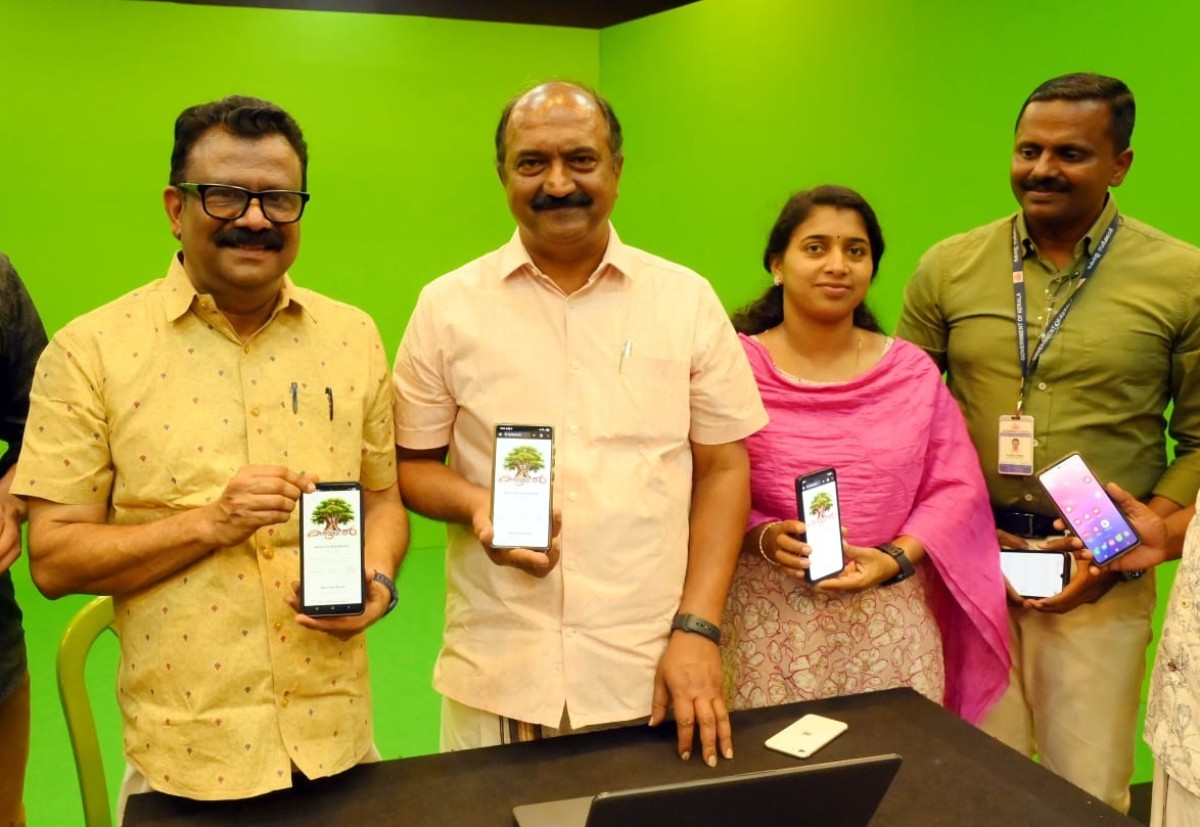
From left, MLA IB Satheesh, Minister KN Balagopal and other officials during the unveiling of the Kattaal.ai website. Image courtesy: Facebook.
 By Arun Surendran, on March 03, 2026
By Arun Surendran, on March 03, 2026
By Arun Surendran, on March 03, 2026
When hundreds of young students streamed into a cinema hall on the outskirts of Kerala’s capital, it looked like opening day for a blockbuster. Instead, the crowd at SP Cinemas, Peyad, had gathered for something far less cinematic – but potentially far more consequential.
On February 19, 2026, by 9:30 am, the theatre was buzzing. The venue, which doubles as a convention centre before the matinee show, was hosting the soft launch of the Kaattaal.ai.in platform – a hyperlocal artificial intelligence system built not for the world, but for a constituency.
The vision came from Kattakada MLA I B Satheesh, with technology partner PACE Infotech and Trinity College of Engineering as community collaborators. Their idea is simple but ambitious: instead of building ever-larger Large Language Models trained on the entire internet, build a Small Language Model trained deeply on one place.
At a time when AI conversations are dominated by scale, Kaattaal.ai focuses on relevance. Domain-specific Small Language Models trained on curated local datasets offer a compelling alternative to general-purpose systems. Large models are powerful, but they are expensive to run and often unpredictable, because they are trained on vast, generic data with little connection to local realities.
Kaattaal’s strength lies in narrowing its database. In a country like India, where authentic documents and reliable records often sit scattered across government departments, the problem is not the absence of data but integrating it coherently.
Strong Foundation: That narrowing became possible because Kattakada had already spent years building structured datasets. Curated documents, institutional knowledge repositories and meticulously compiled records formed the foundation.
The Ariyam Kattakada portal, powered by GIS layers, real-time inputs from IoT devices, and weather tracking stations overseen by the International Centre for Free and Open Source Software (ICFOSS), had already enabled detailed economic and agricultural handbooks. These structured datasets became fertile ground for training the model.
Getting to that stage required months of painstaking work and volunteering by Trinity College students – digitising hard-copy documents, cleaning inconsistent tables and standardising records that were never originally designed for machine learning.
Root Causes: Language itself posed challenges. Malayalam’s rich diversity meant that tapioca could appear as kappa, maricheeni or kizhangu, sometimes within the same document. Teaching the model to recognise that these variations referred to the same crop required careful linguistic mapping.
Once the quality of the data was achieved, creating a public-facing AI platform became possible.
In an era when generative AI systems are notorious for confident hallucinations, Kaattaal takes a different stance. It is designed to say “No”. If data does not exist in its repository, it does not improvise. In that sense, it is deliberately “bluff-proof”.
Queries about the Kattakada constituency can be posed in English or Malayalam. Responses are drawn strictly from verified local datasets. A large language model is used only as a translation layer, not as a knowledge engine.
As the beta version continues to evolve, Kaattaal hints at something larger: conversational governance.
Sound Ideas: In a multilingual, red tape-prone system, service delivery often collapses under its own interface design. “Single Window” portals frequently multiply into a maze of windows – each demanding fresh logins, OTPs and patient scrolling.
A domain-trained Small Language Model could change that interaction layer. Instead of navigating portals, citizens could simply ask: How do I register a land deed? What schemes are available for my crop? The system processes the query, accesses verified records, and responds in natural language – without compromising data privacy or relying entirely on external AI agents.
The longer-term possibilities extend beyond a single constituency: Smart Panchayat dashboards, automated grievance systems, department-level AI helpdesks and intelligent front ends layered over existing ERP systems. Kaattaal positions itself not as a replacement for legacy systems, but as a conversational bridge between citizens and bureaucracy.
Depth Matters: Kattakada is no stranger to governance experiments. Its water resource revival efforts were recognised by the United Nations. The Jala Samridhi initiative became an international model for water security and received acclaim at the International Water Conclave held in Shillong, Meghalaya, where it was recognised as a model that achieved participation of the local community.
The ongoing Carbon Neutral Kattakada project further reflects a willingness to test ambitious ideas at the constituency level.
Kaattaal may yet join that list. If it succeeds, it could offer a replicable AI interface framework for local bodies across India – proving that in artificial intelligence, depth may sometimes matter more than scale.
Big target, bigger task
Kerala Cabinet approved IT Policy 2026 and, as usual, it is a riot of numbers – 5 lakh new jobs, 10 per cent of India’s IT exports, and a 20,000-strong startup ecosystem. It also mentions growth in AI, space tech and semiconductors, along with already announced plans such as private coworking spaces. Hopefully, along with such intent, they will also take steps to listen to what startup founders are saying. A recent plea came from MyDesignation CEO Swaroop Krishnan.
MyDesignation has shown how Kerala-based products are able to scale up and has recently secured backing worth 40 crore rupees for further expansion. In a LinkedIn post, Swaroop says they still hear people saying building national or global D2C brands from Kerala is impossible. As he notes, 90 per cent of nationally scaled Malayali D2C founders have grown their brands from outside the state. His plea to the authorities and other stakeholders is worth listening to.
Read the report, stay calm
An analyst group, Citrini Research, stirred a global debate last week with a dramatic scenario imagining agentic AI triggering mass economic disruption within two years. The hypothetical future features doubled unemployment and a stock market crash wiping out over a third of its value. Even the authors describe it as a scenario rather than a prediction. More than the tech impact, what stood out was the market reaction to the rise and fall of tech companies. There were a few who dismissed the hypothesis, but a day later IBM shares fell after a report said Anthropic agents can now read Cobol. The markets, it seems, were listening.
Medtech under the scanner
The Galgotias University scandal is now sending the medical device sector into introspection, with growing debate over how many ‘Make in India’ products sold to hospitals are simply relabelled imports. As the Medical Buyer report notes, the regulatory framework remains unable to distinguish between devices genuinely made in India and Chinese imports relabelled as local products by some companies. Many Chinese-made devices are routed through intermediary hubs such as Hong Kong, Singapore and Malaysia, according to the report.
AI’s Midas touch spreads
The latest beneficiary of the AI-fuelled boom is computer repair shops. As demand for high-end chips has triggered a RAM shortage, prices have risen by 300–400 per cent. With major chipmakers such as SK Hynix and Micron focusing on lucrative data-centre semiconductors, PC components are in short supply. So used-laptop traders who strip devices for parts or resell them across Asia are now seeing brisker business. One trader told The Straits Times that chips are now “better than gold and stocks”.
