
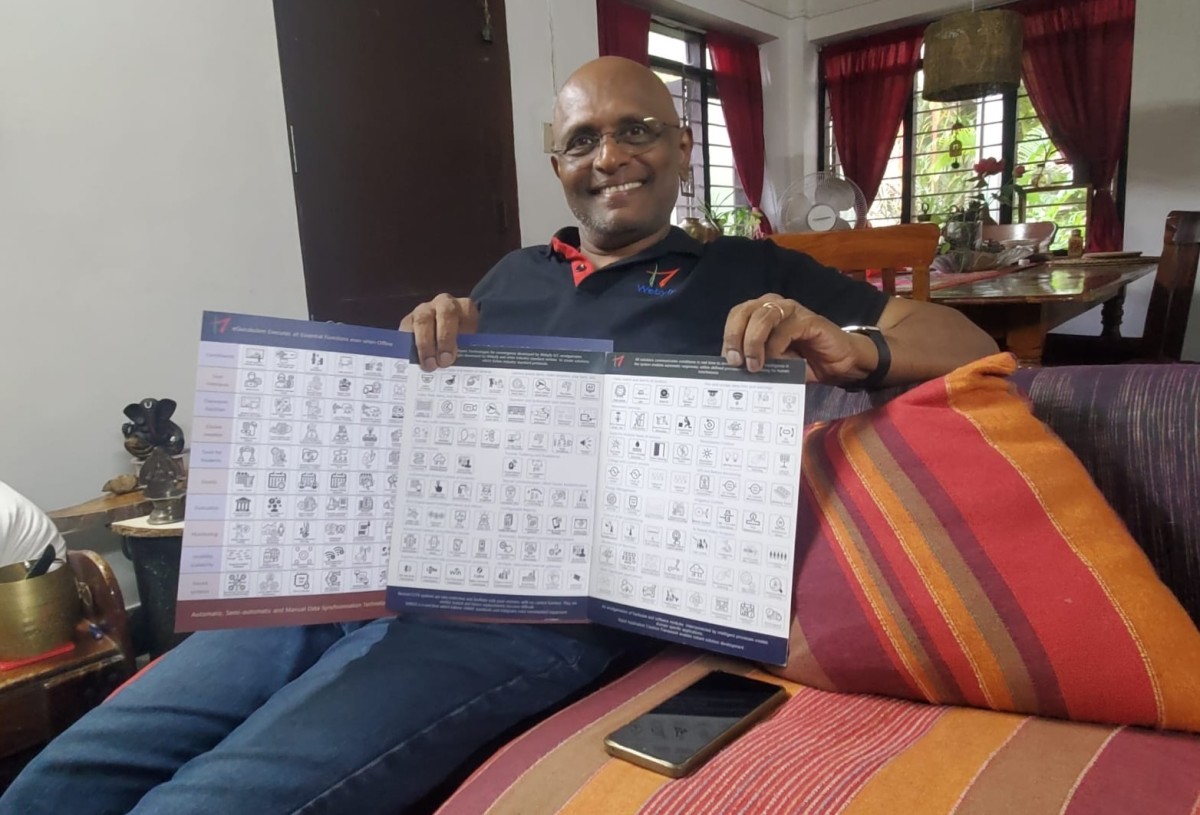
Webyfy founder M Vijaya Kumar says his startup is ready to enter the market with hundreds of products. Photo: TikTalk News
 By Hari Kumar, on July 21, 2026
By Hari Kumar, on July 21, 2026
By Hari Kumar, on July 21, 2026
“Our target is to be the largest IoT company in the country by the end of 2026 by releasing almost 600 products by December. We are planning to release over 2,000 products by 2027 to become the largest IoT company in the world.”
When the founder of Trivandrum-based startup Webyfy, M Vijaya Kumar, says this from the office he built within his home in Kumarapuram, it would not be a surprise for those who have known him.
The rest, however, might need a glimpse into his journey before deciding whether to take him seriously or dismiss it as another startup founder making lofty promises.
After graduating in electrical engineering from the College of Engineering, Trivandrum, in 1983, Kumar began his career at ONGC before a chance encounter with a former classmate led him to General Electric (GE).
He soon climbed through the ranks of the engineering giant, eventually leading major engineering operations across the Asia-Pacific region. Along the way, he collected four master’s degrees and worked across disciplines ranging from product development to human resources.
Returning to Kerala in 2002 for family reasons, Vijaya Kumar later worked with companies including SunTec and Nest. But after two decades of helping build organisations for others, he decided it was time to build one of his own. That led to the creation of Webyfy. After years of R&D, Vijaya Kumar believes the startup is finally ready for showtime.
Building before selling: Unlike many startups eager to get a product into customers’ hands as quickly as possible, Webyfy spent its first seven years building technology rather than chasing sales.
Rather than creating one device after another, Vijaya Kumar says the company focused on developing technology platforms that could eventually support hundreds of products across different industries.
The first is REACH, a modular IoT framework that allows developers to build connected applications by combining reusable hardware and software blocks.
The second, e-Gurukulam, is a learning management platform designed for schools and colleges, allowing classes to continue functioning even when internet connectivity is unreliable.
The third is Advayam, an open-source embedded development platform that he believes can serve developers working on IoT and edge AI applications.
Advayam is an open-source embedded development platform positioned in the same space as Arduino. Vijaya Kumar believes Qualcomm’s acquisition of Arduino has created an opportunity for alternative ecosystems, particularly for developers concerned about the platform’s future direction.
Ambitious Market: Vijay Kumar believes India’s IoT industry is approaching an inflection point.
“Even today, in my estimate the Indian market for the IoT sector is around 2.2 lakh crore rupees per year, out of which almost 1.6 lakh crore rupees is paid to foreign companies. We hardly have any domestic presence in this sector,” he says.
The broader trend is India’s growing component importing bill is difficult to ignore. India continues to import billions of dollars’ worth electronics components and finished products, mostly from China.
Vijaya Kumar believes it is a sector where Indian companies can compete globally. He says Webyfy products have been designed around internationally accepted protocols from the outset rather than being adapted later, a decision he believes will make it easier to compete beyond India.
Seven year Journey: Building those platforms has required both patience and investment.
Vijaya Kumar says Webyfy has spent more than 1.8 crore rupees on research and development over the past few years, even selling personal land at one stage to keep the company moving. Grants from the central government also helped.
Today, the startup has a team of just 12 people. Yet Vijaya Kumar argues that the size of the team matters less than the systems behind it.
“I am a process man. Instead of thinking as a product developer, I see the entire process including supply chain, production lines, marketing and customer service. That is the experience I acquired over the last three-four decades.”
The company says discussions are underway with prospective customers as it prepares to introduce its products commercially.
Tests Ahead: Whether Webyfy can turn seven years of engineering into commercial success remains to be seen. Most of its products are yet to reach the market, and the coming months will determine whether its platform-first strategy can translate into customers.
Vijaya Kumar, however, is not thinking small.
“We are a small company, but our target is to be the largest IoT company in the country by this year, largest in the world by next year, and who knows, even an IPO a couple of years after that.”
“I am a great follower of former president Abdul Kalam. He once said that you have to dream big to make it happen, and we have taken that advice to heart,” he says.
Moonshot fires fresh AI salvo
Another jolt for Western AI companies as Beijing-based artificial intelligence lab Moonshot released a new model that performs as well as leading platforms such as OpenAI and Claude, but costs only about half as much. Moonshot will charge businesses 15 US dollars per million output tokens (a measure of AI usage), compared with 30 US dollars for GPT-5.6 Sol and 50 US dollars for Claude Fable 5. If Moonshot can provide a viable cheaper alternative, it could upend the business case for its competitors.
This comes as China flexes its open-source muscles and President Xi Jinping warns against any nation placing its own security interests above those of others. Xi announced that China will offer 5,000 places in AI training and seminar programmes to developing countries over the next five years. He also pledged to build AI application cooperation centres alongside Asean, the Arab League, the African Union, Brics and other major regional blocs. China will also extend access to an AI-powered weather warning system to 30 countries.
Skyroot’s young guns deliver
If you are not proud of what Skyroot Aerospace has achieved with the launch of Vikram-1, you should be. Not just because it has made India only the third country, after the US and China, to have a private company successfully develop and launch an orbital rocket. What is truly jaw-dropping is the technology behind it. The rocket uses carbon-composite structures and 3D-printed components. It also placed all its satellites into orbit on its very first attempt. The average age of the Skyroot team? Just 28.
Startup chases Alzheimer’s detection
A test that can detect Alzheimer’s disease up to 15 years before symptoms appear – that alone would be a revolution in medical science. Add to that the claim it can be done through a simple blood test. That is what EnLife, a startup founded by Dr Deepak Kumaran Nair, Professor at the Centre for Neuroscience at the Indian Institute of Science, Lt Col Jojo Jacob and Anish Mathew, says it plans to deliver. The claims are yet to be validated, but the startup has already found a backer in Piper Serica VC Fund, which is providing seed funding of 6 crore rupees.
Robot fight loses its head
You need a strong stomach for cage fighting, where opponents try to tear each other apart – even when the combatants are humanoid robots. That was the message from the world’s first humanoid robot free-combat tournament, launched in Shenzhen by EngineAI. In one bout, a robot’s head flew off after a kick, yet its headless body kept fighting. We are not entirely convinced that was the best advertisement for humanoid co-workers.
