
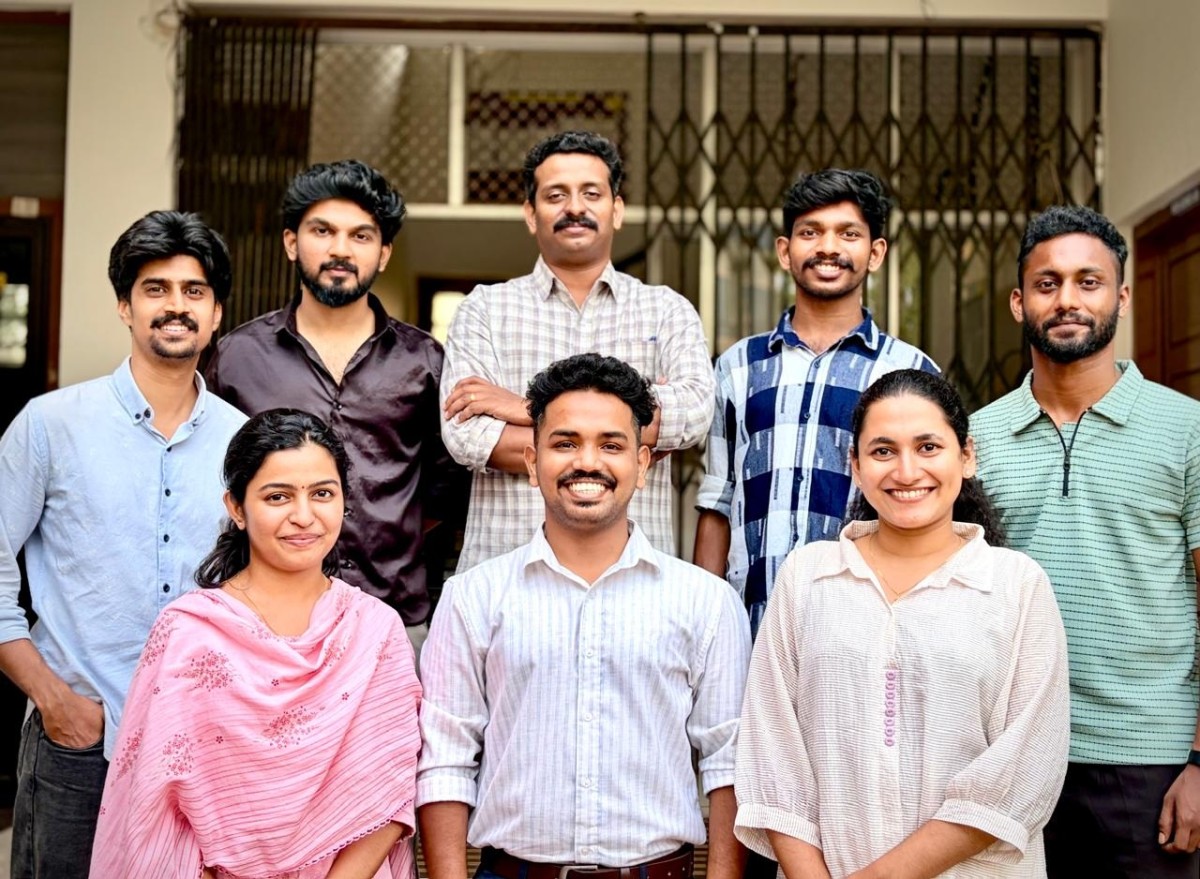
The team behind the Statoberry is headed by Mohammed Hisham (centre, front row) and mentored by Dr Pratheesh P Gopinath (centre, second row). Handout photo
 By Editorial Desk, on May 05, 2026
By Editorial Desk, on May 05, 2026
By Editorial Desk, on May 05, 2026
Picture a PhD student at an agricultural university somewhere in India. She has spent two years in the field – tracking crop varieties, measuring yield, recording soil conditions. The data is good. The findings could matter. What comes next, however, has nothing to do with agriculture.
She now has to figure out which statistical design fits her experiment. Then find the right software for that design. Then run the analysis. Then take those raw outputs that are technically correct, but completely unpresentable.And find another tool to make them look like something that belongs in a journal.
The graphs need to be clean. The tables need to be formatted. If she doesn’t know programming software like R or Python, she’s probably looking at three or four days of fumbling around before she can even think about writing up her results. This is the life of tens of thousands of researchers in a field where everyone is an expert in agriculture and nobody signed up to become a statistician or a graphic designer on the side.
This friction is not trivial. It delays theses, buries good research, and pushes people toward expensive proprietary software just to get clean graphs for publication. And it is a problem that a team at the College of Agriculture, Vellayani, near Trivandrum, decided to solve – quietly at first, then at a scale that surprised even themselves.
Fruitful Mission: The starting point was a tool called Grapes (General R-based Analysis Platform Empowered by Statistics), built in 2020 by Dr Pratheesh P Gopinath, head of the Department of Agricultural Statistics at Kerala Agricultural University. It was designed for students and researchers within the university. It was open source, and it spread far beyond the campus. Within a few years, over 200,000 users across the world were relying on it.
But use at scale revealed the gaps. Grapes did not do everything researchers needed. Requests kept coming in. And a recurring complaint had nothing to do with the analysis itself – it was about what came after.
“Even as Grapes was being used by thousands to help with their research, we often encountered students who wouldn't know how to structure the results of their data findings or provide a graphical representation as it needed use of another programme,” says Mohammed Hisham M, a PhD student in agricultural statistics who is now the CTO of the startup that grew out of this frustration. What once took hours of switching between tools, arranging tables, and formatting outputs now happens within seconds, all in one place
The insight that drove the new platform was deceptively simple. “That was the gap we kept seeing,” Hisham says. “The analysis may be done, but the research is still not ready to communicate. And communication is the whole point. If your results can’t be shown clearly – tables, plots, graphs – your work gets delayed."
"On top of that, many researchers still need separate software, often paid, just to create clean graphs for publication. So even after analysis, you are pushed into extra tools, extra learning, and extra subscription costs."
Complete Tool: The answer was to build something that collapsed that entire obstacle course into one window. The platform that emerged, Statoberry, combines R, Python, and AI in what the team describes as a point-and-click interface. The goal is direct: take research data and turn it into publishable content, without asking the user to become a statistician or a designer. Publication-ready from the start.
Statoberry LLP was formally registered as a startup and incubated at the K-AgTechLaunchPad, a joint initiative of Nabard, Kerala Agricultural University, and Western Sydney University, Australia. The team made up of students and researchers include Hisham M, Arshida A K, Jithin Chandran, Sreethu P T, Adarsh V S, Parthan RK, Sidharth S and Adarsh H S. Dr Pratheesh P Gopinath acts as their mentor.
The first version launched in December 2024, priced to be genuinely accessible – 200 rupees a month and 800 rupees for six months. “At that time, the pricing was basic and student-friendly,” Hisham says. Growth was slow and manual at first. “After releasing the tool, we did a personal marketing by calling up and messaging researchers and students about it. It took about six months to hit the first 100 users.” The second hundred, though, came in thirty days. “That gave us a lot of confidence.”
Constant Growth: The platform started with 13 types of analysis. It now has 54 modules, covering almost every major area touched by agricultural researchers. “Even today, the mindset is the same: keep improving, keep adding what researchers actually need,” Hisham says.
The AI component in the platform is deliberately limited. Hisham is clear about where it draws the line: “We made sure that AI is not used in the analysis part to eliminate the risk of hallucinations for which LLM platforms are prone to.” What AI does instead is help researchers structure their work, navigate the platform, arranging the data, interpret and explore their data through a conversational interface – asking questions, surfacing insights, and navigating findings – without touching the underlying analysis engine.
The user base now goes well beyond the Kerala Agricultural University network. ICAR-Indian Institute of Spices Research, ICAR-Indian Institute of Wheat and Barley Research in Haryana, and 62 institutions under the Nepal Agricultural Research Council are on the platform. The University of Idaho has adopted it for its researchers. Experts from the US Department of Agriculture and other American universities are in discussions with the team.
Tech Lessons: Growth also brought a hard lesson. “When we were nearing 2,000 users, the system suddenly stopped overnight,” Hisham says. “We're from an agriculture background, not a tech background, so at first we didn't even know what exactly went wrong. That night turned into two days of problem-solving.”
The team put up a notice, scaled the computing power, and rebuilt the infrastructure more carefully. “We kept scaling the system stage by stage, and today we have a setup that is much more scalable – strong enough to onboard multiple institutes fully without the platform crashing at the worst time.”
The startup, which remains bootstrapped except for the 5 lakh-rupee grant allotted during the incubation time, has now created a premium version for institutes and research organisations, which can be used by multiple users.
Their ambitions are not staying rooted in agriculture though. “The startup has much bigger goals now. As the tool is in essence a data analytical tool, there is scope for expanding its shadow beyond agriculture. Talks are on with players in different sectors like medical analysis, commodity futures market and others,” says Hisham.
Technology with a real purpose
People using technology to solve problems around them always win our hearts. The latest in our list of heroes are Mumbai-based sisters who have launched Yatri, an app that makes life easier for millions of train commuters in the city. Lakhi Sakaria Chowdhary and Reeva Sakaria created a product that gives real-time local train tracking, powered by proprietary GPS devices installed across the network and fed directly from railway control rooms. Commuters get live train locations, real-time delay alerts, platform change notifications and disruption updates the moment they happen. It has been years since we have been praying for an app like this for bus passengers in Kerala.
Bangalore is undoubtedly the tech hub of India, but it is also a city plagued by civic problems, from water scarcity and flooding after rains to pollution. Now, an attempt is being made by the Karnataka Geographic Information System (K-GIS) to harness the power of technology and the innovativeness of young minds there to churn out some solutions. A two-day event saw students from universities across the state gather at the Karnataka State Remote Sensing Application Centre (KSRSAC) to showcase their tech- and AI-driven solutions. There were plenty of ideas, from floating drones to monitor water quality to crowd-sourced platforms to keep watch on infrastructure. The answers are there. Now all that is needed is some political will.
Moringa recipe for microplastics
The health benefits of nutrient-packed moringa leaves and drumsticks are well known, though India has never fully tapped their commercial potential. Now researchers in Brazil have found another use for the tree. Moringa seeds, which are usually discarded, contain materials that can capture microplastics from water. The research is still at the laboratory stage, but it comes at a time when waterways across the world are increasingly contaminated by microplastics thinner than 1 micrometre. The discovery should encourage more work in this area, especially since many of the current solutions rely on synthetic chemicals.
Japan tests airport humanoids
A robot that cooks and cleans is still a faraway dream, but Japan has started experimenting with a humanoid luggage handler at Haneda Airport. Japan Airlines and its partner in the initiative, Japan Airlines GMO Internet Group, say the idea is to ease the burden on human employees amid a surge in inbound tourism and forecasts of worsening labour shortages. At a demonstration event, the 130cm-tall robot, manufactured by Chinese company Unitree, was seen cautiously pushing cargo on to a conveyor belt next to a JAL passenger plane. Given Japan’s declining population and high labour costs, such experiments are only likely to increase in the years ahead.
Crying wolf with AI
A wolf escaping from a zoo is scary enough, but spotting what looked like one casually strolling down the main streets of the South Korean city of Daejeon was enough to send police patrols scrambling across the area. The wolf was eventually recaptured from another area and returned to the zoo, but the story didn't end there. The viral image posted on social media turned out to be fake. Authorities were not amused by the creator’s “just for fun” excuse and promptly hauled him to court. He now faces up to five years in jail for obstructing official duties. A modern-day case of crying wolf with AI.
