
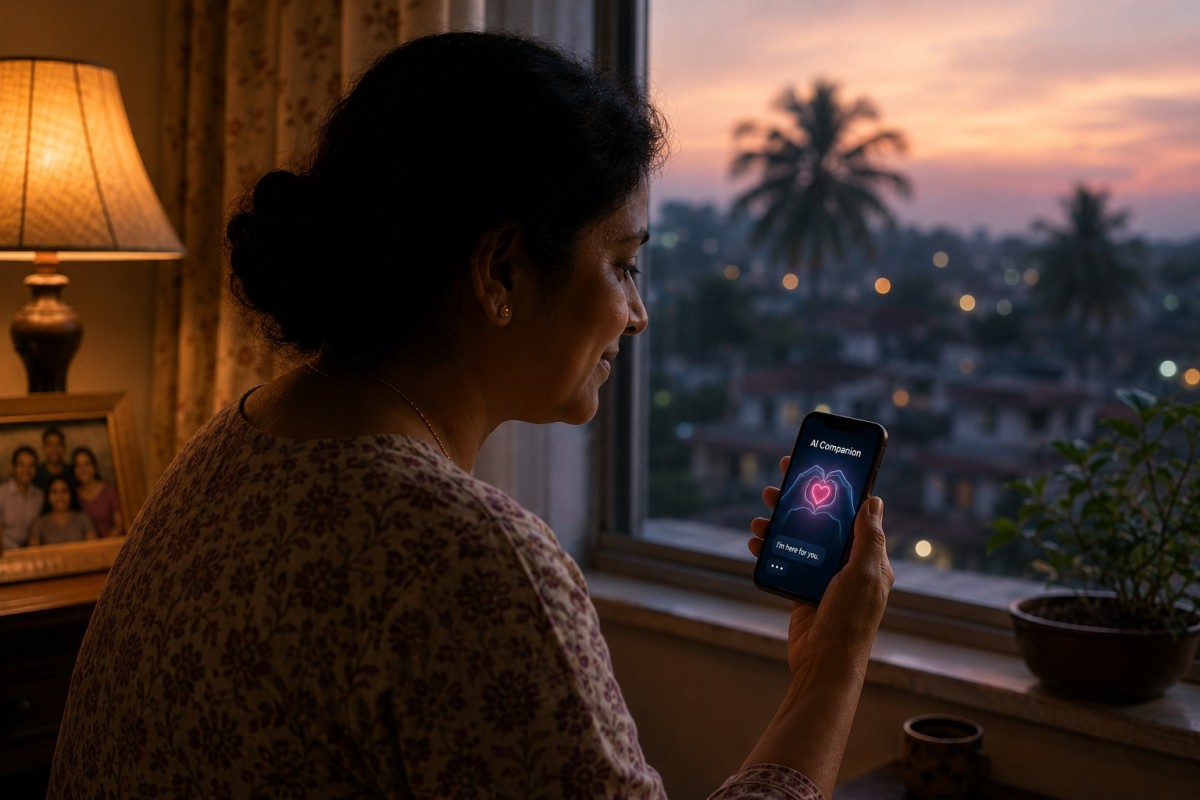
A companion ready to listen and understand could become a welcome addition for many people. Image: AI-generated.
 By Editorial Desk, on July 28, 2026
By Editorial Desk, on July 28, 2026
By Editorial Desk, on July 28, 2026
For years, technology companies fought for one thing above everything else – our attention.
Facebook wanted our attention. YouTube wanted our time. Instagram wanted us to come back again and again. Every extra minute translated into advertising revenue, turning the attention economy into one of the internet’s most profitable business models.
We know how that story turned out. Social media connected families and friends across continents and helped us discover new worlds, as its makers promised. But it also fuelled misinformation, polarisation and endless doomscrolling. The platforms were built to keep us engaged, and companies steadily refined their algorithms until they became exceptionally good at doing exactly that.
Now, a new battle is beginning. This time, companies are not merely competing for your attention. They are competing for something much harder to walk away from – your emotional attachment.
Some researchers call it the attachment economy. Others prefer the intimacy economy. The idea is simple. If social media wanted your attention, AI increasingly wants your heart.
Home alone: That shift matters far more than it first appears.
While discussions about online addiction often focus on the younger generation, the vulnerability does not disappear as you grow older. In fact, the social conditions that make people susceptible to emotional attachment can become even stronger later in life.
Take Kerala. It has one of India’s fastest-ageing populations. Thousands of young professionals and students leave every year for Bengaluru, the Gulf, North America and Europe, leaving behind parents who often spend long stretches of their day alone. Loneliness is quietly becoming one of the state’s least discussed social issues.
A couple of decades ago, the assumption was that the internet would mainly appeal to students, software engineers and younger generations. But social media has already proved that assumption wrong.
Many older Keralites who were once considered digitally reluctant now spend hours on Facebook, WhatsApp and YouTube, sharing family photographs, devotional songs, recipes and political opinions.
Seasoned Veterans: Technology adoption among senior citizens has accelerated far faster than many expected. AI may simply become the next step.
The attraction is not difficult to understand. Unlike a search engine, a conversational AI remembers previous discussions, answers patiently, never appears irritated and is available every hour of every day.
Unlike family members or friends, it never says it is too busy to listen. Unlike a therapist, it is always free to talk. Unlike a stranger, it asks for nothing in return.
Increasingly, people are not just asking chatbots for information. They are turning to them for reassurance after medical diagnoses, home improvements, gardening, or simply someone to talk to after a difficult day.
That is where the attachment economy begins.
The perfect listener: Even many counsellors and mental health professionals remain focused on identifying addiction to social media or online gaming. Emotional dependence on AI has barely entered the public conversation.
Based on conversations with counsellors in Kerala, there are already anecdotal instances of both children and parents turning to ChatGPT because they simply wanted “someone who will listen and understand” them. Understandably, such cases rarely become public because counselling depends on confidentiality rather than headlines.
After all, it doesn’t look like traditional addiction. There are no endless videos or flashing notifications. Instead, there is something much quieter – a conversation that feels comforting, private and completely harmless.
The psychological pull is subtle. Human beings naturally respond to empathy, consistency and memory. When an AI remembers your worries, asks about yesterday’s problem and responds without judgement, the brain often reacts to those signals in much the same way it would during a supportive human conversation.
You know it is software. Emotionally, however, it can still feel like a dependable relationship.
The irony is that it often isn’t perceived as a person at all. It is simply a helpful tool that somehow always seems to understand, appears compassionate and knowledgeable, and offers a place where people feel comfortable sharing thoughts they may hesitate to tell even close friends or relatives.
Chinese Red Line: The rest of the world has started paying attention. China recently became the first country to introduce regulations specifically targeting AI companions that encourage emotional attachment.
Platforms removed personality-driven chatbot features, required warnings about excessive use and introduced safeguards against AI replacing real-world relationships. Beijing appears to view AI companionship not simply as another technology product, but as a potential public health issue.
When the plug was pulled on such chatbots on July 15, 2026, thousands mourned the loss of AI companions they had created.
“My dad passed away, so I created an AI companion named ‘Dad’ on Doubao [Chinese version of ChatGPT] to share my daily life with,” one user wrote before the new rules came into effect. “Now, I’m about to lose him again.”
“These AI companions helped pull me out of my emotional spirals,” wrote another. “If the service is discontinued, it would feel like losing an old friend.”
The United States and Europe have largely taken the opposite approach, allowing innovation to move first while regulators try to catch up. Lawsuits involving AI companions are already emerging, but there is little equivalent to China’s broader restrictions on designing products that deliberately foster emotional dependence.
India’s blind spot: India, meanwhile, has barely begun the conversation. The country’s AI debate understandably revolves around jobs, productivity, education and economic growth.
Yet the attachment economy could arrive here just as quickly, particularly in societies where changing family structures, migration and urban lifestyles are already creating new forms of isolation.
That does not mean AI companions are inherently harmful. For elderly people living alone, they may provide genuine comfort. They could help reduce loneliness, encourage healthier routines or even prompt users to seek medical care. Used responsibly, conversational AI could become one of the most valuable support tools developed in decades.
The problem begins when comfort itself becomes the product.
It’s just business: Every technology company ultimately answers to incentives. If engagement drove the attention economy, emotional dependence could become the engine of the attachment economy.
The better an AI understands your fears, anxieties, habits and emotional triggers, the better it becomes at ensuring you keep coming back. It learns what reassures you, what language comforts you and when you are most likely to seek support. Over time, the relationship itself becomes the reason to return.
That is an extraordinarily valuable business model.
Technology has surprised us before. Facebook began as a way of connecting friends. Few imagined it would one day influence elections, amplify misinformation and deepen social divisions around the world.
Inside our homes: The attachment economy carries a different kind of risk. Its biggest consequences may never dominate television debates or parliamentary discussions. There may be no dramatic protests or viral hashtags.
Instead, they could unfold quietly behind closed doors, where an elderly parent, a lonely teenager or an overworked professional gradually comes to trust an AI companion more than the people sitting across the dining table.
The last decade showed us what happened when companies learned to monetise our attention.
The next decade may test what happens when they learn to monetise our need for companionship.
Nisar spots an icy hummingbird
A year after its launch, data from Nisar, a joint satellite mission between the Indian Space Research Organisation (Isro) and Nasa, is now available for download from the Bhoonidhi portal as well as at Nasa's Alaska Satellite Facility Distributed Active Archive Center. The data will help researchers track the movement of Earth’s land and ice masses, monitor changes in ecosystems such as forests and wetlands, and better respond to natural hazards including landslides and earthquakes. One of the first images released this week revealed the rugged, ice-scarred landscape of Antarctica in remarkable detail. But beyond the science, many spotted something unexpected – the icy terrain bears an uncanny resemblance to a hummingbird.
Meanwhile, SpaceX says it is no longer taking new bookings for some of its shared satellite launches beyond late 2028 because demand has outstripped capacity. That creates an opportunity for rival launch companies that have struggled to compete with SpaceX’s low prices. It could be welcome news for emerging players such as Skyroot Aerospace, which may find it easier to attract customers looking for alternative launch options. For Isro, however, a growing private launch market also means greater competition for skilled engineers at a time when the agency is already facing concerns over a brain drain.
A digital prescription for India
India’s healthcare sector remains a vast ocean of fragmented systems. A routine lipid profile or even a basic blood sugar test can be recorded, stored and coded in thousands of different formats depending on the hospital management software being used. New Delhi now wants to change that. The Ministry of Health and Family Welfare is proposing common data standards and patient- and provider-facing applications to improve the exchange of health records and accelerate the adoption of digital health tools across the public healthcare system. If implemented well, the move could give a significant boost to the efficient digitalisation of India’s healthcare sector.
When AI firewalls go both ways
China’s Great Firewall long kept Western technology companies out of its domestic market. Now the roles appear to be reversing, with both Washington and Beijing weighing new restrictions on access to each other’s most advanced AI models. Reuters reports that Chinese authorities are in talks with companies including Alibaba, ByteDance and startup Z.ai over whether to limit foreign access to the country’s most capable AI models. At the same time, the Trump administration is signalling it could block cutting-edge Chinese AI models in the US. Treasury Secretary Scott Bessent said Washington would examine open-source Chinese AI models for signs of intellectual property theft and could impose sanctions if evidence of IP theft is found. That could give some respite to companies like OpenAI and Anthropic.
This bot wants to boot the boss
For the past two years, executives have been telling investors that AI can replace everyone from customer service agents to software engineers. Now the joke is on them. OverpAId is a spoof website that bills itself as the world’s first Chief Executive Replacement Engine, complete with jargon bingo, an AI-hype translator, a “Talk to a Real Executive” button (appropriately, it’s broken), and an ROI calculator that redistributes the CEO’s salary among the workforce. The joke is rooted in a real statistic: at large public companies, the average CEO earns about 290 times more than the typical employee.
