
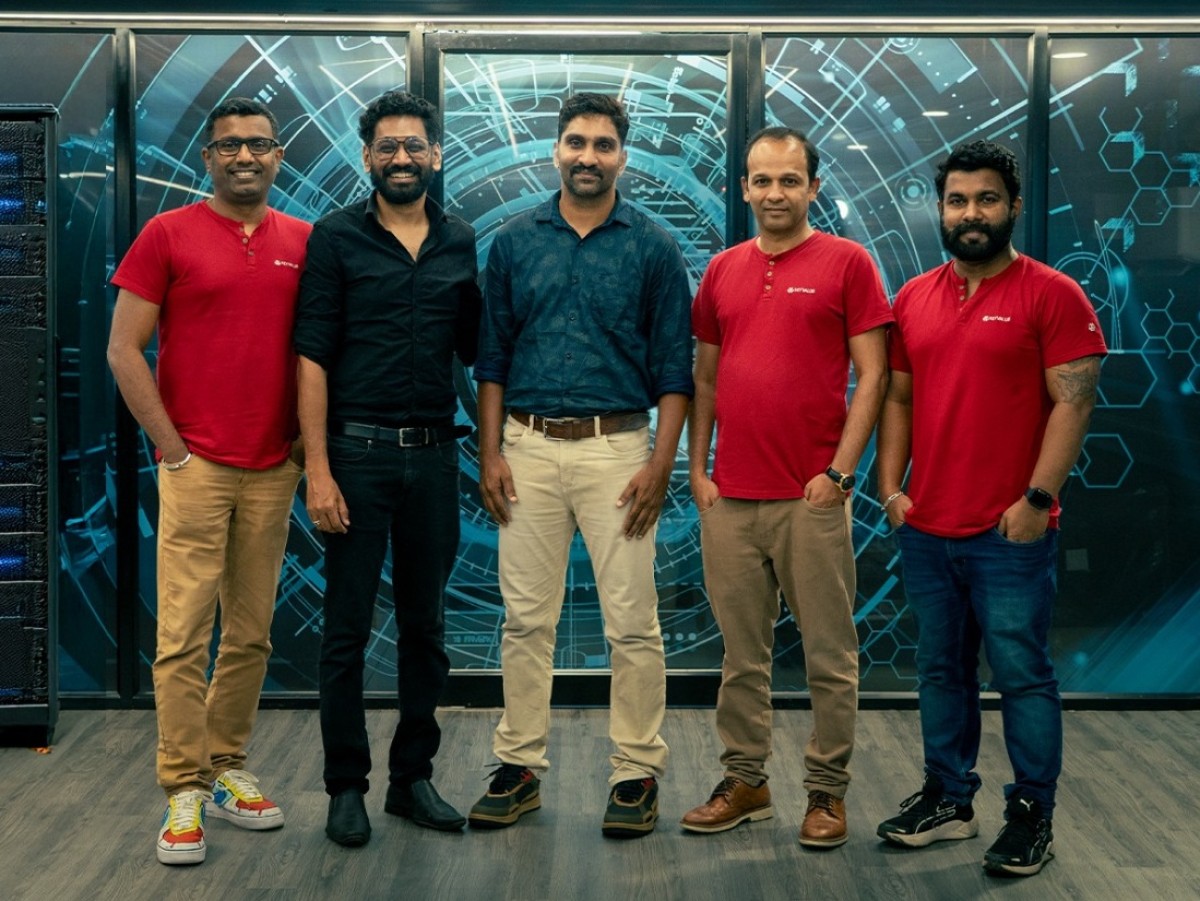
Cofounders of Genesys Labs Systems, Arshad Ali and Ullas Mathew (second and third from left) with the KeyValue Software Systems team. Photo: Handout
 By Hari Kumar, on March 17, 2026
By Hari Kumar, on March 17, 2026
By Hari Kumar, on March 17, 2026
Repairing computers and running tutorial colleges as a side hustle is the norm for many engineering students in Kerala. Idukki natives Arshad Ali and Ullas Mathew travelled that familiar path during their college days in Idukki and Muvattupuzha.
But a decade later, the two had built enough expertise to create what has been billed as Kerala’s first Nvidia AI Factory in Kochi – something that until recently was largely the domain of global technology giants.
The facility their startup GenesysLabs Systems built was for Kochi-based KeyValue Software Systems, a global service provider with a workforce of over 450 engineers and clients across the globe. It was looking to enhance its capability to process large volumes of data at high speed as the future demand will be for AI-driven technology.
As AI tool creation, data analysis and research gathers pace, the capability to run billions of calculations will decide the margin between success and failure. That is what AI factories like the ones built by Genesys Labs provide.
While the AI factory project has already received attention in the media, the larger story it reveals is something else – a snapshot of what Kerala youth can achieve when given the opportunity.
Arshad and Ullas were not fortunate to study in high-profile institutions. Their academic journeys took them through colleges and polytechnics in Kerala’s lesser-known towns, places better known for agriculture than cutting-edge engineering. But through sheer hardwork and ingenuity, they built a startup that could deliver results which, until recently, were the domain of global giants like IBM and L&T.
Starting Point: After college, Arshad and Ullas gradually built up a reputation for designing and servicing high-performance computer systems used by gamers and graphic designers. That niche interest eventually evolved into a deeper understanding of powerful computing systems. By the time they established GenesysLabs as a startup, they had already built credible proof of their expertise.
Their work had earned them recognition as an Nvidia Studio Certified Partner, the only one in southern India, and an Intel Gold Member. They had also worked with well-known cinematographer Mahadevan Thampi and later in 2017 helped provide the computing platform used to create a 3D version of the Mohanlal blockbuster Pulimurugan.
But none of those projects rivalled the scale of the challenge that came when KeyValue approached them. Their need was an advanced infrastructure capable of supporting the latest cutting edge technology.
Thorough Study: According to Arshad, the project was not simply about assembling powerful machines but about understanding exactly how the client would use them. The process started when talks opened in December 2024. “Our approach with all clients is simple: what they have and what they need.”
“We had to work with several departments of the client, including the actual people who were working with the system day in and day out, not just the top-layer management. Only after understanding the needs could we structure the design and the infrastructure that would support it,” he explains.
Once that was done, came the process of putting the plan into action. “It was a long evaluation process with products from different parts of the globe being tested out to stand up to the level of standards that the client needed.”
He says each component of the system was tested repeatedly. “Every part had to be evaluated and run with a similar amount of data to see how much stability it delivers, how much power it consumes, and how quickly the results can be delivered.”
Heavy Workload: Even cooling systems required weeks of evaluation. High-performance AI hardware generates enormous heat, and ensuring that the system could run efficiently under heavy workloads was one of the most complex aspects of the project.
The heat generated by such powerful processors can damage conventional hardware if not handled carefully. Genesys Labs therefore designed a specialised cooling system using 21,000-rpm fans, imported cooling pads and heat shields, along with a power management system that optimises usage while adhering to the startup’s environmental guidelines.
The customised architecture uses Nvidia’s Ada Lovelace GPUs – specialised processors built to handle the massive mathematical calculations required for artificial intelligence. Unlike conventional computers that process tasks sequentially, these GPUs can execute thousands of operations simultaneously, making them ideal for machine learning workloads.
Fast Forward: But computing power alone is not enough in AI systems. One of the biggest challenges in large-scale data processing is latency – the delay that occurs when data moves between storage, memory and processors. To address this, GenesysLabs designed a high-speed storage and networking system that allows data to move across the infrastructure with minimal delay.
The result was a system capable of performing around 144 billion operations every second. This, as Kerala’s IT Minister noted on LinkedIn, is faster than some existing supercomputing systems built under India’s National Supercomputing Mission.
The architecture was also designed with the future in mind. It can expand to handle exascale levels of computing in the future when Nvidia’s next-generation Blackwell chips become available. The system can potentially scale to perform a quintillion – a one followed by 18 zeros – calculations per second.
Futuristic Vision: For Arshad, the experience of becoming an Nvidia partner earlier in the company’s journey helped prepare them for this level of engineering.
“Being selected as an Nvidia partner was a long and difficult road for us,” he says. “The process forced us to maintain the standards expected by a global technology leader. But it also gave us access to deep technical resources and insights into how large-scale data systems are built.”
The experience gave the Genesys Labs team a close look at how the world’s most advanced AI systems operate. “The Nvidia libraries were awesome,” Arshad says. “They gave us a real insight into how deep data analysis can go and how much data could be used by clients in developing AI tools for the global market. That is where technology is headed.”
Lessons for Kerala: Arshad believes Kerala-based organisations should look to develop AI-first products without depending entirely on overseas computing platforms. GenesysLabs says it is already exploring the possibility of building smaller AI labs tailored to the needs of universities, research centres and enterprises that work with large volumes of data.
“Colleges and research institutes that process large amounts of data can build AI labs customised to their needs,” Arshad says. The cost of such labs will depend on the kind of work they undertake and there is no need to build a super expensive facility for each. Moreover, creating such centres would ensure data safety while reducing dependence on expensive cloud services based abroad.
He believes Kerala could consider developing similar facilities within selected colleges to familiarise students with the technologies that will shape the next generation of computing.
“When we were students, we couldn’t even dream of accessing such high-end technology,” he says. "Now we are in a position to provide at least a glimpse of the world ahead. Even if we can contribute in a small way, we would be grateful.”
Kerala products go global
For those who still say global and national brands cannot be launched from Kerala, here is some news. Genrobotics is going global big time, winning an order from PUB, Singapore’s National Water Agency, to supply 44 robots for the upgrade of water infrastructure across the country. More than the order, which will be worth around 80 crore rupees, what stands out is that Genrobotics was selected after an international search that involved more than 600 competitors from across the globe. When the Trivandrum-based students set out on their journey, many rich individuals shooed them away. Here is some news for them: the company in FY25 made 32 crore rupees in revenue and aims to reach 100 crore rupees in FY27. Now the naysayers can wait for its IPO, which is also in the pipeline.
Another Kerala startup aiming for the international market is Fulva, which has hit the sweet spot with its idea of selling traditional halwa to modern consumers, with slick packaging and innovative new products. The startup has recorded astonishing growth and has an Annual Revenue Run Rate of approximately 6.3 crore rupees. Now Aman Gupta, co-founder of boAt, has put his weight behind the brand and is planning to take the brand global. The latest funding round saw industry leaders Prejith Narayan, the Salpido brothers, Ajith Nair and Rahul Mamman also stepping in with support. The amount Fulva raised is undisclosed, but their target is clear: make this Kerala product go global.
Dogged pursuit finds success
Personalised medicine based on your DNA is something that has been predicted for a while now. With advances in genome sequencing and AI protein folding, things are getting tantalisingly close. Sydney tech entrepreneur Paul Conyngham says he created an mRNA vaccine for his dog Rosie, which was having tumour growth, and the results are, he says, “fantastic”. The tech entrepreneur took a long shot after his dog became ill and did a lot of research himself to pave the way for the process. As The Australian reports, the red tape surrounding the process was as tough as the research. So do not expect to see such medicines appearing anytime soon, but this definitely shows what could be possible in the future.
AI agent craze hits China
The AI agentic drama continues – and this time the stage was China. Chinese AI companies began luring users into installing AI agents on their computers, some even offering the service for free. In Shenzhen, more than 1,000 people reportedly lined up outside Tencent’s office for free installation for “lobster raising’ frenzy. Soon the fever spread, with almost every Chinese AI firm pushing free agents, while shops and online businesses popped up offering AI agent installation. Some provincial governments even launched AI agent installation campaigns. Then came the twist. Beijing began issuing warnings about the security risks of such agents and the mood flipped almost overnight. Advertisements soon began appearing offering to uninstall AI agents – for a fee. Chinese soap operas are always fun to watch.
Saving AI from humanity
A millionaire engineer and Harvard-trained doctor turned entrepreneur, Peter Diamandis, is mad at all these AI doom movies. So he is now out to fix this. He is offering prizes worth 3.5 million US dollars for people who make films that show AI in a good light. Aspiring filmmakers can submit three-minute trailers or short films that portray “positive visions of the future” for the chance to be one of five finalists to receive 100,000 US dollars in cash. The winner will receive both the cash prize as well as 2.5 million US dollars to turn the idea into a full-length film. The millionaire, who grew up watching Star Trek, is now on a mission to save AI from humanity.
