
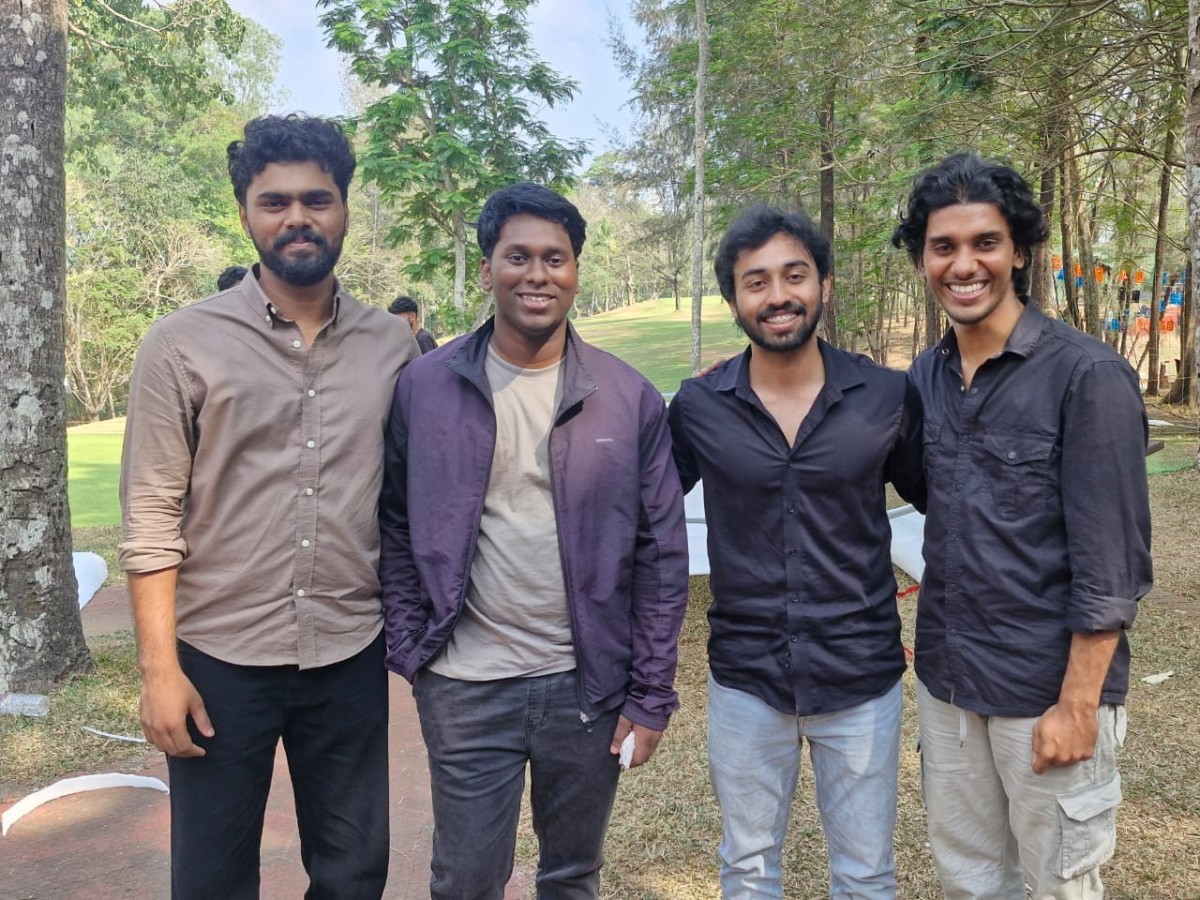
Four members of the team behind Thekku Island, (from left) Adithyan PS, Athul George, Aswin Sunilkumar and Jaivin P Jacob, during their trip to Trivandrum last week. Photo: TikTalk New
 By Hari Kumar, on February 17, 2026
By Hari Kumar, on February 17, 2026
By Hari Kumar, on February 17, 2026
As an avid gamer, school student Athul George of Ernakulam had one pet peeve: there was no game based in Kerala. He then did what most people only daydream about – he started building one himself. As he began posting bits and pieces of his work online, a couple of other young gamers found him through social media and reached out.
What began as a youthful interaction became a collaboration by 2025, culminating in Thekku Island, a 3D psychological horror PC game set in the backwaters, coastlines and an abandoned traditional Kerala house.
The game is slated for release on 27th February 2026, and anticipation has been building steadily within the local gaming community since the trailer dropped on gaming platform Steam. The short teaser shows a man walking into an ancient house set against a distinctly Kerala backdrop, greeted by the Malayalam line: “Njangalude veetilekku swagatham” (Welcome to our house).
It generated thousands of comments, not just from Malayalees but from gamers across the country. People from as far as South Korea asked for subtitles, and the creators say the clip uploaded on YouTube and Instagram has attracted millions of views globally after being shared by game-reviewing platforms such as IGN India.
After watching the teaser during Gamecon in Trivandrum, Ashish Kulkarni, chairman of FICCI’s AVGC-XR Forum, publicly invited the Thekku Island team to the GAFX 2026 event in Bangalore and urged them to release the game during the premier event of the Indian gaming community.
Cultural Turn: Beyond the buzz, the story taps into something larger. This excitement signals something the gaming industry has been slow to accept: cultural specificity is not a liability, but a richness waiting to be explored. The success of the Chinese game Black Myth: Wukong shows how Asian themes can reach heights once reserved for Western narratives.
Indian culture offers a goldmine for a new generation of creators who are now building titles rooted in the stories and settings they grew up with.
“I have been playing games on desktop and consoles for a long time. The absence of home elements in these games always bothered me. We want to attract players from across the globe to games set in our part of the world,” Athul said during the Gamecon event held in Trivandrum recently. A self-taught game developer, the 21-year-oldhad decided to pursue his passion after finishing Class 12.
The release of Thekku Island comes at a time when global appetite for culturally specific, non-Western gaming experiences is growing. The industry is still processing the scale of Black Myth: Wukong, released in 2024, which reportedly sold 25 million copies and generated nearly a billion dollars in revenue, with about a quarter coming from overseas markets.
Strategic Choices: This is the context in which Thekku Island must be understood. The team behind Thekku Island is small and young. Athul, known in gaming circles as Ales Devs, serves as game director. Aswin Sunilkumar is the creative director, and Adithyan P S handles game operations.
Aadhi Gopakumar composes the music, Jaivin P Jacob creates the 2D animation, and Aswin P V manages marketing. Most of them are barely a year older than Athul. Yet they made several deliberate choices early in development.
They were clear that the game would be set in Kerala and use Malayalam as its primary language, even though it was designed for a global audience. Kerala’s artistic traditions and storytelling heritage, they believe, have the potential to travel.
“We are getting feedback from countries like South Korea, and they are asking for subtitles. We plan to include them, as we see interest among gamers in north India and abroad. Some overseas gamers say they know quite a bit about Kerala and love our movies and arts,” said Adithyan, who, along with the two Aswins, studies at Saintgits College of Engineering in Kottayam.
The team also decided against building for mobile phones, where most Indian game development has historically concentrated. The Indian mobile market is enormous, but desktops and console players still dominate the premium global gaming segment. So they opted for a PC game.
Local Texture: Another distinguishing feature of Thekku Island is its theme: a first-person psychological horror experience set in the 1980s. There are no jump scares engineered for cheap effect. Instead, there is light and shadow, silence and the haunting music score by Aadhi. While many Indian developers have drawn heavily from mythology, this game is rooted in Kerala’s coastal landscape, its textures and a period just a few decades past.
The team also chose not to use AI tools. Jaivin, who creates the 2D visuals, says they wanted originality rather than relying on AI-generated imagery. “We create everything by hand. I don’t think AI can deliver the depth and texture of our drawings. As it is our first game, we wanted it to be perfect,” he said. Jaivin studies at Mar Athanasios College for Advanced Studies, Thiruvalla.
The bootstrapped Thekku Island team have just started their journey and are in the process of establishing a company called Redwills Interactive. But their youthful energy and ambition are unmistakable. They are also learning from missteps. A Vaishnava tilak on a character portrayed as a Siva devotee drew criticism from some gamers in north India.
The world of gaming they are stepping into is more complex and filled with minefields. Yet the team reflects the potential and ambition of Indian youngsters. What has long held back such efforts is the lack of an ecosystem to identify and nurture them.
For too long, the infrastructure – funding pipelines, development ecosystems and pathways to global distribution that exist in countries such as Japan, the United States and increasingly China – was absent here. That is changing. And somewhere on a remote island off the Kerala coast, the welcome sign is already up.
Alibaba to sell Made in India goods
As we mentioned last week, India has been steadily increasing trade and technology ties with China. This week Startup India announced the collaboration with Alibaba.com to identify and support local startups that can help onboard and scale Indian exporters on the group’s global B2B platform. The Chinese firm says it will help ‘Made in India’ products reach an international audience. The cold front that existed between the two countries after 2020 deadly border clash is definitely thawing and we have to see if the ban slapped on apps like TikTok, PUBG Mobile, and AliExpress will also be lifted soon.
Meanwhile it is Lunar New Year time in China and the local AI giants have launched massive festive campaigns. Alibaba gave away free drink orders to users of its Qwen app, and it was a huge success by all reports. Qwen shot to the top of app stores, leaving the offerings of ByteDance, Tencent, Baidu, and others in the dust. Social media posts showed the chaos after 10 million orders were placed in the first nine hours of its launch, tea shops made so many drinks that they ran out of cups and food delivery drivers were left overwhelmed with orders.
Agnikul aims to put AI on new orbit
Chennai-based Agnikul Cosmos and NeevCloud plan to build what they call India’s first privately led orbital AI data centre in low-Earth orbit. Instead of discarding the rocket’s upper stage after launch, Agnikul will repurpose it as an extendable hosting platform for NeevCloud’s AI systems. The two companies say this shared-hardware model – where rocket stage and data centre function as a single integrated system – could be a global first, making it more compact and cost-efficient.
Tearful farewell for Chatgpt-4o
Everybody loves a bit of back-patting, it seems. On Reddit, many users have rallied in protest, mourning the loss of ChatGPT-4o – the famously sycophantic model that also helped drag OpenAI into court over lawsuits tied to self-harm and delusional spirals. Officially, just 0.1 percent of its 800 million weekly users still cling to 4o – a “tiny” slice that nevertheless amounts to roughly 800,000 humans. Some are openly professing their love for the ever-affirming chatbot and grieving the demise of their dearly departed digital confidant.
Drone magicians fly high
China’s tech magic show rolls on – this time with a drone football tournament that many swore looked more like a version of “Quidditch” than anything Fifa would recognise. Pilots steered spherical drones through opposing goals at breakneck speed – essentially a real-world spin on the wizarding game from Harry Potter, minus the broomsticks. A whopping 1,116 teams from China and abroad battled it out over three days at the Chengdu Airport International Convention Center in Chengdu.
