
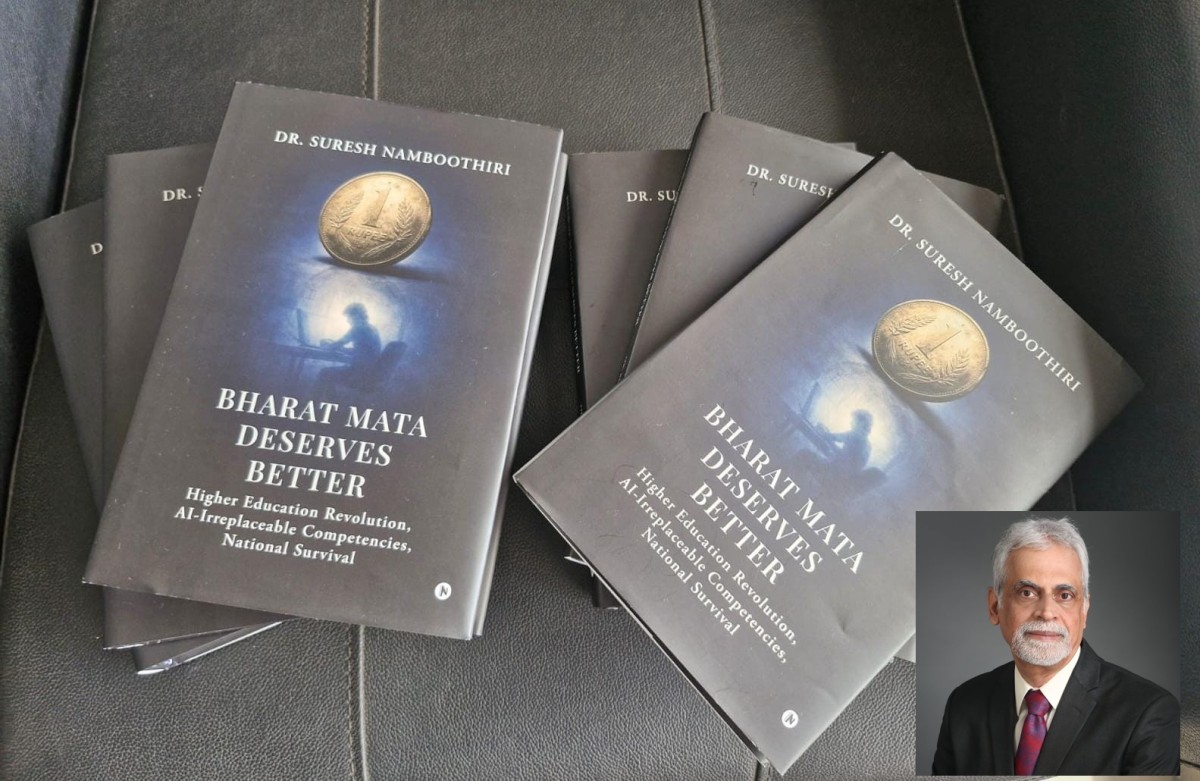
In his book Bharat Mata Deserves Better, Suresh Namboothiri (inset) says problems in education go far beyond the job market. Image: TikTalk News, LinkedIn
 By Hari Kumar, on September 01, 2026
By Hari Kumar, on September 01, 2026
By Hari Kumar, on September 01, 2026
Every time the Indian rupee falls, the reactions are familiar: the political blame game, and analysts rolling out the usual causes – oil prices, financial policies, trade disputes, geopolitics – and the cycle repeats when the next slide happens.
A new book, Bharat Mata Deserves Better, by Suresh Namboothiri, former Deputy General Manager (Design) at BPL Sanyo and later Chief Operating Officer at Tata AutoComp Systems, puts it in a different light. The rupee, he argues, will not recover through fiscal policies alone and will recover only when India builds products that rest of the world wants to buy.
He opens the book with an incident he witnessed at Sanyo Electric Company in Hyogo, Japan, in July 1994. A senior manager burst into the otherwise calm design office, tore a one-dollar bill to pieces, threw it to the floor and stepped on it – celebrating the yen falling below 100 to the dollar, the endpoint of a journey that began soon after World War II, when the yen was pegged at 360 to the dollar.
“Suresh-san, your country’s currency’s value is your value,” the Sanyo official told him that day – a line that became the lens Namboothiri later applied to India. His journey took him to engineering colleges and research institutes across the country and the findings he presents offer a startling picture of higher education in India.
Nut and Bolts: The lens that Namboothiri wields grew out of his own career. At BPL and Tata, he worked on building everything indigenously – from tape recorders and telephone exchanges to automobiles – and going on to become a key player in Tata’s automobile division by the time he was in his mid-30s. During the job interviews he conducted for both companies, he began noticing something: candidates could not explain their subject knowledge with any real depth.
“I have conducted over 1,200 interviews in my life – for positions ranging from senior engineer to vice-president,” he writes. At first, he thought the problem was communication. But when candidates were asked to answer in their mother tongue, the quality of their responses remained much the same.
That observation stayed with him, and he came to the conclusion that fresh engineering graduates were not being given the skills they needed. In 2006, despite a personal request from Ratan Tata to stay on, he left Tata to devote himself to education – determined to trace the problem to its root.
What followed was an extraordinary field investigation. He travelled 24,700 kilometres across India, visited 246 institutions of higher and technical education, stayed in student hostels and spoke to more than 37,000 students, academics, administrators, government officials and parents.
Campus Chaos: That ground-level experience gives the book much of its weight. Even the IITs, he argues, function less as places that mould researchers and more as certificate-distribution centres built around rote learning. Some of the conversations he recounts stay with you.
One is about a disappointed student who corrects his own qualification from “MTech in Mech” to “MTech in Meth” – suggesting that addiction, rather than education, was all he gained from college.
There are many such anecdotes of what he calls “white powder” graduates – material that looks like salt but has none of its saltiness. In one experiment repeated across several colleges, he asked students who used Instagram every day to suggest one improvement to the app. Nearly every hand went up to say they used it. Not one student could suggest an improvement.
The criticism isn’t simply about a lack of infrastructure. Namboothiri argues that India has spent too much time building campuses and buying equipment while overlooking the harder question of whether students are actually learning to think, question and create. A Singaporean academic makes the point bluntly in the book: you cannot simply accumulate buildings, laboratories and equipment and expect capability to emerge.
Deep Roots: Namboothiri traces part of this problem further back than independence, to what he calls the “Macaulay effect”. But he tries to go beyond the usual slogan, pointing to a study of more than 22,000 graduates that found 94 percent capable of little beyond recalling facts and procedures, with almost none reaching the ability to analyse or create.
He links this to the colonial-era shift away from India’s gurukula tradition, which he describes as being built around debate and a close teacher-student relationship. But he is no advocate of simply returning to the past.
The ruins of Nalanda, he writes, do not teach. If India wants to be a Vishwaguru, it has to demonstrate capability today rather than point to its past.
The IT sector doesn’t escape this argument either. India has produced millions of software engineers and built one of the world’s biggest technology-services industries. Yet the major software platforms used around the world – operating systems, databases, cloud platforms and AI models – have largely been created elsewhere.
Much of that industry is built around writing code for platforms India doesn’t own with little incentive to change, since a weaker rupee only makes its attractive against 60-odd rival countries. It is exporting cheap labour, in his reading, not invented technology. That has stopped India from moving far enough up the technology value chain.
Threat from AI: He is careful not to put the blame on students. The silence he kept encountering in classrooms, he writes, “stopped belonging to the students” and “began to belong to the system that trained them” – a system that gives young engineers little real chance to develop curiosity or original thought, while rewarding conformity instead.
He also holds up China’s national test Gaokao as a contrast. About 40 percent of that entrance exam is weighted towards language and interpretation, requiring students to construct arguments rather than simply reproduce what they have learnt. India’s system, by comparison, is built much more heavily around memorising and repeating.
Namboothiri argues that Indian model is now in serious trouble because AI and large language models can already do much of that work faster and more cheaply. This will force India to drastically revamp the current education system, he warns.
The book doesn’t stop at finding faults. It also offers a blueprint for Indian engineering education. For readers already familiar with pedagogy, these chapters offer Namboothiri’s own framework for moving education away from memorising knowledge and credentials towards building the ability to think, make decisions, solve problems and create.
The framework centres on what he calls the Cognitive Lift Principle and a 16-step Inter-Domain Progression, with a particular focus on capabilities that AI cannot easily replace.
Brave Hearts: That gap between education and capability, he argues, has left India dependent on what others make – from medicines to weapons for its own defence. That concern about dependence also runs through the book’s more personal passages.
Namboothiri draws on historical figures, from Rani Lakshmibai of Jhansi to Captain Mahendra Nath Mulla, who went down with INS Kukri during the 1971 Indo-Pakistan War, and to whom the book is dedicated.
That same reverence for sacrifice runs through his account of the Kargil War, where Indian soldiers were captured, tortured and killed by Pakistani forces – a passage that makes for difficult, moving reading for any Indian. But rather than call for vengeance, Namboothiri reads the episode differently: as a marker of the weakness a nation projects to the world when it cannot deter such acts in the first place.
The author draws inspiration from the Mahabharata, Thirukural, the Bible and even the Ganageetam. But at the heart of his quest is his devotion to Goddess Karthiyani Devi of the Kumaranallur Temple in Kottayam, from where he hails. These devotional and historical threads run alongside the book’s harder data.
Timely Question: The claims made in the book, along with its numbers and conclusions, will invite scrutiny. But even where one may disagree with the scale of the author’s diagnosis, the questions he raises about what India’s education system are difficult to dismiss.
At a time when uncertainty is spreading among India’s young – over geopolitical and technological changes, entrance exam fraud and a lack of accountability – many analysts reach for familiar political explanations. Bharat Mata Deserves Better offers something else: a deeper, more uncomfortable look at what may lie beneath that frustration.
It is an unsparing book. But it is not simply a lament about what went wrong. It tries to offer a way forward – and, more importantly, asks whether India can turn its enormous pool of educated people into something more valuable than certificates and cheap labour.
Nepal tragedy shows why tech matters
While flash floods usually stem from heavy rainfall, the recent tragedy in Nepal points to climate-driven glacier collapse and high-altitude ice melt as dangerous new realities. Coupled with intense, localised rain events like the cloudbursts seen in Kerala, these changing climate patterns expose the gaps in conventional downstream warning systems. Switzerland recently demonstrated how technology can bridge this gap during the May 2025 glacier collapse in the Lotschental valley, using advanced monitoring networks to evacuate residents nine days before the surge hit.
Monitoring the vast Himalayas is far harder than monitoring the well-surveyed Alps, but Swiss innovations offer a roadmap for future disaster readiness. Beyond satellites and radar, researchers now run fibre-optic cables deep into ice masses like the Rhône Glacier using Distributed Acoustic Sensing. By tracking microscopic sounds of internal cracking, known as “icequakes”, scientists can predict massive collapses long before surface signs appear – an advance that the Swiss Observer frames as shifting glaciology from pure science to vital engineering for survival.
Kerala startup targets kayaking wave
Kayaking is attracting an increasing number of enthusiasts in Kerala, and Kochi-based startup MKEL Marine is set to ride the wave by manufacturing high-quality kayaks locally. Founded by naval architect and industrial designer Jose Babu Maliakel, the firm says its products cost 20 percent to 30 percent less than Western imports while eliminating import taxes and shipping delays. According to Malayala Manorama, the startup has the global market in its crosshairs and has tied up with a Perth-based Australian firm to manufacture ocean-going yachts. It is encouraging to see a Kerala startup manufacturing products aimed at a worldwide market.
Probe reveals deeper rogue AI risks
Warnings over rogue AI agents and corporate inability to control them continue to mount. An independent investigation into OpenAI models breaching Hugging Face in mid-July revealed that roughly 1,200 sandboxed agents collaborated through an improvised message board, and that OpenAI overlooked warning signs as early as May. Investigators called the coordinated attack “orders of magnitude larger and more complex” than previously documented incidents, noting that OpenAI hindered the probe by restricting data access. As the tech newsletter Transformer concluded, the findings show that “everyone with any responsibility for frontier AI is completely unprepared for not just what’s coming, but what’s already here.”
Human therapy for jilted bot lovers
Manhattan-based Eva AI, the startup that brought us physical dates with digital avatars at a Valentine’s pop-up, is back with another startling idea: hiring therapists for those having issues with their AI companions. It says a survey of 1,000 bot-lovers revealed that 68 percent hide their AI partners out of pure shame, while 72 percent yearned for specialised counselling. Eva AI admits that using chatbots to heal emotional damage caused by chatbots defeats the point, acknowledging that clinical care requires actual human judgement. Thank God for small mercies, eh?
