
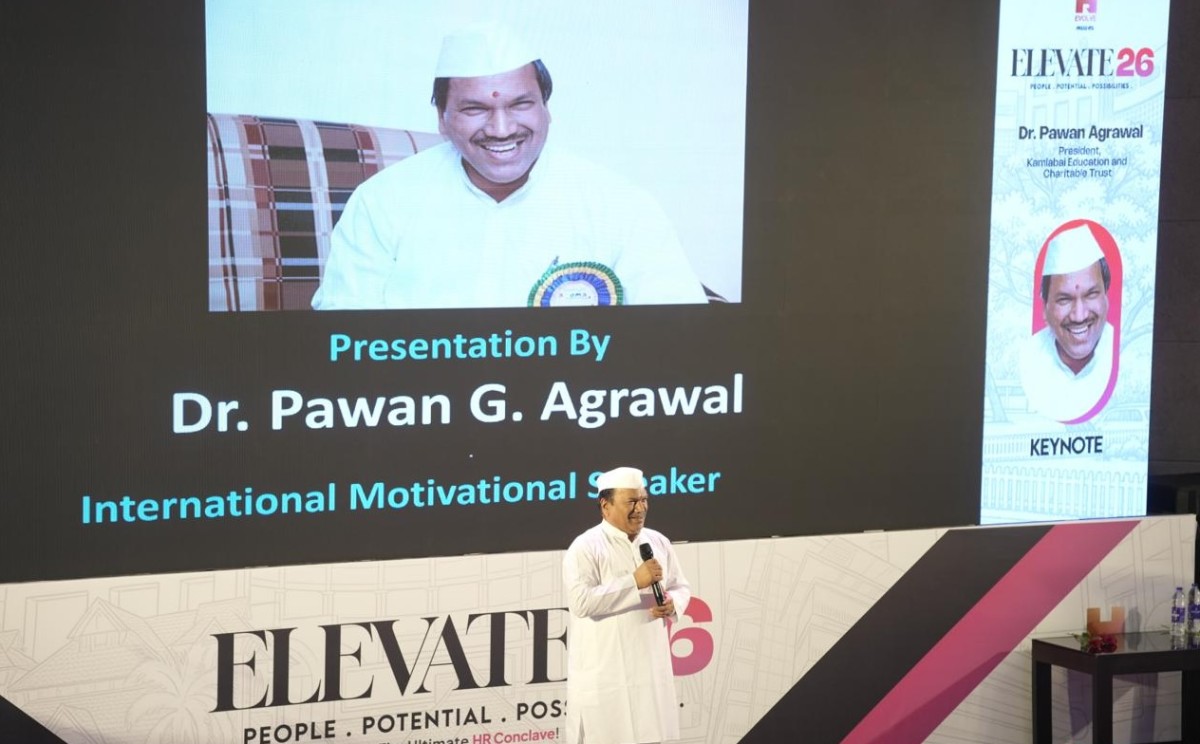
Pawan Kumar Agrawal says lessons from the dabbawalla network is still relevant today. Handout photo
 By Editorial Desk, on November 24, 2026
Technology keeps changing how we live and work, but one thing should not change: a society is only as strong as the way it helps and lifts its people. That was the core message Pawan Kumar Agrawal, an expert on the famed dabbawala tiffin carriers of Bombay, shared with a packed hall of HR professionals at the Trivandrum Techno Park recently.
Speaking at a convention hosted by HR Evolve, a network of HR professionals from technology companies across Kerala's IT parks, Agrawal said the tiffin carriers, whose network has been studied around the world, are now a shadow of what they once were. But their effort to extend a helping hand to the underprivileged, he said, remains strong.
At a time when algorithms and artificial intelligence are sidelining the human element, his words gave an audience of HR personnel, tech CEOs and students a different way of looking at work.
Agrawal, who has written books on the dabbawalas and speaks around the world about the success of their model, said they built a powerful system to deliver lunch from home to workplace. The need that brought the dabbawalas together was basic, but the result was anything but.
Shrinking Network: Long before the internet and GPS, they created a system so reliable that logistics experts across the world studied it as a model of operations, teamwork and supply chain discipline.
More than that, it brought together people who often did not meet the job market’s needs and made them an essential part of the economic ecosystem.
But times have moved on, and so has the city. Bombay became Mumbai in 1995, and the change went well beyond a name. Agrawal said the number of dabbawalas is shrinking rapidly. Schools started providing free lunch, offices set up in-house facilities, food delivery apps arrived, and the sheer expansion of the city rewrote lunch patterns.
With both spouses working in many families, fewer kitchens are preparing lunch at home. The volumes show the fall: ThePrint reported in 2025 that the network once carried over two lakh tiffins a day, a figure that has dropped to under a lakh.
Agrawal also pointed to a practical challenge: the system was deeply tied to Mumbai’s local trains, which made delivery affordable and predictable. As the city expanded beyond what the trains conveniently cover, the old model became harder to run.
Young people who still join the dabbawalas often rely on motorbikes and mopeds, which raises costs for everyone involved. Moreover carrying heavy loads are not a preferred choice for the new labour force.
Strong Foundation: What remains intact, he said, is the network's core strength: a human system supported by a simple alphanumeric code that ensures each tiffin reaches the right person and returns correctly. It is an indigenous solution built on discipline, trust and repetition, and in Agrawal's telling it shows that accuracy at scale does not always need complex technology.
One principle the dabbawalas held to was putting their customers first. When then-Prince Charles of the UK expressed a wish to meet them in 2003, the network set a condition: the meeting should not disrupt their work, as thousands of customers depended on them for lunch.
So he was invited to meet them at Churchgate, where the dabbawalas sorted the delivery of thousands of lunches arriving there. The meeting was fixed at 20 minutes, and Charles, now King Charles, went to them rather than the other way round. "For the dabbawalas, he was just a prince. But their customers were their maharajas," Agrawal said.
British tycoon Richard Branson also came to meet then while Harvard Business School studied their model and published it as a case study.
New Mission: Agrawal also spoke about supporting such a system in a new world rather than romanticising the past. One prototype is a cloud-kitchen-style model run by home cooks, often housewives who already cook for their families.
The idea is to help them cook a little more and distribute meals to people who want that kind of food. The initiative already serves around 5,000 people, he said, and the hope is that it will grow with more participation and stronger local networks.
Another idea was even simpler. Sometimes people get their lunch box delivered but don't eat it: there is an office party, an unexpected meeting, a last-minute change of plan. Instead of letting that food go to waste, the dabbawalas introduced a sticker that says “Share my lunch”.
If a customer places it on the box, the lunch is collected and delivered to those who need it. Agrawal said this effort is already helping feed thousands of hungry children in the city.
Corporate Message: The dabbawala story, he suggested, offers a different way to think about value. The system did not depend on elite degrees or specialised training. It depended on clarity of roles and respect for each role: the home cook, the person who picks up the box, the sorter, the train runner, the final-mile deliverer. Each part alone may not look extraordinary, but tied together with trust and discipline they become an engine that works.
This is where the message landed directly with the HR audience. Agrawal's challenge was not only about upskilling or hiring the “best” profiles. It was about building systems that make use of the human element and help people see how their capability fits into what the organisation needs.
Not everyone will have the same resume, but many people become valuable when the process is designed well and they feel they contribute to its growth. Teams, he said, don't succeed on talent alone; they succeed when people feel they belong, see how their work connects to the larger mission, and take ownership.
The audience he said this to is the one deciding who gets in. Algorithms already screen the resumes, route the tasks and set the pace of work, and AI is taking over the routine jobs that once gave freshers a first foothold.
Working Model: Each gain in efficiency redraws the map of who counts as useful, and those who fall outside it tend to be people without formal education or “in-demand” skills, who still want to contribute but cannot find where they fit.
The dabbawalas are no ready answer to this. Their network is shrinking, squeezed by delivery apps, a sprawling city and changing lunch habits. What they offer is a clue about design.
Their system, with its code marked on a lunch box and roles anyone could learn, became world-famous for its efficiency. It got there with people who seldom met the job market’s needs, by asking where each of them fit and building the work around them.
Third satellite to put Hex20 on new orbit
Trivandrum-based startup Hex20 is set to mark another milestone with the launch of its third satellite, Nila III, next year in association with Skyroot Aerospace. Germany’s Exolaunch and UK-based OhmSpace are also participating in the mission. The mission illustrates the growing role of India’s private sector in space, with a spacecraft built by Hex20 set to fly aboard a launch vehicle developed by Hyderabad-based Skyroot Aerospace for an international customer. Technopark-based Hex20 became India’s first private company to independently host an international client’s payload in space with the launch of its Nila I satellite.
The Himalayas are a sight to behold, even from space, as a photograph taken aboard the International Space Station shows. Canadian Space Agency astronaut Joshua Kutryk was looking out of the station’s window when the majestic mountain range, which stretches across India, China, Nepal, Bhutan and Pakistan, came into view, 402 km above Earth. The photograph shows the Himalayas blanketed in bright snow and ice, with fluffy clouds hovering above. Awesome!
GTA VI fever spreads far beyond gaming
News that Grand Theft Auto VI generated a record-breaking 3.79 billion US dollars is the headline grabber, but the ripples have spread far and wide. In India, reports say some firms gave employees leave to play the game while desi Youtubers live streaming the game attracted millions. Fans have waited 13 years for this game and the excitement has been extraordinary globally. Fans have collectively spent more than 132 million hours watching streams. Police in the US, however, are a little wary. They have warned Americans that street racing, auto theft and gun violence – the main ingredients of GTA VI – are still crimes in real life.
When phones turn into professional cameras
Using smartphones to capture important moments is nothing new. But at the Apec Summit in Shenzhen on November 18-19, Chinese journalists were spotted using an unusual accessory that turned their phones into powerful cameras. The Huawei Z10 ‘Giant Cannon’ is an external camera module that attaches to a smartphone. It features a 1-inch sensor and 10x continuous optical zoom, covering a focal-length range of 24mm to 240mm. The setup also offers the convenience of shooting vertically, quickly adjusting the frame and sending photos or videos directly from the phone, without having to transfer files from a separate camera. The Ruiying Z10 module alone weighs about 346g, taking the combined weight of the phone and camera beyond 580g.
Punters fail to predict Nvidia twist
Those betting on Nvidia shares may be having a rough ride, but punters wagering on CEO Jensen Huang’s future seem to have made a packet. A Polymarket user named paule334 made their first-ever trade on November 10, betting that Huang would resign. The user continued trading until the morning of November 11, when The New York Times broke the story of Huang’s second affair. The payoff was about 38,000 US dollars. Punters on platforms such as Polymarket and Kalshi also placed bets on whether Huang would be arrested and when he might testify before the Senate. But only a few predicted Huang returning as CEO. It seems even crowd-sourced intelligence was caught off guard by Nvidia’s new twist.
