
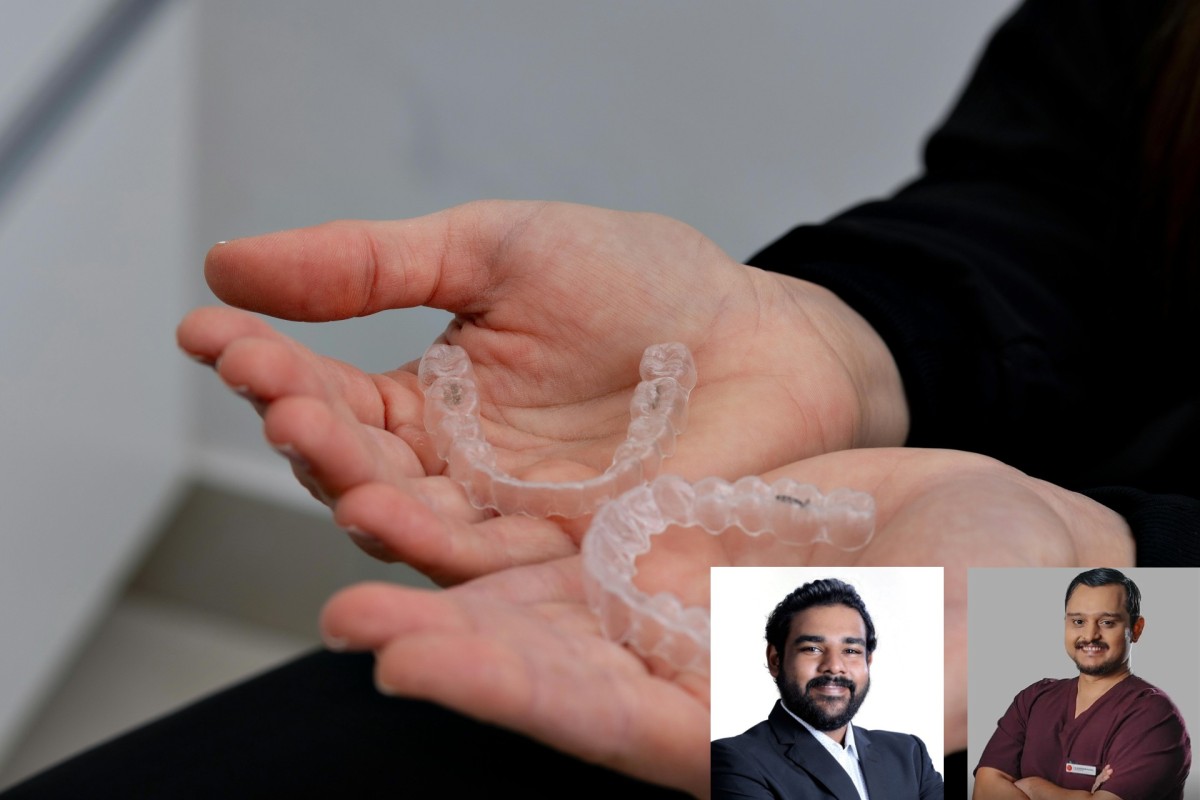
Designing and 3D printing are a passion for dental entrepreneurs Ronnie Boniface (inset, left) and Nandakishore Rajagopal. Image courtesy: Laura Villela Beauty Designer/Pexels, Grinfinity Aligners.
 By Hari Kumar, on April 28, 2026
By Hari Kumar, on April 28, 2026
By Hari Kumar, on April 28, 2026
Startups are considered the domain of engineers and technologists. The founder archetype comes loaded with assumptions – a computer science degree, a garage in Silicon Valley, a pitch deck heavy on disruption.
Ronnie Boniface Dominic and Nandakishore Rajagopal fit none of that template. Both are dentists based in Trivandrum. Yet the instincts that brought them together – a restlessness with convention, a hunger for the engineering dimensions of their craft – are very much the stuff of startup culture.
They are also part of a quietly growing pattern: young entrepreneurs in Kerala, far from the established tech corridors of Bangalore or Hyderabad, who are harnessing cutting-edge tools like 3D modelling and precision printing to carve out entirely new businesses in sectors that traditional tech investment has largely ignored.
Their story, unfolding out of Kerala's capital, is also part of a much larger global shift: the transformation of orthodontics from a discipline of metal and pliers into one of software, 3D printing and precision plastics.
Unusual Start: Ronnie's journey into dentistry was not entirely by choice. “From school days onwards my interest was in computers,” he says. “But after my schooling, I joined for BDS due to pressure from people around me. Becoming a doctor was more attractive to them and I had to comply.”
He graduated from Al-Azhar Dental College in Thodupuzha in 2024, but even as a student he was pulling at the edges of the curriculum – picking up digital marketing through Google, generative AI through IBM, and a data protection course from the University of Pennsylvania. After a brief stint as a business development manager and an even briefer spell in clinical practice, he made his move.
In June 2024, Ronnie incorporated Odontofusion Dental Supplies and Services Private Limited – a company built around the idea that India's dental clinics were ready for a technology upgrade and that someone who understood both worlds could serve them better than a pure-play equipment distributor. He sourced out modern dental equipment from different countries and helped customers who wanted to upgrade their practice.
Sweet Spot: He launched a consultancy platform aimed at helping dental clinics run as proper businesses – covering everything from digital marketing and staff recruitment to website creation, booking system integration, and equipment procurement. The idea was simple: most dentists are trained to treat patients, not to run enterprises, and that gap was costing them.
Odontofusion’s early days were not easy. Company registration hit bureaucratic snags. An attempt to launch an e-commerce platform ran into the deep pockets of established competitors. But the core proposition held: source high-quality dental equipment from global markets and deliver it at competitive prices.
It was around this time that a former colleague from his marketing job days re-entered the picture: Nandakishore Rajagopal, a man whose academic credentials were rather more orthodox – an MDS from AJ Institute of Dental Sciences in Mangalore and a specialisation in orthodontics – but whose instincts rhymed closely with Ronnie’s own.
Rare Combo: “I wouldn't be a dentist but for my interest in orthodontics,” Nandakishore says. “Challenges that branch offers perk me up as I like to find solutions for complex problems. It is a combination of technology and medical science that needs a lot of thought put into it.”
Nandakishore had been working across clinics in Trivandrum and won a Special Jury Award for Orthodontist of the Year at the Famdent Awards – sometimes called the dental Oscars of India. He brought with him not just clinical depth but a broader managerial perspective, holding an MBA in Hospitality Management from Madurai Kamaraj University. When he and Ronnie began speaking about aligners, the conversation quickly outgrew small talk.
Orthodontics, it is worth understanding, is not simply about aesthetics. It is a specialised branch of dentistry concerned with diagnosing and correcting misaligned teeth and jaws – which if left unaddressed, can lead to serious health issues.
“Orthodontics is beyond making smiles beautiful,” Nandakishore says. “Cases of teeth misalignment can lead to chewing difficulty, diction troubles which can be a handicap in life and sleep apnea. The structure of the jaw and teeth can lead to serious health issues if left unattended.”
A smile, he adds, is not merely an emotional reflex. "It is a very important ingredient in everyone's personality and mental wellbeing. A person who feels handicapped when smiling will find it difficult to face the world with confidence."
Crystal Clear: The instrument at the centre of their new venture is the clear aligner – a removable, transparent tray made of smooth plastic that fits snugly over the teeth and gradually shifts them through gentle, controlled pressure. It is nearly invisible when worn, can be removed for meals and brushing, and causes less of the soft-tissue irritation associated with metal brackets and wires.
These qualities have made aligners enormously popular since the technology was pioneered in the late 1990s by a pair of Stanford Business School graduates, Zia Chishti and Kelsey Wirth – neither of them dentists.
Their company, Align Technology, founded in 1997 in California, applied computer-aided design and stereolithography to a problem that orthodontists had always solved by hand. Early venture capitalists laughed them out of the room. But by 2025, the global Invisalign market was valued at 6.8 billion US dollars, and Align Technology reported annual revenues of 4 billion with over 22 million patients treated.
The lesson of that origin story – that the biggest changes in a profession often come from people who weren't trained to accept its limitations – is not lost on Ronnie and Nandakishore.
Reasons to Smile: Their venture, Grinfinity Aligners, is built on a B2B model: they serve dentists, not patients directly. A practitioner sends over either a scan or a physical mould of the patient's teeth; Grinfinity digitises it into a 3D model, analyses the case in detail, and manufactures a custom sequence of transparent aligners.
The trays are made from medical-grade PET-G – a material rigid enough to apply consistent pressure on teeth while remaining flexible enough to be worn comfortably. The aligners come in different thicknesses, selected according to the complexity of the case and the specific treatment stage, with cases ranging from a few months to over two years.
Nandakishore's role at Grinfinity is founder and CEO, with his wife Parvathy S as co-founder. Ronnie serves as product manager, shaping the product from design concept through to clinical use.
Grinfinity's competitive advantage is geography. Invisalign and similar imported systems carry substantial import costs that are baked into the price. Grinfinity, manufactured locally, removes that layer entirely, making the technology accessible to a wider range of dental practitioners, and by extension their patients.
Wide Network: Some clinics also receive white-labelled kits that they sell under their own brand names, adding another layer of business flexibility to the model. This has attracted clients from far and distant regions who hear about their work through the network as professional medical practitioners they are barred from advertising their service.
Lack of clear guidelines about aligner sector often throws up googlies for these entrepreneurs.
“Right now there is way too much red tape to set up even nominal lab facilities while there is very little guidance about creating computerised models for alignments. So you find many people without any knowledge of dentistry offering to do the job for you,” they say.
New Opportunities: The regulatory vacuum, in other words, is both a risk to quality and an opportunity for players who get ahead of eventual formalisation.
For two dentists who grew up wishing they had studied engineering, the convergence is working out rather well. The profession they entered somewhat reluctantly has turned out to be a rich canvas for the instincts they never fully suppressed and proof that the next wave of technology entrepreneurship in India need not wait for an engineering degree or a Bangalore address.
IAF invites drone experts
Indian Air Force is focusing on swarm drone detection under its Meher Baba competition this time. The third edition of the event, which invites startups, MSMEs and researchers, aims to develop a proof of concept for a collaborative swarm of Unmanned Aerial Systems working as an airborne radar capable of detecting, tracking and reporting aerial targets. Successful participants will receive development funding from the Indian Air Force, and the top three winners will be honoured with awards. More details available at this link.
This assumes added importance given the increased drone use on the war front. Recently, China unveiled the Atlas 2 platform, which is compact and capable of launching nearly 100 drones, with a single human touchpoint to control them all. Chinese state media says the system carried out coordinated reconnaissance, identified the command vehicle among three targets on its own, launched its drones, and then struck the selected target with precision.
Mythos leak adds to worries
Just days after Anthropic made a limited release of Mythos Claude, reports say an unauthorised group accessed the platform. Following claims that the system could find vulnerabilities in many operating programs, authorities in several countries called for urgent meetings, fearing adversaries could wreak havoc if they gained access. But the breach did not come from countries like North Korea, China or Russia, but from a random Discord group. It shows how even the best precautions may not be enough when it comes to cybersecurity.
Sony spins a new robot
China has been at the forefront of robotics development, but news from Switzerland shows Japan is also keeping pace. A unit of Sony there has unveiled a table tennis–playing robot that has proved its competence against human rivals. As Nature reports, the robot has some advantages – it has no legs, so it needn’t worry about balance, and has nine video cameras around the table, while humans have only one head and two eyes. Powered by artificial intelligence, the robotic arm can calculate the position of the ball in space as it flies over the table, measure its spin, and react in a tenth of the time a human player would need.
Predictions that blow you away
Prediction markets are heating up – and not in a good way. A US Army sergeant was arrested for betting on regime change in Venezuela, and now Paris is in hot pursuit of suspected data manipulation. French authorities are probing suspicious bets on daily temperatures after some bettors won tens of thousands of dollars, backing the mercury to hit 22°C, in a season when average hovers around 18C. A viral video on social media then suggested a sensor may have been nudged the data with a hairdryer. Turns out, in this market, some forecasts aren’t made – they’re blow-dried.
