
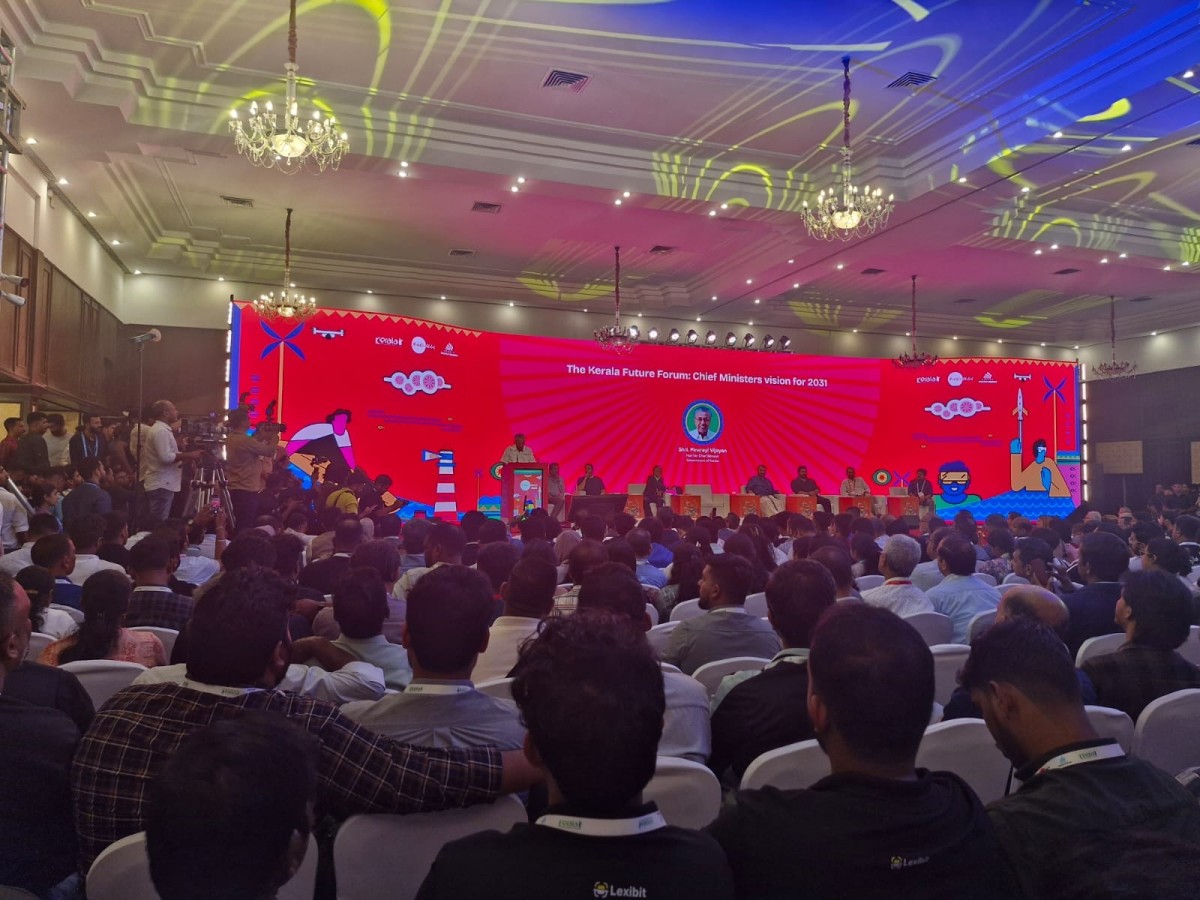
A packed hall at Huddle Global 2025 mirrors the growing sense that Kerala’s startup ecosystem needs more space. Photo: TikTalk News
 By Hari Kumar, on December 16, 2025
By Hari Kumar, on December 16, 2025
By Hari Kumar, on December 16, 2025
The Global Huddle 2025, billed as India’s biggest beachside startup summit, concluded at Kovalam with a moment of political and policy significance. Chief Minister Pinarayi Vijayan used the platform to unveil Kerala’s Vision 2031 – a roadmap that seeks to position the state as a knowledge-driven economy, encouraging the creation of more startups and industries in areas such as spacetech and agriculture.
“Kerala is now a large metro city, fully connected through optical fibre and providing high quality talent, which together provides the most ideal destination for investment and innovation,” he said.
It was a sober, grounded vision statement, one that played to Kerala’s known strengths rather than chasing fashionable superlatives. The emphasis on research-led innovation and globally scalable products reflected a realistic understanding of where the state can compete. Yet, as with most such declarations, the harder question remains – how this intent translates into execution.
That Achilles heel of the state – gap between intent and implementation was visible throughout the three-day event – often in subtle, unspoken ways.
Getting Squeezed: Global Huddle, the flagship showcase organised by the Kerala Startup Mission (KSUM), once again brought together startups, investors and policymakers, generating palpable energy. Young founders pitched ideas, investors scanned for promise, and discussions ranged widely – from artificial intelligence and deep tech to aerospace, health and agriculture.
But the event itself, in many ways, mirrored the broader reality of Kerala’s technology ecosystem.
The enthusiasm was unmistakable. The intent was genuine. Yet the constraints were equally evident. The Leela Hotel venue at Kovalam, scenic as it is, imposed clear physical limits. Cramped exhibition stalls, narrow movement corridors and a heavily congested dining area became recurring points of frustration.
The insistence on a single entry and exit point to the lunch venue created bottlenecks, while the sheer number of delegates by dinner time – the hotel crew says they fed over 3,000 meals on the first day – stretched the venue beyond comfort.
Similar Problems: KSUM had shifted the Huddle Global in 2023 to the nearby Adimalathura beach and the space it provided added electric vibe to the event. But lack of connectivity, parking areas and hotels nearby became heavy burdens. Added to that was the huge cost of erecting a pop-up venue that can accommodate thousands during sultry days, especially when working under a constrained budget.
These may sound like logistical footnotes, but they felt symbolic. Kerala, too, operates within tight boundaries – limited land availability, environmental sensitivities and infrastructure bottlenecks that make large-scale, resource-intensive industrial models difficult. Just as the event had to work around spatial constraints, the state must carefully choose what kinds of industries and innovation it wants to nurture.
External disruptions added another layer of complexity to this year’s event. Flight cancellations by IndiGo Airlines forced several speakers and investors to pull out at the last minute, denting opportunities for startups hoping for face time with investors and mentors. This was beyond the organisers’ control, but it underlined how fragile such high-density, time-bound gatherings can be.
Advantage Trivandrum: Amid this swirl of activity, one theme surfaced repeatedly across panels and conversations – the strategic significance of the Vizhinjam International Seaport. As Sreekumar K Nair, CEO of Vizhinjam International Seaport, pointed out, cargo routed through Vizhinjam can cut sailing times to major global markets by weeks. Ships from 106 ports across the world are already calling to transfer cargo here.
Yet, the port’s biggest promise lies not in what exists, but in what is missing. Onshore and marine support ecosystems are still largely absent. Roads, rail links, logistics hubs and service infrastructure have to be built almost from scratch. This gap, paradoxically, represents a goldmine of opportunity – for startups and industries working on green energy, container management systems, ship repair and servicing, and wastewater treatment.
Seen through this lens, Global Huddle sits in a uniquely advantageous location. Held a short distance from a port of international strategic importance, in a region with abundant hospitality infrastructure, the event could evolve into more than a state-level startup showcase. It could position itself as a gateway forum for southern India – and by extension, India – at a time when investors are actively looking beyond established tech centres.
Wider Vision: That wider, inter-state potential was echoed by delegates from outside Kerala. Vasanth Kumar, CEO of Brand Minds, who travelled from Tirunelveli district in Tamil Nadu, described how his personal engagement with Huddle Global has grown over the years – from attending alone three years ago, to bringing seven friends next year, and now arriving with a group of 21 from neighbouring districts.
His suggestion was simple but telling: dedicate space and visibility to startups from other states, and expand KSUM roadshow outreach beyond major metros into nearby second-tier cities such as Tirunelveli, Kanyakumari and Thoothukudi, where startup activity is quietly gaining momentum.
This points to a larger opportunity. Southern Indian states already function as India’s growth engine in technology and manufacturing. Telangana, Andhra Pradesh, Karnataka and Tamil Nadu are attracting large global investments, while Kerala brings strengths in human capital, research institutions and now, strategic infrastructure like Vizhinjam. A more collaborative, region-wide approach could allow the south to compete not just with other Indian clusters, but with global hubs in East Asia and the Middle East.
Streamlined Outlook: For Global Huddle to play that role, some structural rethinking may be required. At present, the event often feels like a kaleidoscope – each day offering a dense mix of subjects. While this diversity has its charm, it can dilute focus. Streamlining the programme into clearly defined theme days – artificial intelligence, deep tech, aerospace, health or agriculture – aligned with Kerala’s Vision 2031 priorities, could make the event more navigable and more valuable for investors seeking targeted engagement.
Another area that demands attention is visibility beyond the venue. While LinkedIn saw steady activity, the event’s presence on platforms such as Twitter, Threads and Instagram was relatively muted. KSUM’s handles were active, but for an event with thousands of techies in attendance, there was little to show. For a technology summit with global aspirations, this is an underutilised lever.
Consistent, real-time storytelling from the ground can dramatically extend reach, attract international attention and reinforce the idea of Global Huddle as both a serious tech forum and a distinctive beachside gathering. Finding ways to encourage participants to showcase the event on their own social media handles would help amplify its reach.
Global Huddle 2025 demonstrated that Kerala has no shortage of ideas, intent or talent. What it now faces – much like the Vision 2031 roadmap unveiled at the event – is the challenge of execution. With sharper focus, wider collaboration and a willingness to scale its ambitions beyond state boundaries, Global Huddle can evolve into an event that not only reflects Kerala’s aspirations, but actively helps realise them.
KSUM also needs a new vision
One interesting discussion during Huddle Global 2025 was about the way forward for the Kerala Startup Mission (KSUM), which was established in 2006 to promote entrepreneurship and support startups. The mandate of getting more startups registered continues to be the main focus, but there was an overwhelming feeling that the entity has to expand its horizons. One stellar suggestion came from M Sivasankar, former Principal Secretary to Kerala CM. He called on KSUM to focus on identifying 100 startups that can attain 100 crore rupees in the next two years and identify 10 startups that can get into IPOs.
But the reality of what KSUM is facing was put bluntly by Jayasankar Prasad, Director of the Centre for Management Development and a former KSUM CEO. Even after two decades, KSUM remains an extension of a government department, and employees who have been working for over a decade are on an ad-hoc basis. He said a way out is to make KSUM an autonomous body, freed from its shackles. We can add one more to that list: can we also have a full-fledged, independent ministry for IT with a technocrat in charge as part of Vision 2031?
Local wealth remains aloof
The number of venture capitalists and investors at this edition of Huddle Global showed a drop, which can partly be blamed on the ongoing air travel chaos. Many startup founders aired their disappointment about this, though the expectations of some of them sounded a bit unrealistic. An event like this can only provide a chance to make a connection, and expecting deals to materialise overnight would take a miracle. What remains conspicuously absent, however, is our own high net worth individuals, especially non-residents, who mostly park their money in banks or go for real estate. That leads to the question: why are banks here not finding a way to support the Kerala startup ecosystem with the same enthusiasm they show when wooing NRI money?
Gaming, EV startups gain
Among the announcements made during Huddle Global 2025, what caught our eye was KSUM’s LeapX AVGC-XR Accelerator Programme. The plan is to offer a specialised three-month programme aimed at supporting high-potential startups working in the Animation, Visual Effects, Gaming, Comics and Extended Reality (AVGC-XR) domains. Selected startups will receive mentorship, industry and studio access, and funding support. Another was the plan for a six-month incubation cohort aimed at supporting early-stage innovators and startups working in the EV ecosystem. Research Innovation Network – Kerala (RINK) and Trest Research Park will partner in this.
Space for throne makers
One of the best speeches at Huddle Global 2025 came from Prasanth Balakrishnan Nair, Indian astronaut and test pilot, albeit generously peppered with nationalistic fervour – very much the flavour of the season. Beneath that was an eye-opening take on the skills every astronaut must master and the opportunities space missions open up for startups. What really stayed with us was his revelation that even today, all space missions still rely on Russian technology to run toilets. Yes, toilets. It is a timely reminder that spacetech is not just about rockets and satellites. There is, quite literally, a shitload of money to be made elsewhere too.
