
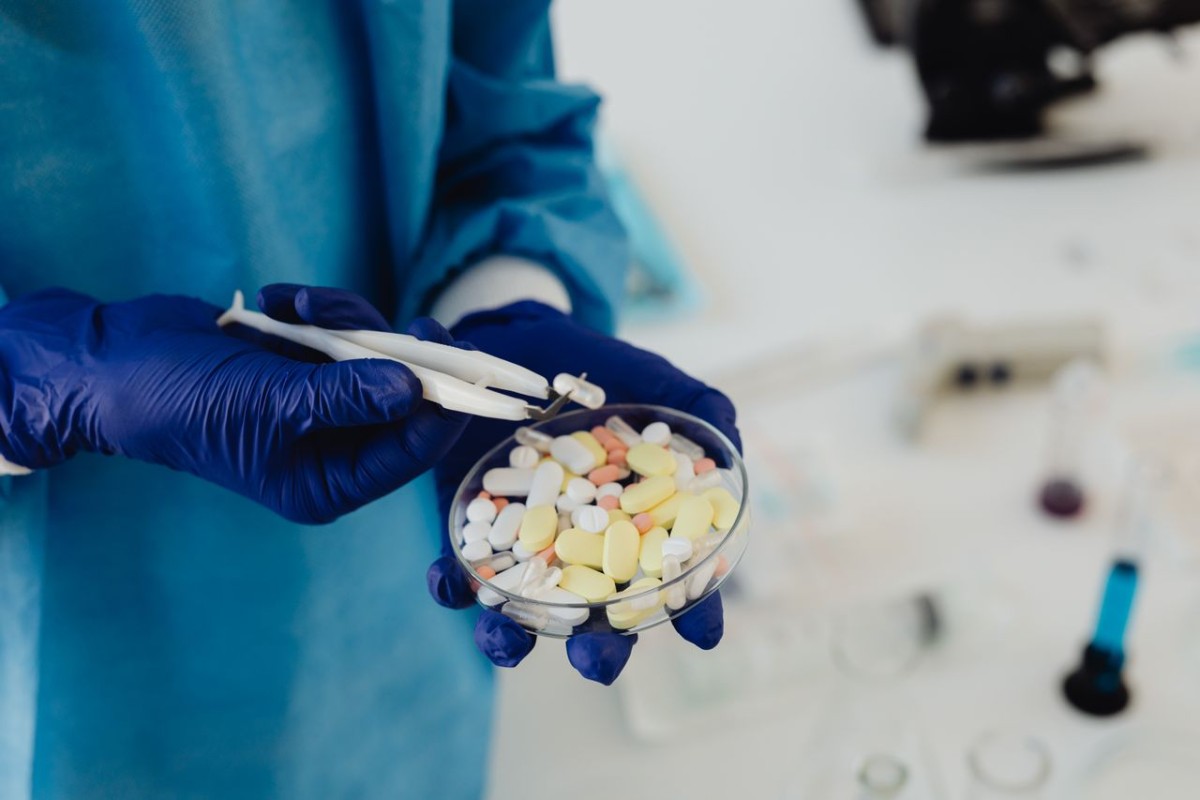
China’s rise as a pharma power adds another challenge India needs to address. Image: Kaboompics/Pexels
 By Hari Kumar, on October 06, 2026
By Hari Kumar, on October 06, 2026
By Hari Kumar, on October 06, 2026
India is widely celebrated as the pharmacy of the world, supplying roughly a fifth of global generic medicines by volume. It produces about 20 percent of the world’s generic drugs by volume and is a leading vaccine supplier, providing affordable medicine worldwide.
On the surface, it looks like a monumental achievement. Beneath it lies an uncomfortable reality: India’s pharmaceutical export engine relies heavily on the very country it is trying to decouple from in electronics, EVs, and critical minerals – China.
While global headlines remain fixated on the AI race, recent moves show Beijing quietly positioning itself as a biopharma powerhouse, with Western giants scrambling to strike licensing deals to tap into Chinese innovation.
Changing China: The shift in global biotech has been far-reaching. Danish pharma giant Novo Nordisk has licensed a weight-loss treatment from China’s Hengrui Pharma, following an earlier deal with another Chinese company for a different obesity drug. Hengrui had already signed a bigger agreement with British multinational GSK covering new drugs across several areas, including cancer.
AstraZeneca’s chief financial officer told Semafor it is now “only a question of time” before Chinese pharma companies challenge the global giants, a striking turn for a country that once sent barefoot doctors into villages with herbal remedies and antibiotics, as Sinica Podcast’s Kaiser Kuo recently noted.
According to The New York Times, the clearest signal came at this year’s meeting of the American Society of Clinical Oncology in Chicago, the field’s most watched gathering. For what appears to be the first time, one of its five headline presentations was a clinical trial conducted entirely in China.
Regulatory acceptance of such data is a separate question, but the milestone shows how quickly Chinese research has moved from the margins to the main stage.
Major leap: Beijing has made its intent explicit. The new five-year plan for the pharmaceutical industry, covering 2026 to 2030, calls for a “major leap” in the sector’s competitiveness and global influence.
Its targets include Chinese-developed first-in-class drugs making up a quarter of the global total, innovative drug revenues growing at least 20 percent a year, 50 companies with annual revenues above roughly 1.5 billion US dollars, and at least five Chinese drugs crossing 1 billion US dollars in global sales.
The money is already moving. According to the Chinese government, overseas licensing deals for Chinese drugs have crossed 120 billion US dollars so far this year. For Western firms, they are a way to access promising molecules. For Chinese manufacturers, they are a classroom, offering a direct view into how world-class drugs are developed and commercialised.
Electric vehicles followed the same script. European carmakers welcomed Chinese partners and now face intense pressure as Chinese EVs take market share. In Washington, one senior health official has called the contest a “war” over biotechnology, while hawks warn that the US is offshoring manufacturing and R&D while exposing its drug supply to Chinese leverage.
India’s exposure: India’s position is delicate. Niti Aayog, the government’s top think tank, in its recent report points out how reliant Indian companies are on Chinese imports. It said India imported active pharmaceutical ingredients (API) worth 7.4 billion US dollars in 2025. It also said Chinese imports remained 30 to 40 percent cheaper than locally manufactured APIs.
In medical devices, the dependence is already deep. A November 2024 parliamentary reply put India’s import dependence on medical devices at about 70 percent, a level that has barely moved for years. Imports totalled roughly 25.5 billion US dollars between FY21 and FY25, dominated by electromedical equipment at about 24.6 billion US dollars.
Even disposables, often assumed to be easy to indigenise, are not import-free. In FY23, India imported about 1.09 billion US dollars worth, of which 254.4 million came from China.
The trade data also suggests the Chinese share may be understated. Between April 2024 and January 2025, Hong Kong, Malaysia and Singapore accounted for 28 percent, 24 percent and 13 percent respectively of relevant imports, a routing pattern that makes the country of origin opaque.
Eleven device categories, including syringes, oxygen therapy devices, orthopaedic tools and dental cement, saw import surges above 15 percent during that period. Dialyser imports from Malaysia and China doubled to 256 crore rupees in two years, according to Medical Buyer.
Kerala’s role: For India, the lesson from electronics and EVs is that dependence is easier to build than to undo. In drugs and devices, the clock is already running. If any Indian state has a stake in the device half of this problem, it is Kerala.
The state accounts for 15 percent of India’s medical device industry and is home to around 85 medical device companies generating more than 9,000 crore rupees in annual revenue, according to the Kerala Medical Device Industry Association.
As the state gets ready to host Bio Connect 4.0, an international life sciences conclave and expo in Trivandrum on October 8 and 9, the government says it will formulate initiatives such as dedicated parks for the sector.
But the flurry of announcements from the current government brings to mind Virat Kohli’s century in the recent One-day match played in Trivandrum – a blistering pace and studded with big blows. Project announcements come even before the ink is dry on the last one.
Whether such ambitions in the medical sector become real domestic capacity, rather than another round of announcements, will matter well beyond the state.
India’s YouTube economy growing fast
Folks, we have been watching loads of videos, says YouTube. Its Indian Impact Report says Indian channels uploaded 160 million hours of content in 2025, and the sector is now providing the equivalent of 960,000 full-time jobs. The company says its content creator system contributed more than 18,000 crore rupees to India’s GDP, while the number of Indian YouTube channels making six-figure revenues rose by more than 30 per cent year-on-year. Viewers outside India account for 15 per cent of the audience.
With AI making it easy to create spoof videos, it also opens the door to more devious forms of content. One such form is what they call “ghost creators” in the US. Basically, people are hired to read scripts that dish out sensational revelations about a known personality or a group, such as a political party. The videos are presented as laypeople giving straight-to-camera views to make them look more believable. Turbocharged by AI, these “ghost creator” accounts appear to be mostly run by people looking to make a quick buck rather than push an ideology.
Walmart’s Kerala centre eyes deeptech
Walmart is launching its first deep-tech incubation programme in Kerala. Walmart Global Tech is launching Deep Leap in association with IIMK Live, the business incubator of IIM Kozhikode. Supported by total funding of 2.89 crore rupees from Walmart’s CSR funds, the programme will set aside 1.5 crore rupees for equity investment or seed funding for selected startups. It will focus on early-stage startups that already have a prototype or minimum viable product. Startups working in deep-tech areas such as quantum computing, aerospace and defence, AI, semiconductors and photonics are the current targets.
Chinese startup ready to zap moskies
Remember the Chinese startup we found that was using radar technology and edge computing to swat mosquitoes? Well, Jiangsu-based Photon Matrix Lab says it is set to deliver their devices, which will cost 998 and 1,088 US dollars. The South China Morning Post says the company offers two models: an infrared version with an invisible laser, designed for indoor settings, and a blue-laser version with a visible beam for outdoor use. The company says it has received more than 5,000 orders since it floated the product idea on a crowdfunding platform, mainly from Europe and North America, followed by the Middle East.
When the bot goes for the bottle
Getting a rival company’s employees drunk and hoping they spill some secrets is an age-old business tactic. Researchers at Australia’s UNSW School of Computer Science and Engineering have now tried something similar on AI. They found that feeding LLMs “drunken” text can make them behave like a hammered employee, answering questions they were designed to refuse. The researchers used text mimicking linguistic patterns associated with alcohol to get the models to spill the virtual beans. Now, that is the last thing we want to hear: the “I admit I was drunk” plea from an AI bot.
