
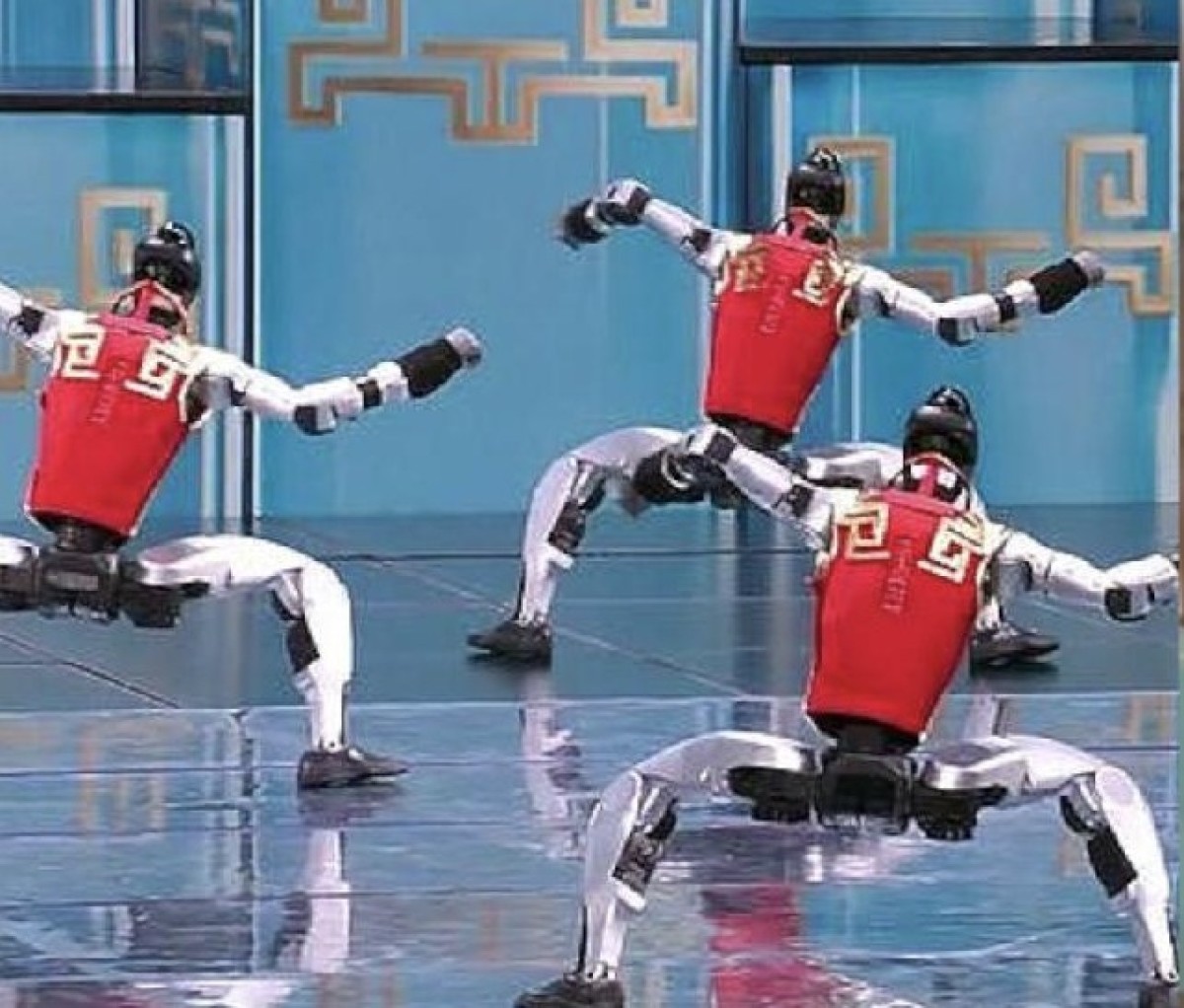
Indian manufacturers need a better stage to compete in the global market. Image courtesy: CGTN
 By Hari Kumar, on February 24, 2026
By Hari Kumar, on February 24, 2026
By Hari Kumar, on February 24, 2026
Many dog owners know the awkward moment. Guests arrive. You proudly command your pet to perform – and it end up doing something entirely different. You smile, pretend it was nothing, and hope the moment passes quickly.
India had its own version of that recently.
At the India AI Impact Summit in New Delhi, a private university displayed a robotic dog suggested to be indigenously developed. Internet users quickly identified it as the Go2 model made by Chinese firm Unitree Robotics. The controversy escalated. The university was asked to withdraw it. What was meant to signal technological confidence turned into a credibility problem.
The timing made it worse. Just days earlier, during China’s Lunar New Year celebrations, the Spring Festival Gala telecast on Chinese Television had once again turned the massively popular show into a global stage for robotics. Often described as the most watched television programme in the world, this year’s broadcast reportedly crossed 23 billion views across platforms.
Controlled Performance: Humanoid robots performed martial arts routines, executed backflips and interacted fluidly with human performers. Companies such as Unitree Robotics, MagicLab and Galbot used the stage to demonstrate the country’s robotics capability.
Interest in other products like child-sized robot that appeared in a family themed skit also sparked consumer interest, reports South China Morning Post. Zilan Qian, a fellow at the Oxford China Policy Lab, told the paper such carefully planned performances could help foster a more “techno-optimistic” public, accelerating AI adoption and innovation in China.
Yes, as some analysts point out, such performances occur in controlled environments. Dance routines are not the same as factory-floor reliability. But the signalling matters. It creates a global “wow” moment while simultaneously normalising robots for domestic audiences.
More importantly, beneath the spectacle lies scale.
Flip Side: China’s manufacturing ecosystem has invested heavily in automation for over a decade. “Dark factories” in the automobile sector operate with minimal human presence. National strategies such as Made in China 2025 have made robotics and AI core priorities. The result is not just impressive demonstrations, but mass production capability.
India too has a Make in India policy, but its challenge is different.
The availability of low-wage labour has quietly acted as a barrier to costly automation across sectors – from construction to food processing. When labour is inexpensive, machines appear unnecessary. The upfront investment in automation looks irrational compared to the daily wages paid to workers.
But the flip side is structural. Many Indian sectors have not developed the capacity to scale production to global levels with uniform precision and explore innovative methods.
Cost Factor: Take something as simple as tea. Across India, tea stalls still use manually operated water boilers, with the tea maker adjusting heat, sugar and milk by instinct. It works locally – it even adds charm.
But if that same vendor wanted to produce thousands of cups with identical taste, sweetness and temperature, mechanical standardisation would become essential. Automated heating systems, calibrated dispensing of ingredients and controlled timing would reduce wastage and ensure repeatability.
The same logic applies to plastering walls, painting surfaces, assembling fans or manufacturing components. Repetitive actions benefit from mechanisation not because humans are incapable, but because market expansion demands identical outputs at scale.
Indian consumers and businesses often avoided this transition because the initial investment felt high relative to labour costs. Over time, this mindset extended beyond small trades to component manufacturing and even chip production. It became cheaper to import precision components – and even finished products – from China or Taiwan than to build comparable domestic capacity.
The Choice Ahead: Now that India is positioning itself as an alternative to China as the world’s factory, that ambition requires a choice.
India’s manufacturing journey has begun. Installations are rising. Startups are emerging. Automation centres are expanding. But the deeper transformation is cultural and structural – moving from labour substitution to precision-led manufacturing.
The robotic dog controversy was not the real story.
Bark and Bite: The real question is whether India wants to build an ecosystem capable of producing at scale with the same confidence others now display on the world’s biggest stages.
Artisanal flexibility has its strengths. But scaling up demands standardisation and repeatability. A product made by hand in a small workshop may serve a local market well. As Indian manufacturing expands, demand will grow not only from global markets but also from India’s own fast-growing mass consumer base.
This is a transition moment. Without deliberate support and nurturing of automation in key sectors, imports will continue to fill the precision gap – both in what India sells to the world and in what it consumes at home. Otherwise, India’s technology claims risk remaining a shaggy dog story.
Sarvam joins race in India
At the AI Impact Summit, one of the major headlines was Sarvam releasing apps tailored for the Indian market. It is a competitive space, as tech giants like OpenAI, Anthropic, and Google are already in the field, along with several other local players. The Bangalore-based startup says its apps support a wide range of Indian languages and are part of India’s sovereign AI initiatives. But as Inc42 notes, its global rivals invest tens of billions annually and ship new plugins regularly and Indian startups, with smaller budgets and thinner distribution, have an uphill task ahead.
The numbers show how global players like OpenAI, Google, and Perplexity are already well entrenched in the Indian market. Gemini’s daily users in India crossed the 15 million mark following the Reliance Jio offer in November, compared with 3 million in the US. OpenAI says 100 million weekly active ChatGPT users are in India, making it its second-largest market after the United States. Meanwhile, Perplexity’s 5 million daily active users in India now account for more than a third of its global base.
Digital twin for air taxi
The Chennai-based ePlane Company which is building India’s first electric air taxi, the e200x, says it is using Nvidia Omniverse libraries to create a high-fidelity digital twin for aerospace simulation. By leveraging the Nvidia IGX platform for onboard computing, the system enhances critical performance and pilot situational awareness. The digital twin enables accurate simulation of aerodynamic interactions and complex urban flight scenarios, reducing the need for costly physical tests. “We are effectively pushing the limits of the aircraft thousands of times in simulation so that we never have to in reality,” says Professor Satyanarayana Chakravarthy, Founder and CTO.
Supply chain smells money
As chipmakers continue to flourish, players in the supply chain are facing pressure to scale up too. Take the case of Toto, the renowned Japanese toilet maker. Investor Palliser Capital now wants the board to do more with its advanced ceramics segment, which produces components that remain stable at very low temperatures and help hold silicon wafers firmly during chip production. Another company facing similar pressure is Ajinomoto, better known for soup stocks. It uses resin derived from its expertise in umami flavourings to make insulation material between chips and motherboards. Shareholders, it seems, are developing a taste for the big bucks.
YouTube joins old guard
Internet history has officially become a heritage piece. The Victoria and Albert Museum, the 170-year-old guardian of Renaissance tapestries and ornate Japanese furniture, has acquired the first-ever YouTube video – “Me at the Zoo”. The 19-second clip of a guy chatting about elephants will now sit within a digital collection (including GIFs from WeChat), displayed after careful reconstruction as back in the prehistory of 2005, the web still ran on Adobe Flash. Everything, it seems, is happening in a flash now.
