
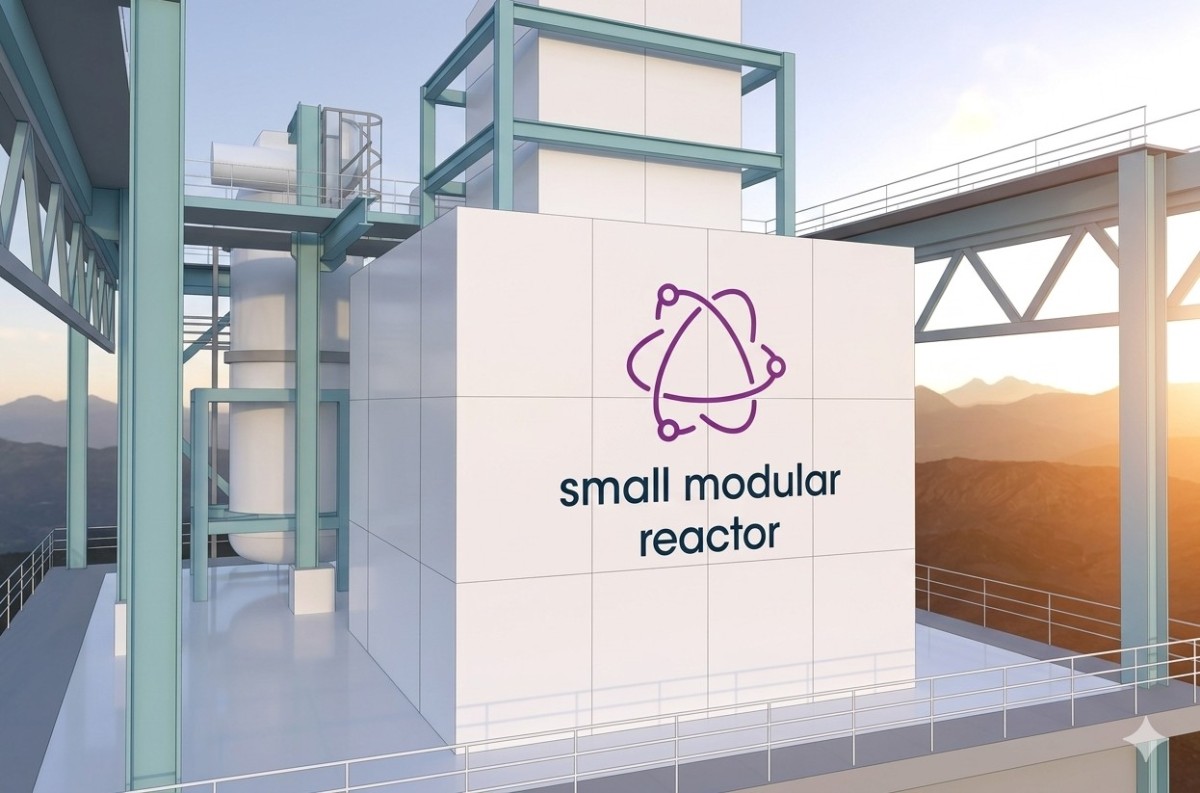
An AI-generated image of a small modular reactor (SMR) that are designed to produce between 30 and 300 MW. Image Courtesy: Gemini AI
 By Arun Surendran, on May 12, 2026
By Arun Surendran, on May 12, 2026
By Arun Surendran, on May 12, 2026
At a moment when Artificial Intelligence (AI) is weaving itself into the very fabric of our daily lives, a silent crisis is brewing: an insatiable hunger for power. The complex algorithms driving our future require such staggering amounts of electricity that the world is being forced to reconsider its most controversial relationship – the one with nuclear energy.
This is the backdrop for the 2025 Union Budget announcement, where the Indian government earmarked 20,000 crore rupees to establish Small Modular Reactors, or SMRs. While the name suggests something minor, in the high-stakes game of national infrastructure, the Bharat SMR is no small fry.
To understand why “small” is the new “big,” we have to look at the numbers. A single megawatt of electricity can power roughly 700 homes. While massive installations like the Kudankulam Nuclear Power Plant boast a capacity of 6,000 MW, SMRs are designed to produce between 30 and 300 MW. This scale makes them comparable to India’s first fully solar-powered airport in Kochi, which operates on a 50 MW plant.
The “Modular” in SMR is the real game-changer. Unlike traditional plants that require decades of complex on-site construction, SMR components are manufactured in a factory and then shipped to the site for assembly. This “plug-and-play” approach aims to slash the timeline of nuclear projects.
Currently, three variants are under development: 200 MW, 55 MW, and a compact 5 MW unit. The goal is ambitious: India seeks a 100 GW nuclear capacity by 2047, providing power for approximately seven crore homes. This push aligns with global trends where decentralised power grids are becoming the preferred safeguard against widespread blackouts.
Bharat Reactor: The Bharat SMRs are built on the foundations of high school physics but executed with cutting-edge engineering. These reactors are designed as Pressurised Heavy Water Reactors (PHWRs). In a standard water molecule (H2O), you have hydrogen and oxygen. However, by using Deuterium – a hydrogen isotope with an extra neutron – we get Heavy Water (D2O), which is essential in nuclear plants for cooling and absorbing neutrons.
The fuel of choice for these local units is Enriched Uranium. Natural Uranium consists mostly of the stable U-238 isotope, but only the rare U-235 is radioactive enough for fission. Through gas centrifuge technology, scientists “enrich” the uranium to increase the U-235 percentage.
When a neutron hits a U-235 atom, it splits – a process called fission – releasing a massive burst of energy and more neutrons. If this “chain reaction” is controlled, you have a stable power plant; if not, you have a disaster.
As Einstein’s famous E=mc2 equation proves, even a tiny loss of mass during this split results in an enormous release of energy. Developing these reactors domestically is a point of pride for Indian scientists, who have faced decades of technological isolation.
Travancore to Trombay: India’s nuclear journey didn't start in a vacuum; it began with the visionary Homi J Bhabha. Long before independence, Bhabha was laying the groundwork, eventually convincing JRD Tata in 1944 to fund the Tata Institute of Fundamental Research (TIFR).
But the story has deep regional roots. In the early 20th century, high-grade Monazite – the source of Thorium – was discovered in the sands of Travancore. The value of this “black sand” was so high that international powers scrambled for mining rights.
The Diwan of Travancore, CP Ramaswamy Iyer, even attempted to leverage these deposits for political sovereignty. Eventually, the Indian government, led by Prime Minister Jawaharlal Nehru and advised by Bhabha and Shanti Swarup Bhatnagar, secured these resources for the nation. This led to the creation of the Department of Atomic Energy in 1954 and Asia’s first reactor, Apsara, in 1956.
Bhabha’s three-stage plan remains the North Star for Indian energy: using limited Uranium to eventually unlock the vast power of our Thorium reserves. This historical context highlights why nuclear energy is viewed not just as a utility, but as a pillar of Indian strategic independence.
The AI Factor: Why the sudden urgency for SMRs? Look no further than the Silicon Valley titans. Sundar Pichai recently described a new AI research centre in Visakhapatnam as a “One Gigawatt Centre”. To put that in perspective, the massive data centres required for AI eat up electricity by the gigawatt, and keeping their GPU networks cool costs millions daily.
Tech giants like Google, Meta, and Amazon are now pivoting toward nuclear technology to meet their “Green Energy” goals, aiming to triple global nuclear production by 2050. A study by MIT suggests that an average user interacting with AI uses about 2.9 kWh of electricity per day – the same as running a microwave for three hours.
As the global economy enters an “AI bubble,” the demand for power is only going one way. The integration of SMRs directly into industrial parks and data centre hubs could solve the transmission losses associated with traditional large-scale power plants.
The Safety Question: Despite the optimism, the shadow of the past looms large. Disasters like Three Mile Island (1979), Chernobyl (1986), and Fukushima (2011) serve as grim reminders of what happens when things go wrong. The cost of failure is not just human; it is fiscal. Decommissioning Fukushima is expected to cost 18 lakh crore rupees by 2050.
Even Kudankulam, our largest plant, has faced over a decade of delays and cost escalations due to local protests and international sanctions. SMRs are theoretically safer because of their smaller radioactive inventory, but they aren’t a magic bullet.
As private sector participation grows, India will need robust new laws to handle nuclear waste disposal and liability in the event of an accident. Furthermore, the public must be engaged through transparent communication to avoid the “Not In My Backyard” (NIMBY) syndrome that has stalled previous projects.
For a developing nation, energy consumption is the ultimate yardstick of progress. We cannot afford to ignore any safe energy source, but we must proceed with eyes wide open. SMRs may be the key to a high-tech future, provided we don’t underestimate the “small” challenges they bring. The next decade will determine if India can truly master the atom to fuel the intelligence of the future.
(Arun Surendran is the Principal of Trinity Engineering College and has completed his Master’s and PhD in Aerospace Engineering from Texas A&M University after his BTech from IIT Bombay.This is an abridged translation of the original article published in the VaijanikamMagazine of the Kerala State Institute of Encyclopaedic Publications.)
Skyroot fuels India’s space ambitions
After India opened up its space sector to private players in 2020, the sector has been on a high-octane trajectory, with around 400 startups officially registered. India now has its first spacetech unicorn in Skyroot. Even more exciting is the news that this Hyderabad-based startup, founded by former ISRO employees Pawan Kumar Chandana and Naga Bharath Daka, is getting ready for the launch of the Vikram-1 rocket. As Inc42 reports, if successful, Skyroot will be among a handful of private companies globally, including Elon Musk’s SpaceX, to have successfully put satellites into orbit through a privately built orbital launch vehicle.
Another landmark achievement in the spacetech sector came when Bengaluru-based startup GalaxEye Space successfully launched its Mission Drishti satellite, the world’s first commercial “OptoSAR” satellite, which integrates both high-resolution multispectral imaging (MSI) and synthetic aperture radar (SAR) on a single spacecraft. It provides India with a sovereign all-weather surveillance capability that is critical for national security, disaster response and maritime monitoring, reports SatNews. GalaxEye aims to deploy a constellation of 10 OptoSAR satellites by 2030.
Kerala engineer shines in AWS contest
A College of Engineering Karunagappally graduate, Abhimanyu RB, has won the Innovation Award at the AWS 10,000 Aldeas Competition, one of the largest developer contests in Amazon Web Services history. The competition invited developers worldwide to build innovative AI applications using AWS tools. Abhimanyu won 10,000 US dollars in cash and 1,000 US dollars in AWS credits after being recognised for standout technical implementation and creative problem-solving. His AI-powered platform simulates how a patient’s unique genetic profile interacts with a drug – an area the medical world has long overlooked, relying largely on datasets obtained from the West. Abhimanyu progressed through several rounds against participants from 115 countries to win the award.
Buddhist monks get an AI robot
Everyone wants a handy humanoid around, and we cannot blame the Jogye Order of Buddhism in South Korea for also succumbing to the temptation. In a widely circulated video, a 130-centimetre-tall robot is seen dressed in Buddhist robes and wearing a string of 108 prayer beads as it is formally ordained and given the Dharma name Gabi. The sect even updated the traditional Five Precepts for the AI era, creating a new code for robots: do not harm life, do not damage objects, do not defy humans, do not deceive, and do not overcharge. That last rule may be worth introducing across the global tech industry – especially for companies that think subscription fees should rise faster than enlightenment.
Even café bosses now fear AI
The latest job reportedly under threat from AI is that of café managers. A café in Stockholm is now being run by an AI manager called Mona, and, awkwardly for humans, both customers and staff seem fairly happy about it. Launched by Andon Labs, a startup based in San Francisco, the AI chatbot has been handling everything from hiring staff to managing supplies. Mona secured permits, designed the menu, sourced suppliers and even recruited employees by posting job listings, conducting interviews and making hiring decisions. Barista Kajetan Grzelczak says Mona is a better manager than many humans he has worked under before. So that is another job potentially roasted by AI.
