
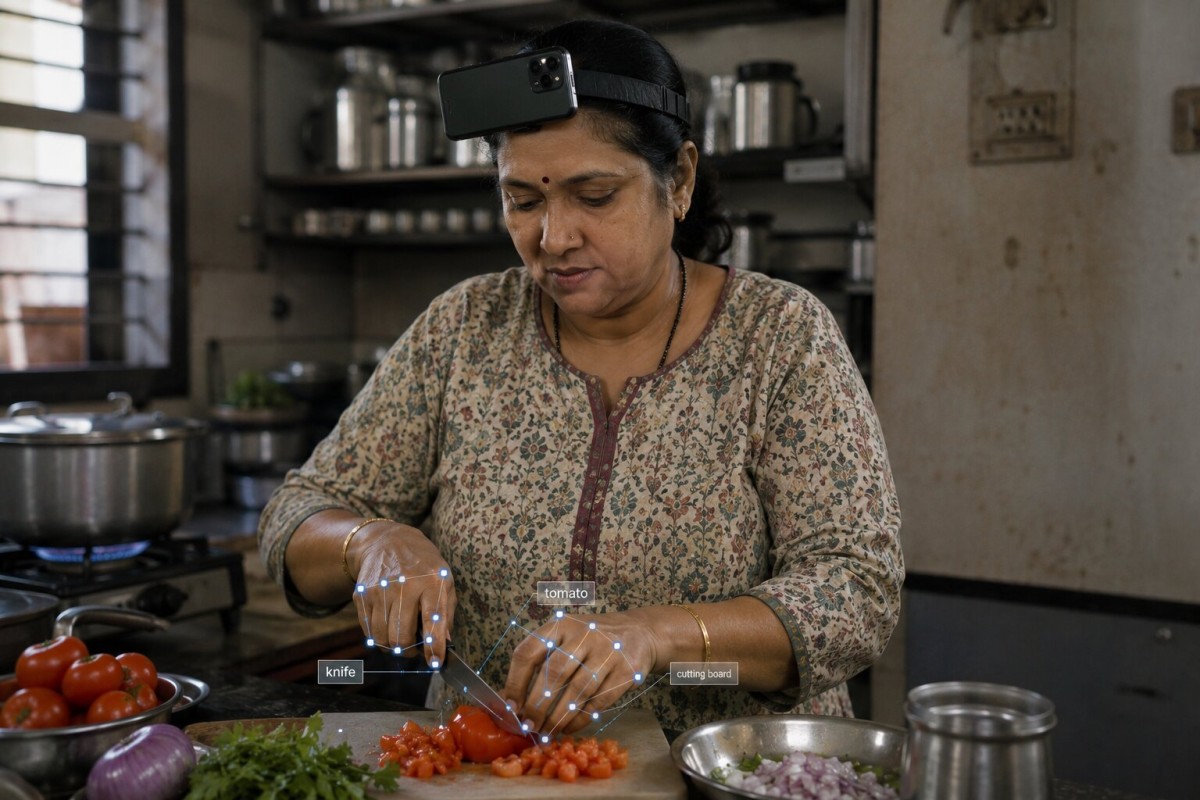
Companies are recording routine activities of ordinary folks and using that data to train future humanoids. AI Image by TikTalk News.
 By Hari Kumar, on June 23, 2026
By Hari Kumar, on June 23, 2026
By Hari Kumar, on June 23, 2026
Most homemakers do not get paid for doing household chores. Nagireddy Sriramyachandra does. All she has to do is strap a smartphone to her head and record her actions while going about her day. For an hour’s work, she earns about 250 rupees.
The footage is not destined for social media. It is training data for robots.
When AI companies launched large language models (LLMs), they scraped data from the internet. Robots cannot learn that way. To learn how to navigate the physical world, they need footage of real people performing real tasks. As companies race to build robots for homes, hospitals, warehouses and factories, that requirement is creating a global race for a new kind of resource: human activity data.
Just as India became a hub for data labelling during the AI boom, it is now emerging as a major supplier of this data. That position offers enormous opportunity – but it also carries a familiar risk.
The IT boom created one of the world’s largest pools of software talent, but much of the intellectual property and product ownership remained elsewhere. India supplied the labour; others captured the value. A similar pattern now appears to be emerging in robotics.
The pattern is visible in AI more broadly. The aggressive push by major LLM companies to offer free or heavily discounted subscriptions in India is not purely a market expansion strategy. The text and public data that trained the first generation of language models has largely been exhausted. Millions of Indian users generating fresh data daily are, in effect, filling that gap. The subscription is cheap because the real transaction is happening elsewhere.
Taped Out: Human Archive, a Y Combinator backed startup founded by Shloke Patel, Samay Maini, Rushil Agarwal, and Raj Patel – engineers from Stanford and Berkeley – says they pay gig workers in India to wear kits equipped with downward-facing 4K cameras, depth sensors, wide-angle lenses and motion sensors.
The equipment records how people perform everyday tasks at work. The company says it has already collected tens of thousands of hours of footage and plans to scale that to millions.
The startup has formed more than 120 partnerships spanning industries such as textiles, jewellery, coal, steel, hotels and quick commerce. India sits at the centre of its collection strategy because it offers both labour depth and industry diversity. Andhra Pradesh-based Qanat Consulting Services says it supplies about a dozen larger data firms with recordings which could even include audio.
Watch and earn: The scramble for data is producing increasingly creative business models. A German startup called MicroAGI recently launched a free home-cleaning service in New York, sending workers fitted with head-mounted cameras into people's apartments. The service was free, but the footage was valuable. The company could then sell the resulting data to AI labs developing robotics systems.
In Shenzhen, in China’s Guangdong province, a company sends cleaners to your house with a robot and an engineer. The robot is designed to help the cleaner by taking over some of the routine work, like removing garbage and folding clothes. But results are yet to reach the levels of what we see on social media, according to some reports.
An MIT Technology Review report says Micro1, a US company based in Palo Alto, California, has hired thousands of contract workers in more than 50 countries, including India, to collect physical activity data for robotics training. They recruit mostly through social media platforms like LinkedIn and YouTube.
Global Hunt: What looks like an isolated business trend is actually part of a much larger shift.
The world’s leading AI companies are increasingly looking beyond chatbots and toward machines that can operate in the real world. OpenAI recently announced a renewed robotics push, with CEO Sam Altman launching a hiring drive spanning hardware, machine learning, systems and operations.
Tesla, LG and other multinationals are already training robots to work in factories. Goldman Sachs projects the global market for humanoids could reach 38 billion US dollars by 2035.
The race is no longer just about who builds the smartest AI model. It is increasingly about who builds robots capable of working in homes, hospitals, warehouses and factories. For India, that creates both an opportunity and a dilemma.
Data Goldmine: The opportunity is obvious. Few countries can match India’s combination of population scale, labour diversity and industrial breadth. Whether it is a textile factory, a hotel kitchen, a warehouse, a farm or a hospital, India offers an enormous range of human activities that robotics companies want to study.
That advantage alone, however, does not guarantee an industry. The larger value in robotics is likely to accrue to those who build the models, products and platforms that use this data.
Robotics could become a major advantage for India. The question is whether the country will merely supply training data or develop the ecosystem needed to turn that advantage into products and companies of its own.
Silk Route: China appears to be taking a different approach. Rather than outsourcing data collection to cheaper labour markets, Chinese companies are building robotics ecosystems around their own domestic market. JD.com is working with local authorities in Suqian of Jiangsu province to generate 10 million hours of robotics training data over two years.
Residents are being paid to record household chores while workers in farms and elderly care centres wear cameras to capture everyday tasks. The objective is not merely to create datasets. It is to accelerate the development of robotics products for homes, factories and workplaces.
The push extends well beyond individual companies. Recently, China’s Ministry of Industry and Information Technology and the State-owned Assets Supervision and Administration Commission jointly directed local governments and state-owned enterprises to accelerate the adoption of humanoid robots and embodied AI across manufacturing, logistics, retail and healthcare. The goal is ambitious: more than 10,000 humanoid robots deployed commercially by the end of 2026.
China’s data is feeding Chinese robotics ambitions. India’s data, by contrast, appears to be feeding robotics programmes elsewhere.
Indian Challenge: To be fair, Indian entrepreneurs have spotted the opportunity. Neocambrian AI, an Indian startup focused on large-scale human action datasets for robotics and embodied AI, is pursuing a model similar to Human Archive. But that also illustrates the challenge. India is beginning to participate in the data layer of the robotics economy, not necessarily in the product layer.
That distinction matters. Data collection creates economic activity, but the larger value often accrues to those who build the models, the robots, the software platforms and the surrounding ecosystem.
India already possesses one of the key ingredients these systems need: scale. Millions of people perform billions of physical tasks every day in homes, factories, warehouses, hospitals and farms. As robots learn to operate in the physical world, that human activity is becoming an increasingly valuable resource.
What India lacks is a robotics ecosystem capable of turning that advantage into globally competitive products. But the semiconductor sector offers a useful lesson.
Ecosystem Push: For decades, India supplied engineering talent to the global chip industry while manufacturing remained concentrated elsewhere. The market alone did little to change that reality. It took a deliberate push through the India Semiconductor Mission, production-linked incentives and state-backed infrastructure support to begin creating a domestic ecosystem.
Robotics presents a different challenge but perhaps a similar lesson. The opportunity is not simply to collect more data. It is to create enough domestic demand for robotics that companies have a reason to build products, deploy them and improve them within India.
Public hospitals could become test beds for care and assistance robots. Manufacturing facilities could adopt robotics to improve productivity and quality. Logistics hubs, warehouses and ports could provide large-scale environments for automation systems to mature. Defence applications could create early demand for specialised robotic platforms.
Different Strokes: The objective is not to replicate the semiconductor playbook exactly. Semiconductors required design and manufacturing capability. Robotics requires deployment capability.
The data being collected from Indian workers today is already helping train the next generation of robots. Some of the machines that eventually work in homes, hospitals and factories around the world may owe part of their capabilities to lessons learned from Indian workers.
The question is whether India will merely provide the lessons while others build the machines. Or whether it can use this moment to create a robotics ecosystem of its own.
HCLTech backs India’s AI challenger
India’s latest unicorn is Sarvam, the Bengaluru-based AI company aiming to build an indigenous LLM for India. The milestone comes after HCLTech earlier this week acquired a 10.46 per cent stake by investing 1,427.25 crore rupees. Following the controversial action against Anthropic by the United States government, calls for self-reliance in AI are growing stronger, and Sarvam is positioning itself to play that role. The company said it would fund research into its next-generation AI models, while also expanding access to computing infrastructure as it scales deployments across industries.
But, as a report in Business Standard points out, Sarvam will have to show that sovereignty can be sold as a business advantage, not just a national aspiration. So far, India’s AI push has relied heavily on government support, with the IndiaAI Mission earmarking a five-year outlay of 10,371.92 crore rupees. Private capital, such as HCLTech’s investment, brings the enterprise distribution, market discipline and operational scale needed to take these technologies global. If more Indian corporates and investors follow HCLTech’s lead, the country could begin building the funding base needed to compete seriously in AI. But companies like Tata and Reliance have so far relied on overseas firms for their LLM ties.
NIIST chief wins global recognition
Our salute goes out to Dr C Anandharamakrishnan, the CSIR-NIIST Trivandrum centre head, who has been recognised as one of the “2026 Top Agri-Food Pioneers” by the World Food Prize Foundation, which is celebrating its 40th anniversary. To mark the occasion, the foundation selected 40 pioneers from 30 countries, highlighting individuals whose work is creating measurable impact across the global agri-food ecosystem. As we reported earlier, Anandharamakrishnan has won accolades for his work on developing a high-protein, low-glycaemic index rice fortified with iron, folic acid and vitamin B12 to help address diabetes, anaemia and malnutrition. Good to know the world is taking note of his work.
Retail therapy minus the expense
Shopping is a quick-fix dopamine generator, but unfortunately an expensive form of therapy. Young South Koreans, however, have found a cheaper solution: online platforms that mimic shopping. Users log in and pick goods they would like to buy, place orders, add items to carts and even track fake deliveries. The platforms are designed to look and function like popular food delivery and quick-commerce services. However, no payment is processed and no goods are delivered. Instead, users get to experience the anticipation and satisfaction associated with online shopping without the financial cost.
Flush with innovation and wheels
Going to the toilet may soon be as outdated as getting up to change the TV channel. A Chinese company called Yueban has unveiled Xiaoban, a robotic toilet that comes to you when nature calls. Designed mainly for people with limited mobility, the wheeled throne rolls up on demand. Once your business is concluded, it quietly drives itself back to a docking station connected to the home’s plumbing. The idea is that you can tuck it away in a cupboard when it’s not needed. If this catches on, tomorrow’s tiny apartments may feature a robot toilet parked beside the Roomba, both waiting patiently in the closet for their next assignment. One cleans up after you. The other really cleans up after you.
