
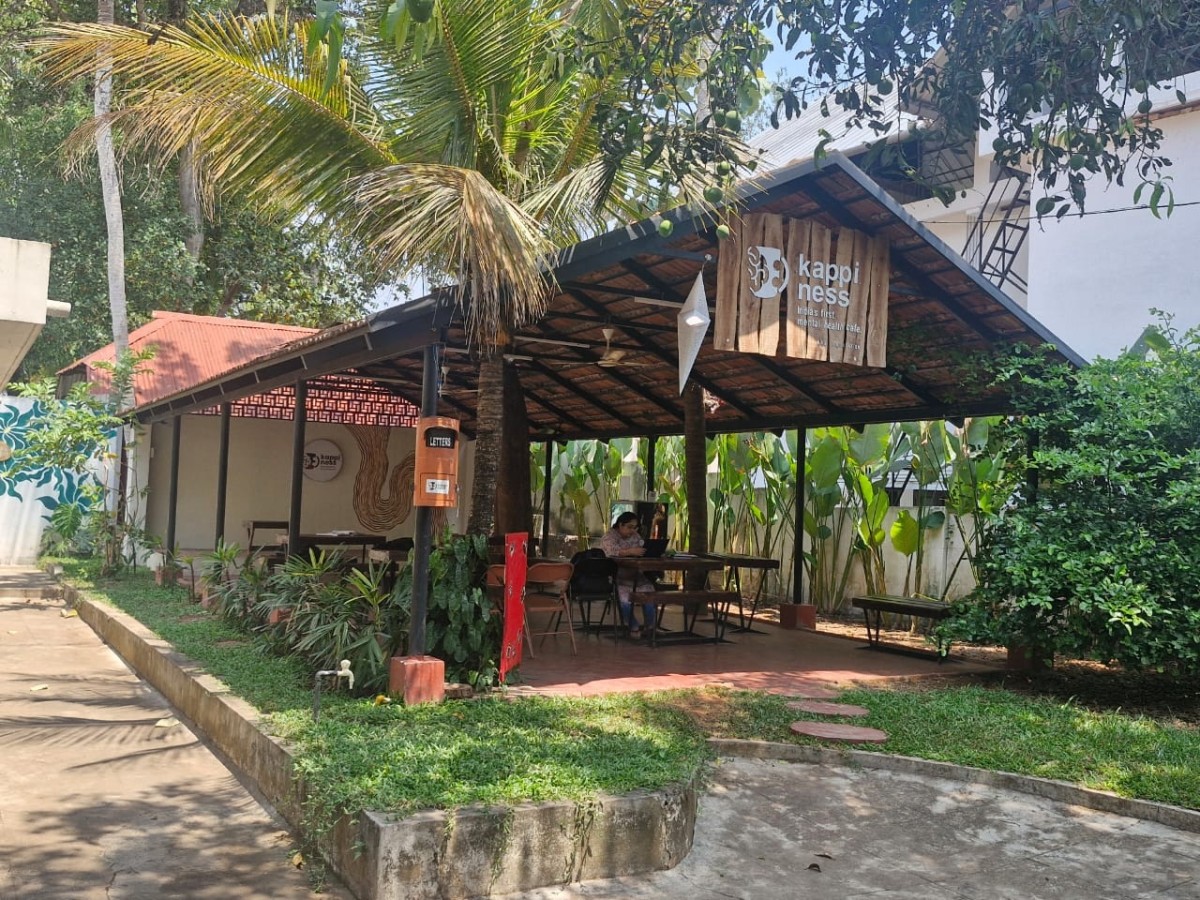
A relaxed, café-like setting and conversations under a garden tree welcome visitors to Kappiness. Photo: TikTalk News
 By Hari Kumar, on March 31, 2026
By Hari Kumar, on March 31, 2026
By Hari Kumar, on March 31, 2026
While most startup founders focus on software and hardware products and services, one group of youngsters based in Trivandrum has chosen a social cause as their venture – mental wellness. They say the mental health of society has undergone significant changes with the times, and its treatment and analysis must keep pace.
That is when Prabin PB, Neha Padayan and Jixon Punnoose established a mental health café and therapeutic centre called Kappiness in Trivandrum – a space that blends counselling services with a relaxed, café-like setting. It offers therapy sessions, support groups, informal conversations, activities and other engagements.
Their aim is to take counselling out of its stigma-ridden image of visiting a clinic, a dedicated health facility or a doctor’s home. The founders have located their multi-room facility in a large, leafy compound surrounded by trees. It feels like a home, offering far more tranquillity than a modern healthcare centre.
The startup says it keeps counselling and interactions with professionals informal and casual, so visitors feel like they have dropped in for a coffee and a friendly chat rather than entering a doctor–patient setting. The facilities include a mud house, a garden retreat and rooms for one-to-one conversations.
Breaking Stigma: It employs over half a dozen professionally trained experts who help with personal and professional issues. Engagement opportunities are offered both offline and online, and Prabin says they even have people from overseas reaching out through their website.
He says the idea behind Kappiness is to keep its programmes aligned with changing times. “We have campaigns against problems like alcoholism. But the thrust of such campaigns has remained the same and is often based on crossing lines set by parents or similar value systems. That has not changed with the times or made it attractive to today’s youngsters. We try to change that.”
On the other hand, older people often view counselling as treatment for mental illness, leading to stigma. Prabin recalled an incident when a school head introduced a newly arrived counsellor as a ‘mind reader’. Students were told the counsellor could uncover their thoughts, prompting them to hide things, he said with a laugh. “That kind of approach will make any counsellor’s work difficult.”
Kappiness organises interactive programmes and expert-led talk sessions on modern-day issues such as eating disorders. This helps widen its audience and draw more people to the centre.
Interactive Formats: He says they try to innovate and introduce gaming elements to make activities more engaging. One such initiative involved blindfolding participants and asking them to interact. This removed the fear of being judged, as they could not see who they were speaking to, only hear their voice. “This led to a lot of productive interaction in a fun way,” says Prabin.
The centre also provides internships to students interested in counselling as a career, with some continuing as volunteers.
Prabin says youngsters often volunteer during their college years, but once they begin working, there are few platforms to continue such engagement. This gap was a key idea behind the project established by the NGO Nadi Foundation, headed by Prabin.
“The idea was to create a friendly, welcoming space where one can drop in, have a coffee and relax. Engaging a counsellor or professional to deal with stress or emotional wellbeing is a difficult choice, given the stigma that exists in our society. Kappiness is a place where you can drop in and relax – it is not like going to a clinic or a professional centre.”
Future Plans: The team now plans to expand into a family-focused mental wellness model and open a new centre at Kazhakuttam on a 1.5-acre plot. The idea is to create a larger space where people can spend an entire day, with boarding facilities as well. Activities in a tranquil environment will be central to the experience, says Prabin.
The group is also in talks with IT companies to develop programmes that benefit employees and improve their mental outlook through creative engagement.
Kappiness has registered with Startup India and is in discussions with Kerala Startup Mission for scaling support. The startup also plans to approach companies for CSR backing to expand its mental wellness initiatives in rural areas and support students who often lack access to opportunities available to their urban counterparts.
Poll heat map journey continues
TikTalk News has been on a bit of a roller-coaster with our experiment of using AI platforms for things beyond the usual – like images, videos and memes. Becoming part of the On The Dot podcast series was mainly to get a sense of Kerala’s political heat map in the run-up to the polls. The feedback so far has been an equal mix of brickbats and bouquets, with many assuming we were trying to predict results. We are not. What we are doing is using AI to pull together insights from vast sources to understand how social media is playing out right now.
Startups solving local problems always catch our eye – and Palakkad’s TevanovaTechtrade does exactly that. The company’s product Chuvarbot 2.0 was built to address something every Keralite recognises: the annual scramble for wall artists during election season as Manorama points out. Doctors-turned-innovators Shakkib Geethanjali, and Acsah Peter designed a machine to do the painting instead. Makes you wonder how many such gaps are hiding in plain sight for anyone willing to look closely at the poll ecosystem.
Top talent now heads East
The flow of top scientists from Asia to Western universities is an old story. But times are changing. Chennai-born Singaporean materials scientist Seeram Ramakrishna, long regarded as the father of electrospinning and one of the world’s leading names in nanoscience, has moved to China’s Tsinghua University. He has been awarded its highest professorial faculty title, according to the South China Morning Post. Chinese media has been actively spotlighting such arrivals since turbulence hit American academia, signalling that the direction of travel is no longer only westward.
The game that rewrites the past
From plans to build on the moon to cattle herding, Y Combinator's latest batch offers its usual eclectic mix. TechCrunch reports VCs were busy wooing founders, but what caught our eye is Pax Historia. Founded by Virginia Tech students Eli Bullock-Papa and Ryan Zhang, it's an AI-powered alternate-history sandbox where you pick a country, a moment in time, and rewrite what happened next – “What if Rome never fell?” or “What if the USA took over Greenland?” Unlike traditional strategy games, generative AI drives every response, making each playthrough unpredictable. The founders say it already has 35,000 daily users.
Good moaning in office
Complaining about a dull office? Get SlapMac– a new app that makes your MacBook moan when you slap it. It uses the laptop’s motion sensors to detect impact and fires back with a range of sounds, like suspiciously human moans, punching sounds, and yes, farts. The developer who says the three-dollar-app fetched him 5,000 USD in just three days, also threw in USB Moaner mode, which does exactly what the name suggests every time you plug something in. So, stop moaning about dull offices, things are getting a sound makeover.
