
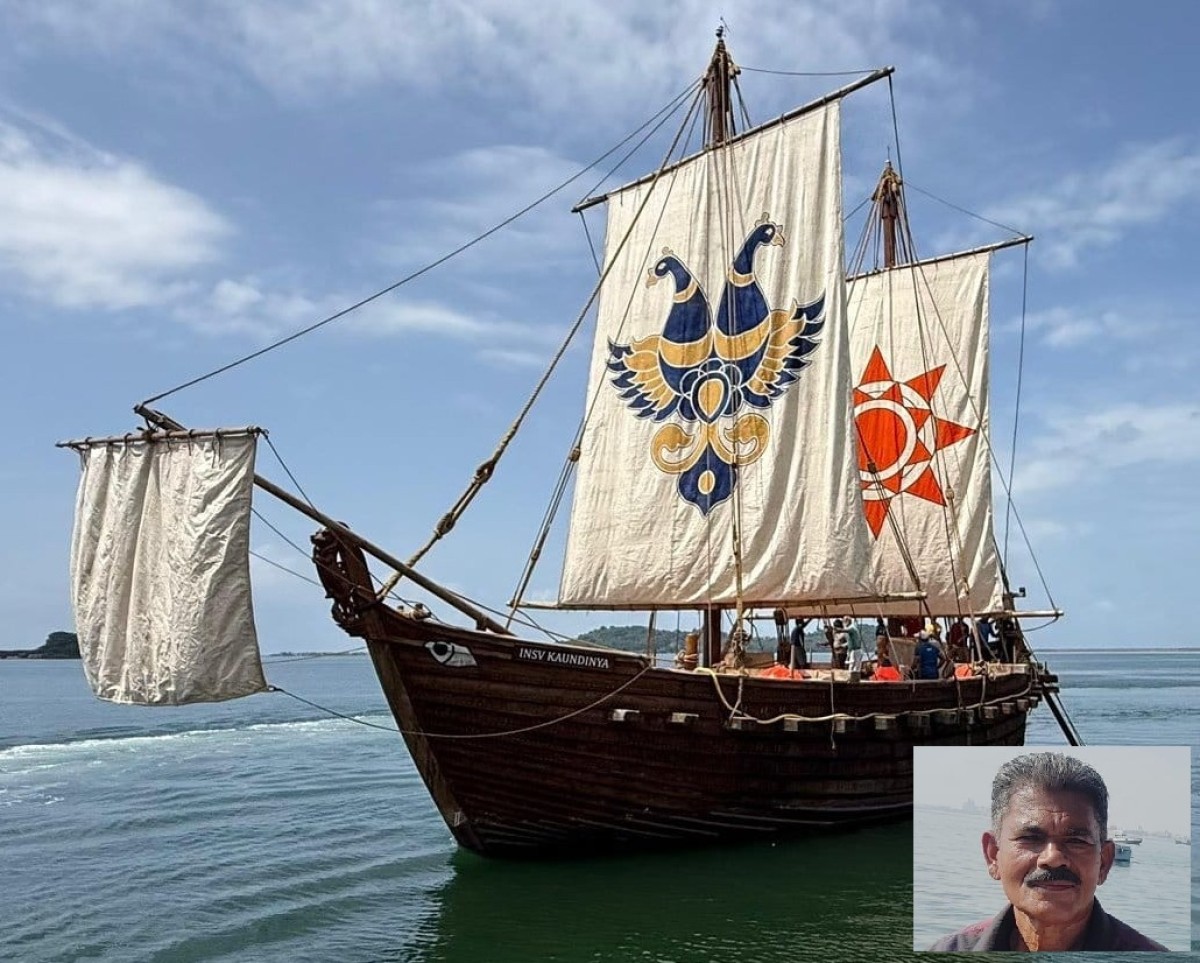
Indian Navy vessel INSV Kaundinya represents a rich knowledge system that India possessed centuries ago. Inset: Babu Sankaran. Photo courtesy: Sanjeev Sanyal and Indian Navy.
 By Hari Kumar, on January 13, 2026
By Hari Kumar, on January 13, 2026
By Hari Kumar, on January 13, 2026
Indian Navy’s INSV Kaundinya is somewhere in the Arabian Sea right now, heading towards Muscat after departing from Porbandar, retracing a trade route that Indian seafarers navigated for centuries. The vessel, made of wood and without a single metal nail, represents something more complex than maritime nostalgia. It is a moment of visibility for a knowledge system that once made the Malabar coast a maritime power.
The chain of events that led to this historic journey began with a mural painting. Sanjeev Sanyal, noted economist and member of the Prime Minister’s Economic Advisory Council, noticed a depiction of a sewn boat in the Ajanta Caves and began researching it. This revealed what turned out to be one of India’s most sophisticated but least documented maritime technologies.
His research caught the attention of the Indian Navy, then the Ministry of Culture, and eventually Prime Minister Narendra Modi himself. What started as a historical inquiry became a question of national significance: could this vessel even be built in India anymore? Did anyone still possess the knowledge?
The search itself revealed how thoroughly a knowledge system can recede. The Navy’s Directorate of Naval Architecture spent four months tracking down leads. They scoured YouTube videos mentioning stitched ships and identified academics like Tom Vosmer from the University of Western Australia and Eric Staples from Zayed University in Abu Dhabi, who had worked on similar projects.
After four months of digital detective work, and a chain of emails and phone calls, they eventually reached a person with knowledge that once flourished along India’s southwest coast: Babu Sankaran from Vadakara.
Economic Drift: Babu Sankaran’s path to becoming perhaps the last master of sewn boat construction was itself a product of economic churn. He dropped out of school in the fifth standard to assist his father in building fishing boats and catamarans for local fishermen. At a time when metal and fibreglass boats ruled the waves, this was a livelihood that was being squeezed out.
At fifteen, he heard that a foreigner was recruiting in Kochi for people with knowledge of wooden boats, called uru in local parlance. The lure was irresistible, and Babu Sankaran and a friend took a train to Kochi without even telling their families.
“The interview was not like what you imagine,” he recalls. “I can hardly speak English, but I managed to tell the British man that I work assisting my dad, who makes wooden boats. He smiled and shook my hand. But then he continued to feel my hands and broke into a smile. Then he told me, ‘Very good.’ He was making sure that my hands bore the evidence of woodwork.”
That handshake in 1979 landed Sankaran a job in Muscat, which led to an introduction to British explorer Tim Severin, who was working to recreate Sinbad’s voyage. Work on that project led to more such projects over the decades, including the Jewel of Muscat commissioned by the Omani government, which was later presented as a gift to Singapore. It was in Oman, ironically, that his Kerala-born knowledge found institutional support and expanded into mastery.
Anchor Found: When the Indian Navy finally located him in the UAE, Babu Sankaran had already worked as a shipwright on many prestigious projects for Gulf countries. He had been dreaming for years of building a major vessel in India, and promising offers had come his way, but they all ran aground when the matter of funding arose. The Kaundinya project changed that – institutional backing finally aligned with craft knowledge that had been waiting for recognition.
The boat-making process involves the selection of wood such as karimaruthu, teak, and jackfruit, which are steamed and bent into the required shape. They are then bound together with coconut fibre rope treated with fish oil and kundroos resin (made from tree sap), a technique that seems improbable until one understands the sophisticated mathematics and material science embedded in it.
Babu Sankaran did not work from blueprints or technical manuals. The knowledge of how to shape a hull, which wood to use, and how to proportion the curves – all of this existed in his hands and mind, passed down through generations of oral instruction. “The kind of skills that I have acquired comes more from inspiration than perspiration,” he says. “It is based on your talent, and like music, not all can get it just by practising.”
Kerala Links: He even sought blessings through a ceremonial Theyyam puja near his home in Vadakara before proceeding to the yard of Hoda Innovations in Goa, where work started in September 2023. A team of traditional artisans from Kerala then hand-stitched thousands of joints under Babu Sankaran’s guidance, and the 21-metre ship was launched in February 2025.
The vessel was formally commissioned into the Indian Navy on May 21 as INSV Kaundinya, named after the legendary Indian merchant and mariner from the 1st century CE, whose voyages led to the establishment of the Funan kingdom, part of modern-day Cambodia.
As the boat construction proceeded, Indian Navy experts also managed to use modern technology to validate this ancient knowledge. Because no blueprints existed for such vessels, the Navy collaborated with IIT Madras to computationally model the hull form and conduct hydrodynamic testing in wave basins. This made it a project that brought together two sophisticated knowledge systems, separated by millennia, validating each other.
Even the symbolic elements carried modern Kerala’s creative touch. Kochi-based fashion artist R Sharmila, founder of Docart Productions, designed the vessel’s insignia – the Gandabherunda, a mythical two-headed eagle from the Kadamba dynasty, which flourished in the Konkan region.
New Age Economy: The sands of time have shifted, but Kerala still brands itself as a knowledge economy. The state produces software engineers, medical professionals, and researchers, and IT parks dot the landscape where spice warehouses once stood centuries ago. But this isn’t Kerala’s first knowledge economy – it is at least its second.
The maritime technology that Babu Sankaran represents was itself a knowledge economy: specialised, export-oriented, requiring years of training to master, and generating wealth through expertise rather than raw materials. The difference is structural. One knowledge system was encoded in practice and memory, transmitted through apprenticeship and observation. The other lives in servers, textbooks, and institutional credentials.
What makes the Kaundinya voyage significant isn’t nostalgia for a lost past, but what it reveals about how knowledge persists, or doesn’t. Some systems of knowing are designed to endure – written, codified, reproducible across time and space. Others are designed to be living and adaptive, transmitted person to person in contexts where the knowledge itself is constantly adjusting to time and circumstance.
Time Travel: When the economic conditions that sustain them shift, they don’t collapse dramatically. They simply fade as practitioners age and students choose other paths.
Babu Sankaran is frank about this. “It is hard work, and not many youngsters show the willingness and dedication to learn this ancient craft. It will take monumental effort to attract newcomers and retain the knowledge.” While that kind of approach is yet to surface in India, Babu Sankaran says some scholars from the United States and Italy have been interacting with him to document his work.
Kerala’s state government, which actively brands the state as a knowledge economy, seems to have missed the boat here. When INSV Kaundinya began its voyage, it drew national attention, with even the prime minister congratulating the mission. But the state government that regularly stages tech summits showed little interest in highlighting a knowledge system that actually originated in Kerala.
When INSV Kaundinya docks in Muscat, another cycle will come to a close. Babu Sankaran and his knowledge travelled away from Kerala, matured elsewhere, and returned for one institutional project. Kerala’s knowledge economy will continue its time travel, and the Kaundinya voyage marks one moment in that journey, not its destination.
Robotics scene gets hotter
If reports coming out of the Las Vegas CES are anything to go by, robotic companies are racing ahead with humanoid development. But the day robots will come to cook and clean your house is still a few years away, say experts. There is no shortage of claims, though. South Korean company LG promised to show a humanoid that could do household chores, but TechCrunch says it was unimpressed with the performance at the event. The race, however, is continuing furiously. Boston Dynamics, which has been at the forefront of humanoid development, has now tied up with Google AI research lab DeepMind to speed up its progress.
China’s Unitree, meanwhile, keeps releasing more awe-inspiring videos of its humanoid, the latest showing flying kicks and kung fu punches. If humanoid robots become commercially viable, China’s early cost and manufacturing advantages could give it a leg up in the industry. Major Chinese companies such as BYD, Geely and Xiaomi are already testing or deploying humanoid robots in factories and logistics. In Robot Almanac, Volume 3: Humanoids & Industrial Robots, released recently by Morgan Stanley, China is said to have recorded 7,705 humanoid patents over the past five years, compared with 1,561 in the US.
A neighbourly tip for Kerala
This is something that Kerala should take note of. Tamil Nadu has launched its Deep Tech Startup Policy, committing 100 crore rupees to support 100 deep tech startups over the next five years. Under the policy, the government will provide funding and training for over 10,000 professionals, while also facilitating technology transfer and patent filings. The initiative will offer structured support across the innovation lifecycle – from early-stage grants and incubation to state-funded innovation hubs and flexible funding mechanisms. Kerala may not have the same kind of resources that its richer neighbour has, but some components of this policy could be used as guidelines to help deep tech startups here.
China says US stealing its tech
It was Washington that had been accusing countries such as China and India of stealing its technology and expertise. Now China is raising similar alarms, with Beijing saying it will review the deal between Meta and Manus, the Singapore-based Chinese company that is popular for its AI agentic products. The Commerce Ministry says it will investigate the deal to see if it violated the country’s export controls, foreign investment or technology transfer rules. Some analysts say this is also a warning to other AI companies in China that may be looking at big bucks from the US, as deep-pocketed Silicon Valley giants hunt for AI expertise worldwide.
Bard boys lead AI astray
Here’s a tip if you want your AI chatbot to do things it’s not supposed to do: don’t argue with it – write a poem. Researchers at Italy’s Icaro Lab found that poetic prompts can confuse AI models, making it harder for them to spot banned or harmful content. Somehow, rhyme and metaphor seem to loosen safety guardrails. No one is quite sure why. And if you’re hoping to see the exact prompts used, tough luck – the exact lines they used in study has not been released for security reasons.
