
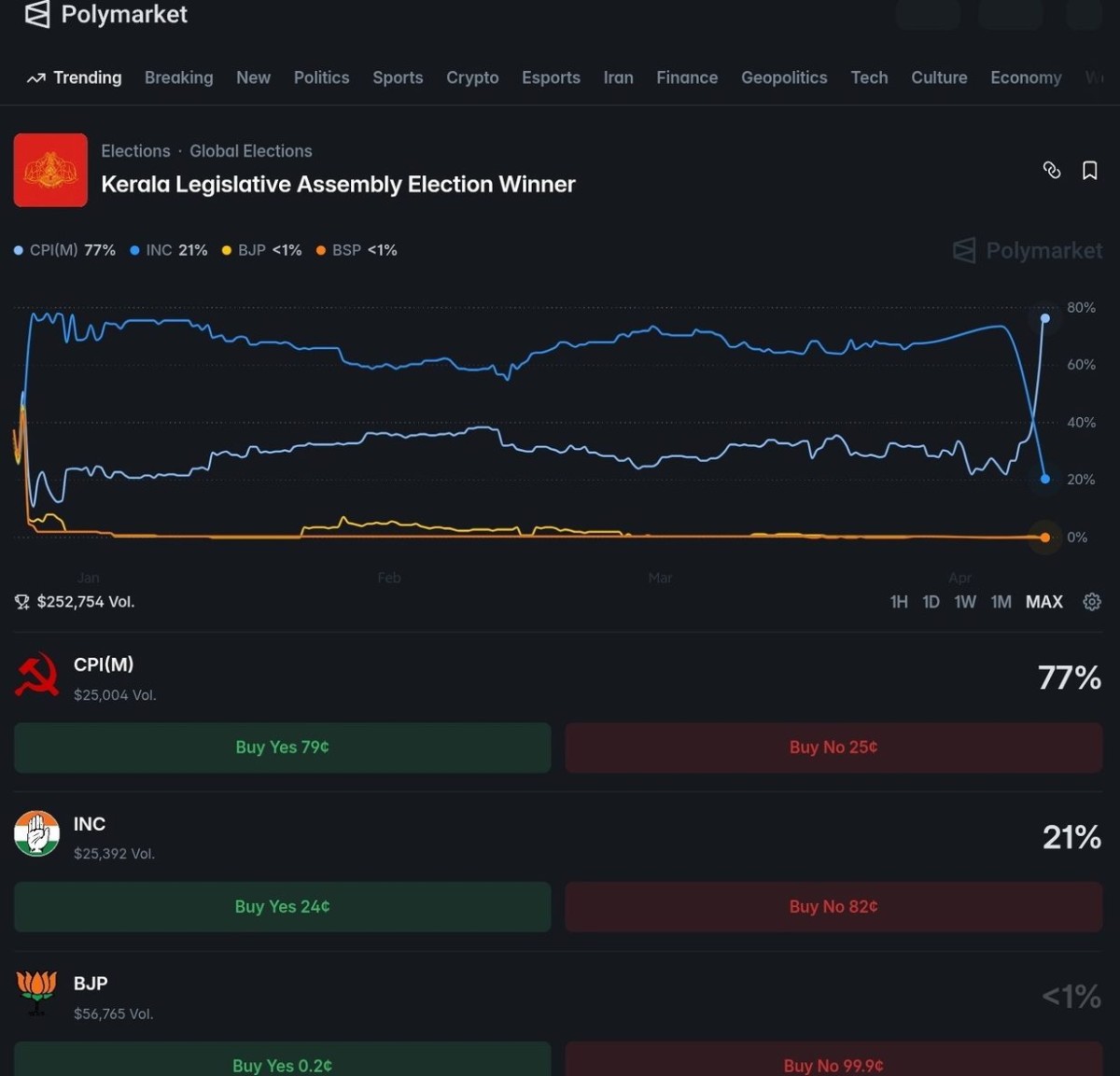
The sudden shift in Polymarket odds remains a mystery as worms of two rivals flipped positions. Image: Social media
 By Editorial Desk, on April 14, 2026
By Editorial Desk, on April 14, 2026
By Editorial Desk, on April 14, 2026
Kerala voted on April 9 to choose its next government, with results due on May 4. In the weeks between, speculation is inevitable – in drawing rooms, tea shops and WhatsApp groups – about who will come out on top. But this time, the guessing game isn’t confined to Kerala, or even India.
Thousands of miles away, on a Manhattan-based prediction market platform called Polymarket, people have been placing real money on the outcome of the Kerala election. Since at least February, the platform had been showing odd with a clear lead for the Congress-led UDF, something local media outlets had picked up on at the time.
Then something strange happened. As voting was progressing on April 9, some tech-savvy observers noticed the Polymarket graph was shifting dramatically. Congress’s odds started dropping sharply, while those of the Communist Party of India began climbing. By afternoon, the board had flipped entirely – CPI(M) at roughly 80 per cent probability of emerging as the winner, Congress down near 20 per cent.
Speculation followed immediately. Was this the result of an information leak? A few large bettors placing outsized wagers? Or something more coordinated?
Nobody knows. And that uncertainty, it turns out, is the real story.
Global Betting Lens: To understand why a platform based in Manhattan is even running odds on a Kerala election, it helps to go back to 2014 – and to a teenager named Shayne Coplan. At sixteen, Coplan bought Ethereum at around thirty cents a token, an early bet that would later become part of crypto lore.
By 2020, the New York University dropout had become a proponent of prediction markets and founded Polymarket, a platform that allows users to buy “Yes” or “No” contracts worth 1 US dollar on real-world events, with prices reflecting the probability of an outcome. Subjects were varied – from sports results to when singer Taylor Swift would get married.
The idea is simple: when people risk money, their predictions should, in theory, be more reliable than opinion polls. That premise has helped the platform gain traction – it’s about putting money where your mouth is.
US Poll Boost: During the 2024 US presidential election, its odds showed a clearer swing towards Donald Trump even as traditional polls suggested a tighter race. Since then, Polymarket has grown rapidly, drawing high-profile investors and reaching a valuation of 9 billion US dollars.
The backers include figures such as Donald Trump Jr, whose venture firm has invested in the platform and who now sits on its advisory board, and Silicon Valley investor Peter Thiel, whose Founders Fund has backed its growth – linking the platform to both political power networks and influential tech capital. It became part of the mainstream financial sector after the parent company of New York stock exchange, Intercontinental Exchange, decided to invest 2 billion US dollars in the startup.
But the promise of prediction markets comes with caveats. For one, these platforms operate in a legal grey area. US regulators have previously fined Polymarket for operating without proper registration, and debates continue over whether such platforms should be treated as financial exchanges or simply as a new form of online betting.
Prediction markets have also faced persistent concerns over manipulation and insider trading. There have been instances where traders placed large bets shortly before major geopolitical events, fuelling suspicions that those with early or privileged information could influence market prices and profit from them.
Needle of Suspicion: Sure enough, some of the Polymarket bets warrant such suspicions. Just before US forces captured Venezuela’s president Nicolás Maduro, an anonymous user placed bets worth tens of thousands of dollars on his fall, eventually walking away with a 400,000 US dollars payout. That fuelled speculation that a government insider may have been involved.
The needle of suspicion pointed again in a similar direction after the Iranian conflict escalated. A trader with the username “Magamyman” earned more than 553,000 US dollars after placing bets on the removal of Iran’s Supreme Leader Ayatollah Ali Khamenei, just hours before the announcement of his killing.
More controversial bets followed – on attacks, oil prices, ceasefire timelines and even rescue operations. But Polymarket and its main competitor Kalshi, founded by MIT graduate Tarek Mansour, have denied such allegations.
Market Movers: Even without insider information, markets can be moved. Unlike large financial markets with deep liquidity, many event-based prediction markets are relatively thin. A handful of large trades – often called “whale” bets – can significantly shift the odds, creating the appearance of strong consensus where none may actually exist.
That brings the focus back to Kerala.
What exactly caused the sudden swing as voting progressed? Was it new information filtering in through informal channels? A reaction to ground-level voting patterns? Or simply a few large bets that tilted the market?
There are no clear answers. And Polymarket itself offers no easy explanations – only a price that updates in real time, reflecting whatever forces are acting on it. In many ways, that is both its strength and its weakness.
Data and Drama: The platform presents itself as a kind of “News 2.0” – a real-time aggregation of belief backed by money. But as critics point out, belief is not always the same as truth. It can be shaped by incomplete information, speculation, herd behaviour or strategic bets designed to influence perception.
For observers in Kerala, the Polymarket episode adds a new layer to election watching – one that sits somewhere between data and drama. Because unlike opinion polls or exit surveys, prediction markets don’t just measure sentiment. They create it.
Interestingly, the Polymarket swing barely registered in Kerala’s mainstream media and unlikely to have an impact on voters. It remained largely confined to a niche, tech-savvy audience tracking the platform in real time.
That raises another possibility. Much of the trading on platforms like Polymarket happens outside India, particularly among the Indian diaspora and global crypto-native users. If so, the sharp swing on polling day may have reflected not ground-level sentiment within Kerala, but interpretations, speculation or even overreactions from afar – filtered through social media, fragmented information and time-zone gaps.
New Political Frontier: But if markets are supposed to reveal truth, what exactly did this sudden swing reveal? A shift in collective wisdom, the arrival of new information or simply the weight of a few well-timed bets?
On Polymarket, the numbers always look precise. The probabilities update to the decimal point, giving the impression of certainty. But the forces behind them remain anything but clear.
For now, its impact may be limited. But as access to such platforms expands and familiarity with prediction markets grows, it is not hard to imagine a future where these signals begin to carry more weight in how elections are read and discussed in Kerala.
Mythos release paused over risk fears
AI platform Anthropic has created a stir after it announced it will not publicly release its latest model Mythos, as the company felt its offensive and defensive capabilities are so vast that, in the wrong hands, it could identify and exploit software vulnerabilities, posing significant cybersecurity risks. Instead, the company will release it to limited players through Project Glasswing, which will bring together some of the world’s biggest tech companies like Apple, Google and Microsoft to beef up their defences. According to reports, Anthropic has also briefed a handful of senior US officials about Mythos and says it will release the model only after the loopholes are plugged by others.
Just a few days earlier, Anthropic had accidentally leaked over 100,000 lines of source code for its AI coding tool Claude Code through a packaging error, exposing key engineering details, architecture and internal design choices. The news was received with glee in China, where Claude is not available. Developers in the country rushed to download, analyse and reverse-engineer the leaked code. A social media post featuring the leaked code had more than 2.6 million views, with many local developers sharing what they had learned. The company says the leaked information does not include key features and will not cause much damage.
RoshAi gets 22-crore rupee boost
Cochin-based startup RoshAi got a major boost in its quest to develop autonomous vehicle technology when it raised funding worth 22 crore rupees (about 2.4 million US dollars). RoshAi is building an autonomy platform that includes retrofit hardware, an in-vehicle autonomy system, and a cloud-based fleet management platform. This enables industrial operators to upgrade existing fleets instead of investing in new vehicles or infrastructure, reducing costs and accelerating adoption. The company says the new funds will be used to strengthen its core technology, expand deployments and scale operations.
France moves away from Windows
France is planning to move some of its government computers currently running Microsoft Windows to the open-source operating system Linux to further reduce its reliance on US technology. French minister David Amiel says the French government can no longer accept that it does not have control over its data and digital infrastructure. Lawmakers and government leaders across Europe are growing more aware of the looming threat facing them at home, and their over-reliance on US technology. Paris has recently said it will stop using Microsoft Teams for video calls and start using French-made Visio, a tool based on the open-source, end-to-end encrypted video meeting platform Jitsi.
Next up, meme betting market
No points for predicting the winner in this one. A 19-year-old named Justin Jin made a fake app as a TikTok joke — a landing page that looked like a Google product — and one hundred thousand people signed up. So Justin and his friend Edwin Wang built the real thing. The app lets you “buy” videos you think will go viral, like a stock market for memes. Early backers earn points — and soon, real money. The two have since attracted funding worth 1.2 million US dollars — and yes, the exact amount raised was 1,234,567 dollars, which is also a joke. A journalist at TechCrunch wrote that covering this story gave them anxiety. We are more worried about how memes are taking over the world.
