
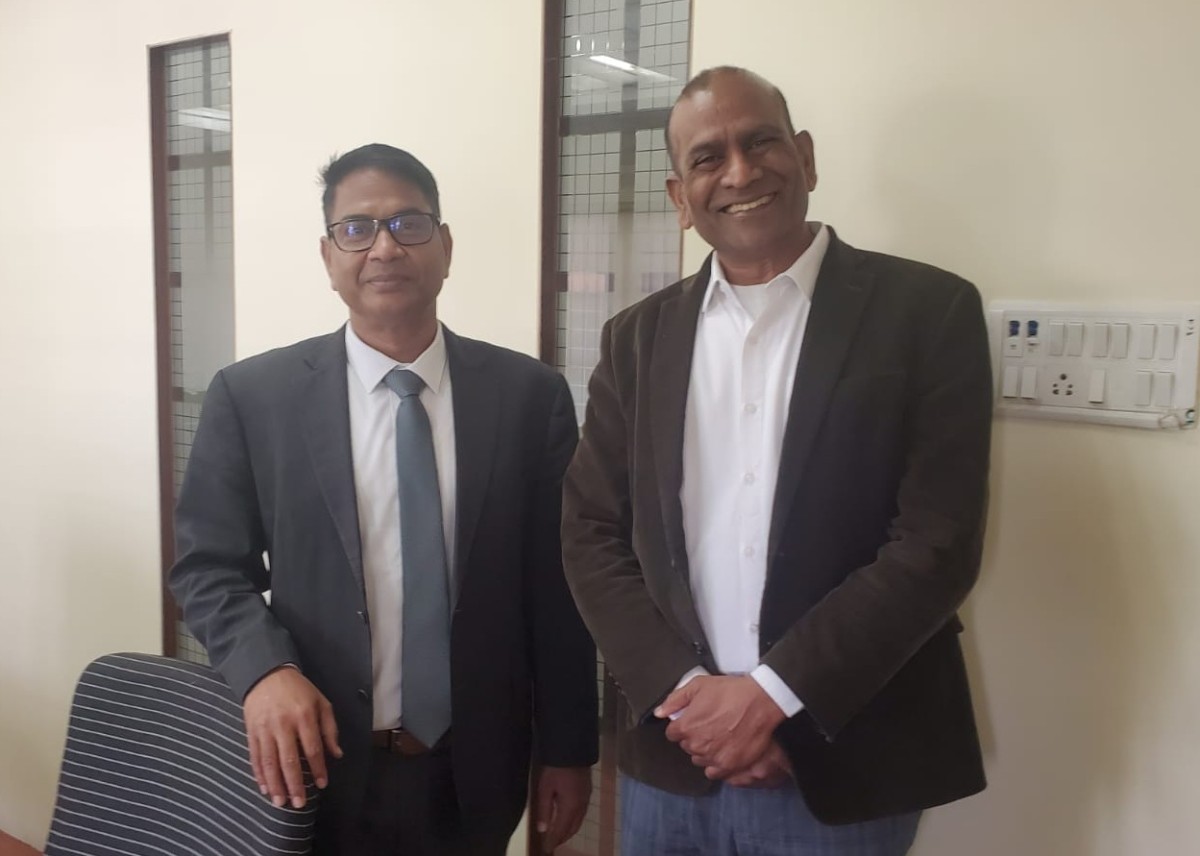
DIA India executive director Ashok Kumar Swain and DIA director Palaniappan Chockalingam (right) during their visit to the KMTC office in Trivandrum. Photo: TikTalk News
 By Hari Kumar, on February 03, 2026
By Hari Kumar, on February 03, 2026
By Hari Kumar, on February 03, 2026
In a significant boost to Kerala’s medical device sector, the Washington, DC-headquartered Drug Information Association (DIA) is planning to host their Indian MedTech conference in Trivandrum in April 2026, and have initiated talks with the Kerala Medical Technology Consortium (KMTC) regarding this.
The proposed DIA India MedTech Conference reflects the growing concentration of medical device manufacturers in southern India. Kerala, in particular, stood out for its established players and emerging innovation ecosystem.
Palaniappan Chockalingam, a director at DIA and Co-chair of its Science Policy Advisory Committee, said the decision followed a closer look at India’s regional strengths.
“When we were exploring locations for the Indian event, our initial thought was New Delhi, which was last year’s venue,” he said. “But we realised there were more medical device manufacturers in South India, and we were pleasantly surprised to see that Kerala had some well-established names. Once we started talking to KMTC, it became clear that Kerala would be an ideal choice, given its ambition to grow as a knowledge economy.”
Past Links: Palaniappan has had a long association with Kerala’s medical technology landscape. Decades ago, while heading research and development at Terumo Penpol’s blood division, he was introduced to the team in the state that would go on to build a global presence.
“I was based in Denver when I took on the top R&D role in Terumo Penpol’s blood division, and that’s when I first visited Kerala,” he recalled. “Even before that, I had heard a lot about this team of around 10 people. I invested in the team because I saw the talent. Today, it has grown into an operation of nearly 200 people globally.”
Now a physician-entrepreneur, Palaniappan leads Aridica, a company he founded that is working on advanced cell-based therapies, which he describes as “living drugs”. These therapies involve collecting a patient’s own T cells, modifying them and reintroducing them into the body to target cancer cells.
“A patient’s very own T cells are collected, isolated, genetically engineered and reintroduced into their body to attack cancer cells,” he explained. “With a single-dose treatment, this personalised therapy has shown the potential to bring critically ill patients back from very advanced stages of disease.” He added that while such treatments remain expensive, they underline the need for closer collaboration between researchers, industry and regulators to make breakthrough therapies more widely accessible.
Long History: That intersection of science, regulation and industry is central to DIA’s role globally. Founded in 1964 in the aftermath of the Thalidomide tragedy, which exposed gaps in drug regulation worldwide, DIA emerged as a neutral platform for dialogue among regulators, researchers, industry and patient groups. Over the decades, it has grown into a non-profit, member-driven global life sciences association with regional offices in Europe and Asia.
DIA works closely with regulatory authorities such as the US Food and Drug Administration and European agencies, facilitating discussions on emerging science, policy trends, harmonised standards and patient access to healthcare innovations. Its annual global meeting and regional conferences bring together regulators, innovators and experts to examine evolving regulatory frameworks, real-world evidence, technology integration and patient-centric approaches in drug and device development.
In India, DIA established its local chapter in 2008 to lead regional engagement. Ashok Kumar Swain, Executive Director of DIA India, said the Trivandrum conference is expected to bring global regulatory and industry leaders to Kerala.
Many Opportunities: A physician with nearly three decades of experience spanning the Indian Army, academia and multinational pharmaceutical companies, Swain said he has seen first-hand the regulatory and market hurdles faced by Indian firms.
“There are significant opportunities for Indian startups in this space,” he said. “Many smaller companies find it difficult to afford solutions designed for big pharma or large-scale device manufacturers. There is room for innovation that is more affordable and better suited to local needs.”
He pointed to recent efforts by the Indian government to streamline regulations and strengthen the domestic medical device sector. “India is gradually establishing itself as a medical device manufacturing hub, and the world is beginning to take notice,” he said.
Swain added that regulatory engagement around medical devices is also deepening. While US FDA officials in India have traditionally focused more on the pharmaceutical sector, he said a senior device expert from the US is expected to visit India to interact with local regulators and industry stakeholders. Several such international experts are likely to attend the Trivandrum summit.
Perfect Timing: Organisers have already begun discussions with heads of leading research institutes in the city and plan to involve professional bodies, academic leaders and patient groups to ensure broad representation at the event.
For Kerala, hosting the conference would mean more than just another industry gathering. It would place the state in direct conversation with global regulators and innovators at a time when advanced medical technologies are becoming more complex, more personalised and more tightly regulated – and signal that its MedTech ecosystem is ready for a larger global role.
The planned event comes at a time when research institutions in Trivandrum are beginning to translate laboratory innovation into market-ready products.
The Sree Chitra Tirunal Institute for Medical Sciences and Technology (SCTIMST) recently announced the commercial rollout of Cholederm, described by its developers as the world’s first tissue graft scaffold derived from the gall bladder of farm animals. Researchers say the product has shown promising results in the treatment of chronic diabetic foot ulcers and leprosy-related wounds.
This was followed by the CSIR – National Institute for Interdisciplinary Science and Technology (NIIST) unveiling a system that converts pathogenic biomedical waste into value-added soil additives, reducing reliance on energy-intensive incineration methods.
Growing Role: Both technologies are now being taken to market by Kerala-based startups – Alicorn Medical and Bio Vastum Solutions, respectively – and engagement with a global platform such as DIA could help such firms better navigate regulatory pathways and international standards.
Kerala already plays a notable role in India’s push for greater self-reliance in medical technology. The state’s pharmaceutical sector is valued at around 15,000 crore rupees and accounts for roughly 3.5 per cent of India’s overall pharmaceutical market. It also contributes an estimated 15 per cent to the country’s medical device industry.
A combined effort by KMTC and DIA could further strengthen this ecosystem, particularly by supporting companies and startups that already have market-ready products but still lack access to the ecosystem support needed to scale.
AI agent claws into every field
If your tech feed has felt extra chaotic lately, blame it on Openclaw – the AI agent project that exploded across social media and GitHub. Created by Austrian developer Peter Steinberger who got too rich and too bored, the tool can manage emails, calendars and other services through messaging apps like WhatsApp and Telegram. That already sounds ambitious. What began as a productivity assistant quickly spiralled into an internet spectacle, with online communities watching in equal parts fascination and disbelief. A CNET report captured much of the early frenzy after Steinberger’s agent burst onto the scene.
British programmer Simon Willison described Moltbot as “the most interesting place on the internet right now”, but many experts have raised alarms. One Openclaw post called for private spaces where bots could chat “so nobody (not the server, not even the humans) can read what agents say to each other unless they choose to share”. Andrej Karpathy, OpenAI co-founder and former director of AI at Tesla, said that while “it’s a dumpster fire right now”, we are in uncharted territory with a network that could potentially reach millions of bots. As agents grow in number and capability, he warned, the second-order effects of such networks will be difficult to anticipate.
TN students race to glory
A student team from Tamil Nadu has made waves internationally. Team ReNew from Kumaraguru Institutions in Coimbatore secured third place at the 41st Shell Eco-Marathon Asia Pacific 2026 in Qatar. They competed in the Hydrogen Fuel Cell Prototype category – a first for an Indian team at the event. The competition focuses on sustainability and efficiency, ranking vehicles by how far they can travel on minimal energy. A podium finish here is not just a medal moment – it signals serious Indian student talent in clean mobility innovation.
Racing for a job, literally
US-based defence tech company Anduril has launched something straight out of sci-fi – an AI Grand Prix where contestants don’t even fly drones themselves. Instead, participants submit algorithms that pilot standard drones built by Neros Technologies, turning coding skills into race-day performance. The competition runs through three qualifying rounds starting in April, with a final Grand Prix in November. Open to global entrants (except Russia), the contest doubles as a recruiting pipeline. Winners may walk away not just with bragging rights, but with job offers. Turns out your next interview could be … a drone race.
Solving a ripe old problem
While Indian delivery platforms race towards ever-faster “instant” drop-offs, Instacart, the leading grocery technology company in North America, is going bananas. The company has unveiled a feature that lets shoppers choose their “ideal” banana stage, from not ripe to ripe, bravely attempting to solve a problem humanity has somehow survived without for centuries. It is even rolling out a Super Bowl ad directed by Spike Jonze and featuring Ben Stiller and Benson Boone to spotlight the update. Instacart says the feature may later expand to avocado ripeness and deli meat thickness, because clearly the future of technology lies in tasty innovations.
