
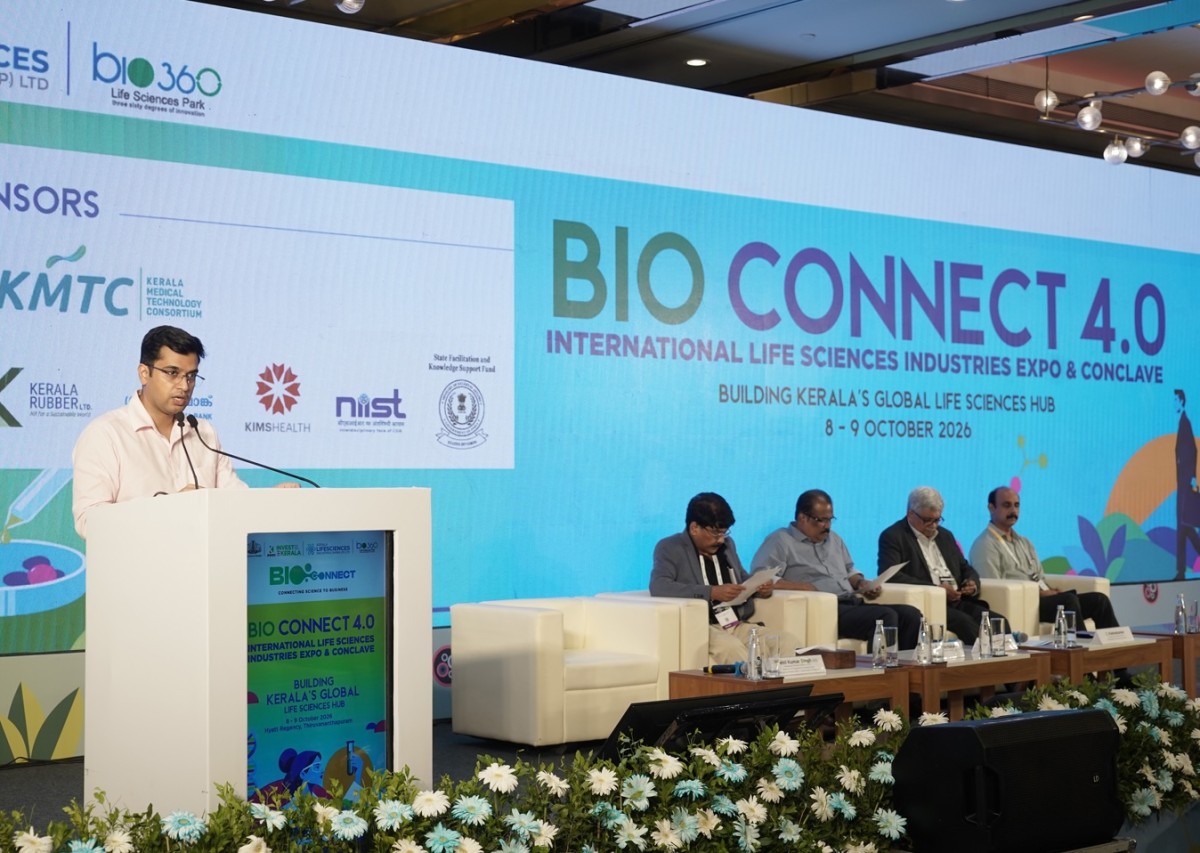
Bio Connect 4.0 once again highlighted Kerala’s potential in the life sciences sector. Photo courtesy: MD Niche
 By Hari Kumar, on October 13, 2026
By Hari Kumar, on October 13, 2026
By Hari Kumar, on October 13, 2026
Bio Connect 4.0, the fourth edition of Kerala's life sciences conclave, held last week in Trivandrum, again showcased the state's growing sector. The turnout lent it some weight, with more than 600 delegates and over 45 exhibitors taking part.
Speakers at the two-day event emphasised regulatory enablement, stronger R&D inputs, and tighter academia-industry collaboration. Authorities held up examples like Bio360 Park at Thonnakkal, Trivandrum, as proof of their intent to nurture an ecosystem that furthers the state's progress in the sector.
Several tie-ups that could potentially bring investments worth 713 crore rupees were also announced. But having read a recent report on the gap between announcements and actual realisation, it may be prudent not to headline that as the outcome of the event. One way to raise the credibility of such pronouncements would be to show the progress of the tie-ups unveiled the previous year.
More than what was discussed and displayed at the event, the real proof of Kerala's potential perhaps came in the Stanford/Elsevier top 2 percent scientists list, which came out at the same time. Aswathy Udayan, co-founder and CTO of Accubits Invent, who was a delegate at the event, was among those on the global list.
The list ranks researchers by how often other scientists cite their work and is not an award. Scientists like Aswathy can retain their place only if they keep advancing their work.
Undervalued Assets: She says the bigger difficulty for researchers in India is how their work is valued. Researchers are often considered overly qualified by the private sector and often don't get hired for jobs. The value of research “remains unappreciated and acts as a deterrent for youngsters who may want to choose that path.”
A good researcher, in her view, needs a wider vision to turn information into value. “But such an approach is not encouraged as many characterise this as lack of focus in the core area,” she said. Still, Aswathy has managed to scale new heights.
Sreeraj Gopi, a top molecular biologist, is another example of such Kerala-rooted global expertise. He too has figured on the Stanford/Elsevier list for multiple consecutive years, and his work is cited in hundreds of publications every year.
Leaving opportunities abroad behind, he came home and founded Molecule Biolabs in Koratty. The company reports a turnover above 100 crore rupees and 75 employees. He was also on the conclave's panels, offering ideas on how the state should move ahead.
What stands out is that both reached the top despite an ecosystem with few comparable knowledge centres, in Kerala or elsewhere in India. They got there on determination and hard work.
The next generation is following. Students from TKM Institute of Technology showed prototypes at the conclave, including a muscle fatigue detector for underwater divers, while Rajagiri College of Social Sciences, Kalamassery, brought seaweed and mushroom products.
Scientists who have excelled in their fields, youngsters with innovative startups, and mentors and researchers based in Kerala would together help attract the other components of a vibrant ecosystem, such as funding and high-tech facilities.
Route Change: For most young researchers who meet the same obstacles, the practical answer has been to leave. The usual route runs overseas, mostly to the US, where labs, funding and mentors are easier to find. Kerala has long exported talent this way, from nurses to engineers to scientists.
That may now be changing. Anyone weighing a career in an American institutions is looking at a very different mood from a few years ago.
On October 8, the day the conclave began, the US Labor Department suspended eight companies, including Indian firms Infosys, TCS, Wipro and HCL, from the Permanent Labor Certification programme (PERM), a key step towards a green card, with Vice President JD Vance accusing them of using the system to bring in “indentured servants”.
These rules do not target scientists, and the suspension hits tech and IT services firms, not laboratories. But Indians waiting for green cards are now looking over their shoulders, and the language has unsettled the wider Indian professional community in America. That mood will matter to experienced professionals as well as young scientists deciding where to build a career.
Nothing yet shows people rushing back. But if some talented minds begin to rethink their futures abroad, a region like Kerala, with a long record in education and knowledge, has a chance to hold on to some of them, provided it has something to offer.
Early Start: Attracting life science talent needs more than just roots in Kerala. It needs an ecosystem that helps them pursue their line of work. Bio360 Park is a push in that direction, and it already houses a virology institute and other facilities.
Many startups are said to be lining up for space, and the park fits the national push in drugs, pharmaceuticals and medical devices. It is a notable government move, and KSIDC managing director Snehil Kumar Singh spoke at the conclave of further facilities and policies planned.
Research and facilities are key, but startups also need other kinds of support. The job of a dedicated park is to leave startups free to work, and not to burden them with land record hurdles, and other red tape woes.
That is the part facilitators and dedicated parks in different sectors have not fully delivered in Kerala, and, according to some of its occupants, Bio360 seems to be heading the same way. They point to file-pushing and delay in ensuring even basics such as proper roads and lighting.
Past Lessons: Kerala has been here before. It often moves first, then watches other states overtake it. Techno Park in Trivandrum was an early first-mover that others later outpaced. Other states may have had more land, money and connectivity, but the pattern is hard to miss.
Critics say government platforms set up to nurture entrepreneurs often behave like interrogation centres instead of hand-holding agencies. Even some of the staff, say founders, throw up their hands in frustration at the bureaucratic maze.
Perhaps the state should build a management system modelled on the Cochin International Airport Limited (CIAL) for dedicated parks that draws on professionals who have travelled this path, instead of the old bureaucratic machinery, which tends to reproduce the habits it knows. The aim should be proactive help for startups, not just real estate management.
Kerala’s best work is already travelling the world without help. But top talent thinking of coming home needs something more: actions that speak louder than words and an ecosystem that works for them.
Road to another experiment
If AI comes, can robotics be far behind? That was the thought that came to us when Kerala Police announced that they were exploring the use of robots for traffic management. As humanoids appear on social media reels doing everything from making omelettes to boxing with human opponents, many are hoping to join the rush. It will be amusing to see where they plan to place the robots, given that bikes, cars and three-wheelers are already jostling for space on our roads.
Still, it is good that our policemen are such forward-looking people. Hopefully, this will not end like the AI traffic cameras that were launched with great fanfare a couple of years ago. The implementing agency, Kerala State Electronics Development Corporation (Keltron), said recently that it had suspended the operation of the AI-enabled automated traffic enforcement system over massive dues. The arrears amounted to 90 crore rupees, according to Mathrubhumi.
The dream job of watching cricket
Watching cricket and making money might sound like a dream job, but that is what US-based AI firm Mercor is offering. According to a job posting, selected candidates will follow live international T20 matches and ask AI assistants the kinds of questions cricket fans would typically have while watching a game. They will then assess the responses for accuracy, usefulness and presentation. The company is reportedly offering 20 US dollars (approximately 1,900 rupees) an hour for the role, says Moneycontrol. A report by Ken last month said several other firms are also in the field, most of them supplying material to illegal betting sites.
A tiny drone that sails home
Researchers at the Singapore University of Technology and Design have built a small sailboat drone called Albatross, which can be dropped from an aircraft or another drone. It spins like a falling maple seed, slowing its descent enough to land gently on the water without landing gear. Once afloat, the same rigid wings that helped it glide become sails, while a tail-like rudder that swishes from side to side provides propulsion. The craft weighs just over a kilogram. The team says it can be deployed more than 100 km from its starting point and sail back to shore. It is designed for urgent tasks far out at sea, such as tracking oil spills.
Bot your papers?
“Can I see your ID, please?” is a question we humans are used to hearing. In China, AI digital avatars are about to hear that question too. A Beijing pilot project is issuing them ID cards with a name, birthday, address and facial features, allowing them to hold digital currency wallets and sign commercial deals. Yuri, a one-year-old virtual idol, was among the first recipients. With more than 1.3 million firms in the business, the registration office has its work cut out. Supporters say the cards will help curb scams by tracing avatars back to their companies.
