
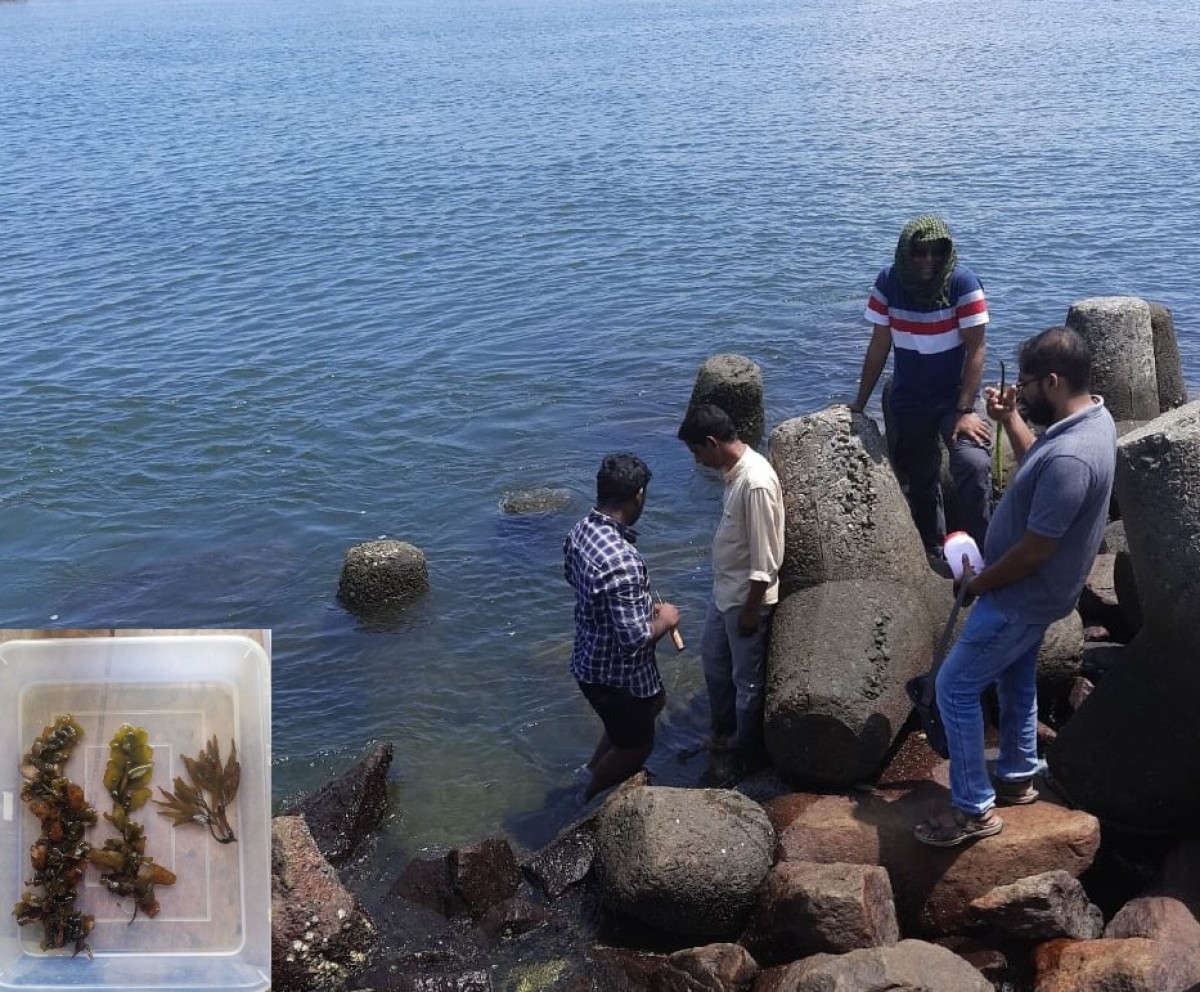
Research team collects seaweed species from a coastal area of Kerala. Inset: some of the species found in Kerala. Handout photos
 By Hari Kumar, on July 07, 2026
By Hari Kumar, on July 07, 2026
By Hari Kumar, on July 07, 2026
Fish has long been a favourite on the Malayali dining table, thanks to Kerala’s long Arabian Sea coastline. But researchers now say another nutritious marine resource has been quietly growing along those same shores for centuries, almost entirely overlooked: seaweed.
A 2023 survey commissioned by the Kerala State Biodiversity Board and carried out by Government Women’s College, Trivandrum, documented more than 100 species of seaweed along Kerala’s coast.
Many of them are edible and suitable for developing value-added products ranging from foods to cosmetics. Countries such as China, Japan and South Korea have built thriving industries around seaweed.
Kerala, the researchers believe, possesses much of the same natural advantage but has barely begun to tap it.That untapped potential has now produced its first tangible technological breakthrough.
Researchers led by Associate Professor Shyam Kumar of the Women’s College Botany Department recently received an Indian patent for an antibacterial body wash made from extracts of two seaweed species.
The patent is the latest outcome of years of research that has also produced seaweed-based foods, soaps and cultivation techniques aimed at creating new livelihood opportunities for Kerala’s coastal communities.
Ironically, despite Kerala’s push for a knowledge economy, the researchers cannot utilise the patent for commercial purposes because of regulations for government arts and science colleges. Unlike engineering colleges, the faculty members of these colleges are classified as gazetted officers who are barred from pursuing commercial activities.
Marine Resources: But for Shyam Kumar and his team, the patent represents something much larger than a single product. It is proof that Kerala’s neglected seaweed can be transformed into technologies with commercial potential.
Their journey began with a simple question: exactly how much seaweed does Kerala possess?
The Biodiversity Board sanctioned around 10 lakh rupees after finding that existing records relied on historical observations and were oblivious about the state’s present-day seaweed diversity.
A team of researchers travelled from Kasaragod to Trivandrum, collecting seaweed along Kerala’s coastline.One of the expedition’s key members was Abhin Lal, a marine biology student from Pondicherry University and a native of Kovalam, whose swimming skills proved just as valuable as his scientific training while collecting samples from rocky coastal stretches.
The survey documented over 100 species of seaweed, with particularly rich growth around Thirumullavaram in Kollam and Kodikal in Kozhikode. According to the researchers, nearly 90 percent of the species they documented are edible after suitable processing.
Beyond their commercial value, seaweeds are increasingly attracting global attention for their environmental benefits. They absorb carbon dioxide, provide habitats for marine organisms and help protect coastlines from erosion.
The discovery of such large seaweed on Kerala shore has convinced Shyam Kumar that the state was sitting on a valuable but largely ignored natural resource.“We have the biodiversity,” he says. “The challenge is to find practical ways to use it.”
Wooing Malayalis: Identifying edible seaweed turned out to be the easier part of the project. The bigger challenge was finding ways to convert it into popular snacks as seaweed has never been part of Kerala’s traditional diet.
Shyam Kumar then teamed up with his colleagues at the Home Science Department at his college to develop simple processing techniques that could reduce the characteristic smell of seaweed while improving food safety. The Biodiversity Board’s directive was to develop methods that ordinary households could replicate without specialised equipment.
After numerous trials, the researchers developed seaweed-based biscuits, cutlets and noodles. They even experimented with seaweed wine as another possible value-added product.
“Even a slight odour can discourage people,” says Shyam Kumar. “We had to work on recipes that people would actually want to eat.”
The researchers also paid close attention to food safety. Samples collected from relatively unpolluted coastal areas showed no heavy metal contamination, although Shyam Kumar says testing would remain essential before any large-scale commercial production.
Beyond food: The team’s work extended well beyond the kitchen. Working with the Chemistry Department at the college, the researchers began studying whether locally available seaweed extracts could be used in personal-care products.
One formulation, using extracts from the seaweed species Sargassum and Ulva, showed promising antibacterial properties. The team made soaps and body wash with the material to test its viability.
The first volunteer to try these products was the college’s former principal, Anuradha VK. Only after she gave the feedback was it made available to teachers and later distributed among students, whose feedback helped refine the formulation.
The composition used to make the body wash has now been granted an Indian patent.
The Chemistry Department also developed an affordable seaweed-based soap using locally available materials, whereas such products cost hundreds of rupees in the market.
For Shyam Kumar, these products are not intended as laboratory curiosities but as technologies that could eventually be adopted by entrepreneurs and self-help groups.
Coastal livelihoods: The researchers believe the greatest opportunity lies not in large factories but in decentralised production.
After visiting the seaweed research facilities at Mandapam in Tamil Nadu, Shyam Kumar returned to Kerala and built an experimental floating cultivation platform using bamboo and plastic containers. He says his experiment has convinced him that small-scale cultivation methods could work under Kerala’s conditions.
They are now experimenting with nutrient formulations and controlled growing systems with artificial seawater that could eventually allow seaweed to be cultivated in household compounds.
Such an approach, Shyam Kumar believes, could provide supplementary income for women in fishing communities, particularly during the monsoon months when fishing activity declines.
“It doesn’t have to begin as a large industry,” he says. “If families can grow seaweed on a small scale and convert it into value-added products, it can become another source of income for coastal area women.”
Still at Sea: Yet none of the team’s patented or prototype products has reached the market.The obstacle is not scientific but regulatory.
“I told the Biodiversity Board that I was willing to transfer the intellectual property to them,” says Shyam Kumar. “But since the patent is in my name, they also saw practical difficulties. Right now, all we can do is keep the IP in a file.”
The researchers say they have recently taken up the matter with the authorities and the concerned minister who had visited the Women’s College recently and they have promised to look into the matter.
For now, Kerala’s seaweed story remains one of unrealised promise. The state has mapped an abundant marine resource, researchers have demonstrated its commercial potential and even secured patents.
The next challenge lies not beneath the Arabian Sea, but beneath layers of regulations that keep those promising ideas from reaching the marketplace.
Sri Chitra device back in market
Ceridrain, a device developed by the Sri Chitra Institute for Medical Sciences and Technology (SCTIMST) to treat hydrocephalus by draining excess brain fluid, is set to re-enter the Indian market. Its manufacturer, HLL LifeCare, has received regulatory clearance from the Central Drugs Standard Control Organisation to relaunch the product. The Ceridrain hydrocephalus shunt is a biocompatible system that drains excess cerebrospinal fluid from the brain into the abdominal cavity, where it is naturally reabsorbed.
The technology was transferred to HLL LifeCare in the early 1990s, enabling the manufacture of an affordable and reliable hydrocephalus management solution. But somewhere along the way, production ran into difficulties and was discontinued in 2021 due to “various business and operational reasons.” In many ways, Ceridrain’s journey reflects the challenges faced by Indian medical device manufacturers when producing low-volume products that must compete with established multinational brands.
A new way to raise the bar
Walking into your local bar for a beer and a chat is perfectly normal. But expecting to hear a discussion on bat ecology, neuroscience or rocketry is something else. That, however, is exactly what a Bangalore-based startup, Pint of View, is organising. Founders Harsh Snehanshu, Shruti Sah and Meghna Choudhary say they attract hundreds of paying attendees who would rather spend an evening engaging with ideas than making small talk. We think it is a great idea. At the very least, it gives you a more scholarly excuse to visit the pub.
Cyborg roaches now head underwater
Remember the cyborg cockroaches developed by Nanyang Technological University in Singapore? They are now getting a diving suit that will allow them to go underwater and explore flooded areas. The cyborg insects could eventually assist with infrastructure inspections, emergency response and other tasks in confined or hazardous environments. Researchers say the diving suit will enable the cockroaches to survive and move in underwater and low-oxygen environments for up to three hours.
When birds recycle modern warfare
War has always accelerated technology. The Ukraine–Russia conflict is proving no exception. But the latest story from the battlefield suggests the innovations are now influencing more than just humans. After a Russian strike brought down a tree in Ukraine’s Donbas region, a songbird’s nest was discovered woven almost entirely from fibre-optic cable. The strands are believed to have come from fibre-optic FPV drones. As the video shows, the birds seem to have excellent engineering instincts. They may not understand drone warfare, but they clearly know good construction material when they see it.
