
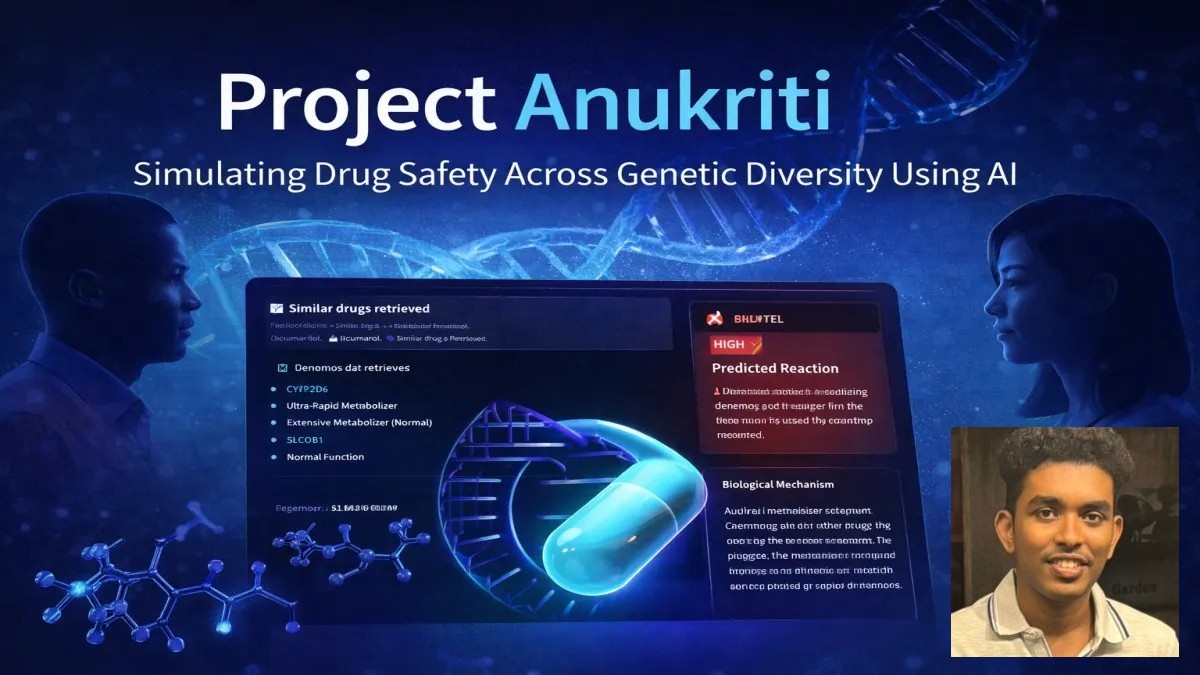
Karunagappally Engineering College student Abhimanyu RB (inset) and his team were among the winners of the AWS 10,000 Aldeas Competition. Handout image.
 By Hari Kumar, on May 19, 2026
By Hari Kumar, on May 19, 2026
By Hari Kumar, on May 19, 2026
Ten thousand entries from over 115 countries made it one of the largest developer competitions Amazon Web Services has ever run. When the AWS 10,000 Aldeas Competition narrowed its field to a thousand, then fifty, and finally twenty teams over a few weeks, one Kerala student team was still standing.
The platform they created, Anukriti, is an AI-powered platform designed to tackle a problem that modern medicine has quietly struggled with for decades: the lack of genetic diversity in drug trials. It was picked for the Innovation Award category, a round in which winners were chosen by an AWS expert panel based on technical innovation, implementation quality, and market impact. The entry won 10,000 US dollars in cash and 1,000 US dollars in AWS credits.
The team behind Anukriti is not from one of Kerala’s marquee engineering campuses or noted research institutions. They come from colleges that rarely feature in conversations about Kerala’s startup elite. At the centre of the team is Abhimanyu RB from College of Engineering, Karunagappally. His teammates included Atul Alexander, Johan George from his own college and Aagneye Syam from College of Engineering, Pathanapuram.
Their colleges in the Kollam district lack the legacy and resources of top-tier engineering institutions. The students themselves also came from ordinary middle-class families, without the financial cushion that computationally intensive AI research projects often require. They found each other the way many ambitious students outside Kerala’s elite college circuit often do – through hackathons, tech events organised by TinkerHub Foundation and informal peer-learning communities.
Their shared obsession eventually converged around healthcare, genetics and AI. What they built has been recognised through the AWS award. The Anukriti team has also been shortlisted by two international accelerators – Base44, an AI application builder acquired by Wix for 80 million US dollars, and Zerobase, an online startup school built by alumni of YC. Neither shortlist guarantees a cheque in the bank, but both are signals that the idea has managed to cut through the noise.
Hidden Problem: The problem Anukriti is trying to solve sits at the uncomfortable intersection of medicine, genetics and geography. Around 90 per cent of drug candidates fail during clinical trials, and a significant share of those failures involve adverse drug reactions that pre-clinical testing failed to detect.
One major reason is genetic variation. Human bodies do not process medicines uniformly. Enzymes responsible for metabolising drugs vary across populations, yet much of the genomic data used during early-stage drug development still comes predominantly from populations of European ancestry.
When medicines developed using those datasets are administered to South Asian, East Asian or African populations with different genetic profiles, unexpected – and sometimes serious – reactions can follow.
“Clinical trials often operate under the assumption that all bodies process drugs uniformly. This is not the case,” says Abhimanyu. “Drug metabolism can vary greatly across different genetic populations, yet many trial designs rely on genomic data that reflects only a small segment of global diversity. This oversight can lead to predictable harm that is only recognised after the fact.”
Anukriti aims to identify those risks before they become real-world problems. The platform uses AI to simulate how a drug interacts with an individual’s genomic profile before physical trials even begin.
Digital Power: Researchers can input a drug compound and genomic dataset into the system and receive a structured risk assessment quickly. The platform flags potential adverse reactions, identifies the likely biological mechanism and maps possible clinical implications computationally – without waiting months for conventional testing cycles.
“We analyse patients’ genomic data prior to their enrollment in clinical trials, identifying drug-gene risks across diverse ancestry populations automatically, before any potential harm occurs,” Abhimanyu says.
The ambition is not to replace traditional drug trials, but to add a predictive layer before the most expensive and dangerous stages begin – helping researchers identify whether a drug is likely to behave differently across populations long before those risks emerge in hospitals or trial centres.
Cloud Credits: The Anukriti team still has a long way to go, but winning the Innovation Award at the AWS global competition shows that they are on the right track.
It was not their first breakthrough either. The project had earlier won recognition at the Amazon Nova AI Hackathon. Across various developer competitions, the team has also accumulated nearly 100,000 US dollars worth of cloud credits from companies including Microsoft Azure and additional support from MongoDB.
For a bootstrapped student team without institutional backing, these credits are not symbolic trophies. They are the computational infrastructure keeping the platform alive. AI systems handling genomic analysis require enormous computing resources, and for early-stage builders, cloud credits often become the difference between an idea remaining theoretical and becoming operational.
Beyond Classroom: None of this came easily. Abhimanyu says the deeper he moved into engineering education, the more he felt curiosity itself becoming secondary.
“Campuses hardly nurtured such interests,” he says. “Priorities shifted to rote learning, marks, and attendance during semesters.”
That gap became increasingly obvious as the team worked on Anukriti. Pharmacogenomics is an intensely specialised field, and none of the team members came from formal biotech research backgrounds. They had no dedicated mentors walking them through genomic modelling or drug metabolism pathways. Most of the learning had to be self-driven.
“Then it was a lonely journey of diving down the rabbit hole to explore fields of knowledge I didn’t even know existed,” says Abhimanyu. “Scouring the internet, collecting books on subjects and studying from them, seeking out whoever can help – these were the only way out. But I was determined and kept digging. Fortunately it all came through.”
Ecosystem Gap: What sustained the team most, however, was peer learning. Abhimanyu later became the campus lead of TinkerHub at his college, and the team frequently travelled to Kochi to access Tinkerspace facilities, mentorship and networks through the organisation.
“For students, peer-to-peer learning groups hosted by platforms like TinkerHub and MuLearn are probably the only way to expand their horizon,” he says. “An ecosystem connecting academia with research organisations or R&D departments of private companies is almost non-existent. It is often networking done during events like hackathons that lays the ground for future projects.”
That observation cuts into a larger issue within Kerala’s technology ecosystem. The state has spent years speaking about innovation, startups and building a knowledge economy. But outside a handful of top-tier campuses, many engineering students still operate inside systems optimised for job placement statistics rather than research or experimentation. Peer-driven tech networks have increasingly become the real innovation pipelines for students trying to build ambitious projects from smaller towns.
Challenges Ahead: The team is now focused on pushing Anukriti beyond competitions and into real-world deployment. Their next phase involves improving the platform’s predictive accuracy, expanding genomic coverage and refining the scalability of the system. They are also exploring mentorship opportunities, accelerator support and collaborations that could eventually connect the platform with pharmaceutical and healthcare ecosystems.
For Kerala’s broader tech ecosystem, the story carries another message. Some of the state’s most ambitious technology projects may not emerge from glossy campuses, heavily funded labs or established startup corridors. They may emerge from smaller engineering colleges, late-night Discord calls, and students teaching themselves subjects nobody around them fully understands yet.
This team found their way. Somewhere in Kerala’s smaller colleges, others may still be looking for a door.
Rise of robotic builders
It is inevitable that labour-intensive sectors like the construction industry will see a wave of robotic solutions emerge. So it is no surprise that Bengaluru-based construction robotics startup Flo Mobility has raised 21 crore rupees (2.5 million US dollars) to expand its autonomous robotics business. Founded by Manesh Jain and Pratik Patel, the startup's flagship product, the Flo Hauler, is a battery-powered autonomous robot designed to transport heavy construction materials. The company says the new funding will fast-track its entry into international markets, particularly the Middle East.
The deployment of robotic helpers is now happening in space too. China says its planned Chang’e-8 mission will feature a “Moon mechanic” – a robot that will act like a construction worker to help assemble and lug equipment around once deployed. Developed by Hong Kong University of Science and Technology (HKUST), the robot weighs around 100 kg and has four wheels to move across the rough lunar surface. Unlike previous moon rover-type robots, this new machine comes with a pair of robotic arms for handling and manipulating tools.
Dhruva Space lands grant
Bengaluru-based spacetech startup Dhruva Space says it has secured a grant worth 105 crore rupees (10.9 million USD) through the Research, Development & Innovation Fund announced by New Delhi. The funding will be used to build a production-ready 500 kg-class satellite platform for large-scale deployment of constellations across telecom and national security applications. The platform is also expected to support GEO- and MEO-class missions in the future. Founded in 2012, Dhruva Space provides end-to-end space engineering solutions, including small satellites, ground stations and mission support.
Claude powers new coders
There has been plenty of buzz around Anthropic’s Claude and its ability to help even non-coders build software, though many remain sceptical. But the company says the winning apps at its recent hackathon were created by people with little coding experience. The global competition selected 500 builders from over 20,000 applicants and gave them a week to build with Claude Code. Winners included a lawyer who built a permit-processing app, a doctor who created a voice-based clinical simulator, and a teacher who developed an educational coding platform. The top prizes went to participants from Istanbul, the French Alps, and Chile – not traditional AI hubs like Silicon Valley or London.
Private jet doomsday alert
If the apocalypse is coming, how will we know? Apparently, by checking whether billionaires are suddenly taking off in private jets. There is now a platform called Apocalypse Early Warning that claims to do exactly that. Its founder says that if the super-rich sense a nuclear winter or similar catastrophe is imminent, they are likely to fuel up their jets and disappear into the horizon. The site tracks how many private planes are currently in the air compared with normal traffic levels for that time and day. There are five alert levels – and once it hits five, maybe start worrying about canned food and underground bunkers. Unfortunately, the platform does not appear to offer guidance for people without private jets. Our recommendation: switch off the computer, call a few friends, and head to the nearest watering hole.
