
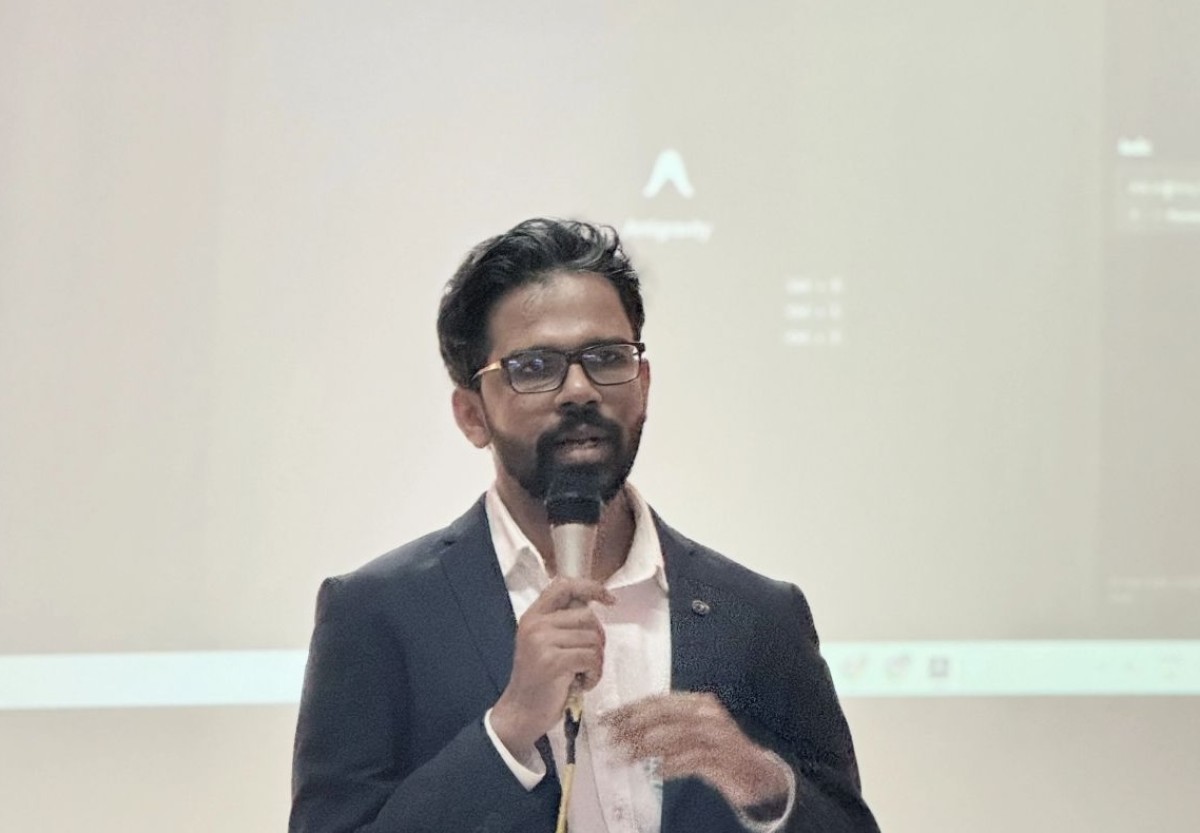
Founder of Convai Innovations, Nandakishore, has built an AI model that has attracted a lot of attention. Photo courtesy: LinkedIn
 By Hari Kumar, on November 10, 2026
A young engineer from Kasaragod is attracting attention from AI enthusiasts and researchers around the world with a different approach to artificial intelligence. Nandakishore Mukkunnoth, a graduate of Government Engineering College, Kannur, has developed Laya, an open-source AI model designed to help machines make decisions without having to generate lengthy responses.
The approach has acquired fresh significance with the arrival of Jev, a model built around a similar concept by TypeSafe AI, a Silicon Valley-based startup co-founded by Diogo Almeida, a former OpenAI researcher who helped develop ChatGPT.
Jev does not produce conventional text responses. Instead, it returns probabilities or what its developers describe as calibrated decisions. Launched in September 2026, it quickly caught the attention of the AI community. TypeSafe AI subsequently raised 870 million US dollars at a valuation of 7.5 billion US dollars.
Despite the similarities in their broad approaches, the two projects had very different beginnings. Jev arrived with the visibility and backing of a Silicon Valley startup. Nandakishore, meanwhile, had been pursuing a similar idea independently, with little of that attention or resources.
In March 2025, he published his first research paper on the approach, making the model weights and training dataset publicly available. He says the work attracted little attention at the time. The contrast becomes even sharper when you consider his background. Unlike the founders of the Silicon Valley startup, Nandakishore came from a family whose daily income was just 200 to 300 rupees.
The youngest of three children born to KV Thampan, a mason, and Kalyani, a beedi worker, he had secured admission to IISER Mohali. But the fees were beyond what his family could afford, having already stretched its resources to educate his elder siblings, one in medicine and the other in homeopathy.
Open Route: Nandakishore instead studied electrical engineering in Kannur, but did not limit himself to the classroom. He immersed himself in hackathons, conferences and independent research. He even filed provisional patents for graphene-based hybrid solar panels, partly to understand how intellectual property worked. Later, he also became involved in the medical devices sector and founded his startup Convoy Innovations.
When Jev attracted attention in September, Nandakishore took to LinkedIn to point out that he had been working on a similar idea the previous year.
He revisited his earlier research, refined the model and released it as Laya under an open-source licence. It soon climbed Hugging Face’s trending charts, drawing attention from technology enthusiasts and researchers, several of whom began building their own fine-tuned versions.
Different Path: Rather than eyeing the big money that such popularity could bring, Nandakishore remained focused on the open-source community. For him, it was how he wanted the model to grow. He believes developers often make the mistake of trying to monetise an innovation before building a sizeable user base.
“What many do is put a price on their innovation and then tried to grow distribution. But if you adopt open source way, you can build up distribution fast and then when the product becomes widely used, you can find ways to monetise it. When you have a large number of users, even a low price like one dollar can bring you a handsome reward.”
He sees this as a lesson India could learn from Chinese AI companies, which have used open models to build a broad user base.
“That is what Chinese models have opted for. Models like DeepSeek have chosen to go for open models instead of closed models of Silicon Valley. They use the advantage of higher number of users. India should also use that advantage, but the ecosystem wants most of the startups to look for returns quickly.”
Number Growth: The reach of Laya appears to support his belief in the power of open-source distribution. In a LinkedIn update, Nandakishore reported that the model had crossed 270,000 users within a little over a month of its creation.
It was being used on more than 35,000 Android phones and 17,000 Apple devices. The project had also attracted more than 34,000 stars on GitHub, over 3,000 forks and more than 150 contributors. Nandakishore’s LinkedIn page shows him regularly tweaking the model and engaging with AI users.
The community, he says, is not confined to established technology centres or wealthy countries.
“A lot of users are from India and even from countries which are not known as IT powerhouse, like Thailand and Indonesia. That is the strength of open source community. It attracts people from everywhere, not just developed societies.”
He believes India can support innovation in this space without having to match the enormous investments made in large language models.
“Finding hundreds of billions of dollars to develop large language models is a tough ask. But it is easier for countries like India to find a few hundred millions to encourage innovations that can have greater impact through models like Laya.”
Limited Compute: To understand why Laya has caught the attention of technology enthusiasts, it helps to look at how most AI systems work today. Large language models such as ChatGPT generate responses by predicting one word, or part of a word, at a time and gradually building sentences. This requires considerable computing power and energy, as well as expensive infrastructure.
Laya takes a different route. Rather than generating a response word by word, it selects an answer from a set of predefined possibilities and attaches a confidence score indicating how certain it is about its choice. In simple terms, it works more like a decision-making system than a conventional chatbot.
This does not mean Laya can do everything a chatbot such as ChatGPT can. Large language models can generate open-ended conversations, stories and explanations. Laya is designed for tasks where the possible answers are already defined and the system needs to identify the most appropriate one.
According to Nandakishore, the model can produce an output in just under 33 milliseconds using a single graphics processing unit (GPU), a powerful chip used for handling computing tasks. It also supports more than 100 languages.
The larger idea is to make AI smaller, faster and less dependent on large data centres. Nandakishore envisages specialised AI models running directly on devices such as mobile phones, robots, cars and medical equipment.
A Wider Opportunity: The emergence of Jev has given decision-making models considerable visibility. Jev has already attracted a large user base and substantial investor backing. Laya will have to establish its own place in a competitive field, and a similar underlying idea alone will not be enough to persuade users to switch. Finding data to improve its utility will remain a major hurdle.
Yet such models point to a broader possibility. The success of DeepSeek, for instance, prompted established AI companies to reconsider their pricing and development strategies. Models that offer faster or cheaper ways of handling specific tasks could add to that competitive pressure, ultimately benefiting users.
One such model emerged from Silicon Valley, backed by a well-oiled ecosystem capable of propelling it to the next level. The other came from a small-town researcher’s independent work and an open-source community.
Even the government agencies entrusted with supporting startups and develop AI technology in Kerala have yet to highlight Nandakishore’s journey.
Organic Growth: Nandakishore works as a researcher and founder of Convoy Innovations. His elder sister, homeopathy doctor M Archana, is a co-founder in their technology venture. Their eldest sibling, Dr M Anjali, is an assistant professor of Community Medicine at Kasturba Medical College in Mangaluru.
For a country like India, this is a story worth looking at more closely. One of Kerala’s distinctive social strengths has been the importance families across income levels place on education.
Even those with modest means often stretch their resources to send their children to college and help them build professional careers. A mason and a beedi worker raised three children who have gone on to build careers in technology, medicine and homeopathy.
That is the “Kerala Story” the rest of India should hear.
Kerala’s startup world gears up for Huddle
The 2026 edition of Huddle Global, Kerala’s premier technology showcase, opens at Kovalam, Trivandrum, on November 12. We look forward to the events lined up over the three-day gathering. One session that should draw attention worldwide features Mathias Lauda, racing driver and son of the legendary Niki Lauda. Sessions like these should take this year’s event to a new level.
India’s push to boost its manufacturing base continues apace. New Delhi has now approved 12 applications worth more than 7,500 crore rupees under the Electronics Components Manufacturing Scheme. The projects cover 10 product segments, including electronic components, supply chain products and capital goods, as the government seeks to reduce dependence on imports. They are spread across seven states – Gujarat, Karnataka, Madhya Pradesh, Maharashtra, Punjab, Tamil Nadu and Uttar Pradesh.
Pune robotics startup sets sights on America
Good to see Pune-based Peppermint Robotics, which develops cleaning robots, extending its footprint in the US. The company says it plans to set up an assembly line in North America over the coming months, complementing its existing Pune facility as it expands its workforce and global operations. Its heavy-duty cleaning robots are used in factories, hospitals, airports, malls, warehouses, hotels and universities. Incubated at IIT Bombay, Peppermint has secured funding of 100 crore rupees and is looking to expand its global market presence, competing with Chinese firms that dominate the robotics market.
US data centre projects face opposition
The AI data centre boom hit a massive roadblock during the 2026 US midterm elections, as voters overwhelmingly rejected local expansion plans. NBC exit polls revealed that 76 percent of voters oppose having data centres in their own communities, while 57 percent believe AI will ultimately harm society. With Goldman Sachs estimating that 45 percent of planned US data centre capacity faces potential freezes, even Elon Musk mused that building data centres in space looks appealing right now. With a shift in politics and Democrats prepare to lead AI regulation hearings, the era of a hands-off federal approach to US AI infrastructure appears to be over.
App times loo visits for movie fans
Ever sat in a theatre, legs crossed, praying for a slow scene so your bladder doesn't burst before the climax? Enter RunPee, the app that mathematically optimises your toilet breaks so you never miss a plot twist while answering nature’s call. With 231,000 desperate moviegoers across 24 countries using it, this bizarrely brilliant tool has turned bladder control into a 1,800 US dollars-a-month business. It gives you colour-coded green windows for safe exits, red flags for “hold it unless it is emergency” moments, and a stopwatch timer to sync with the film. Tech in the film world is nothing new, but now it’s literally seeping into the audience.
