
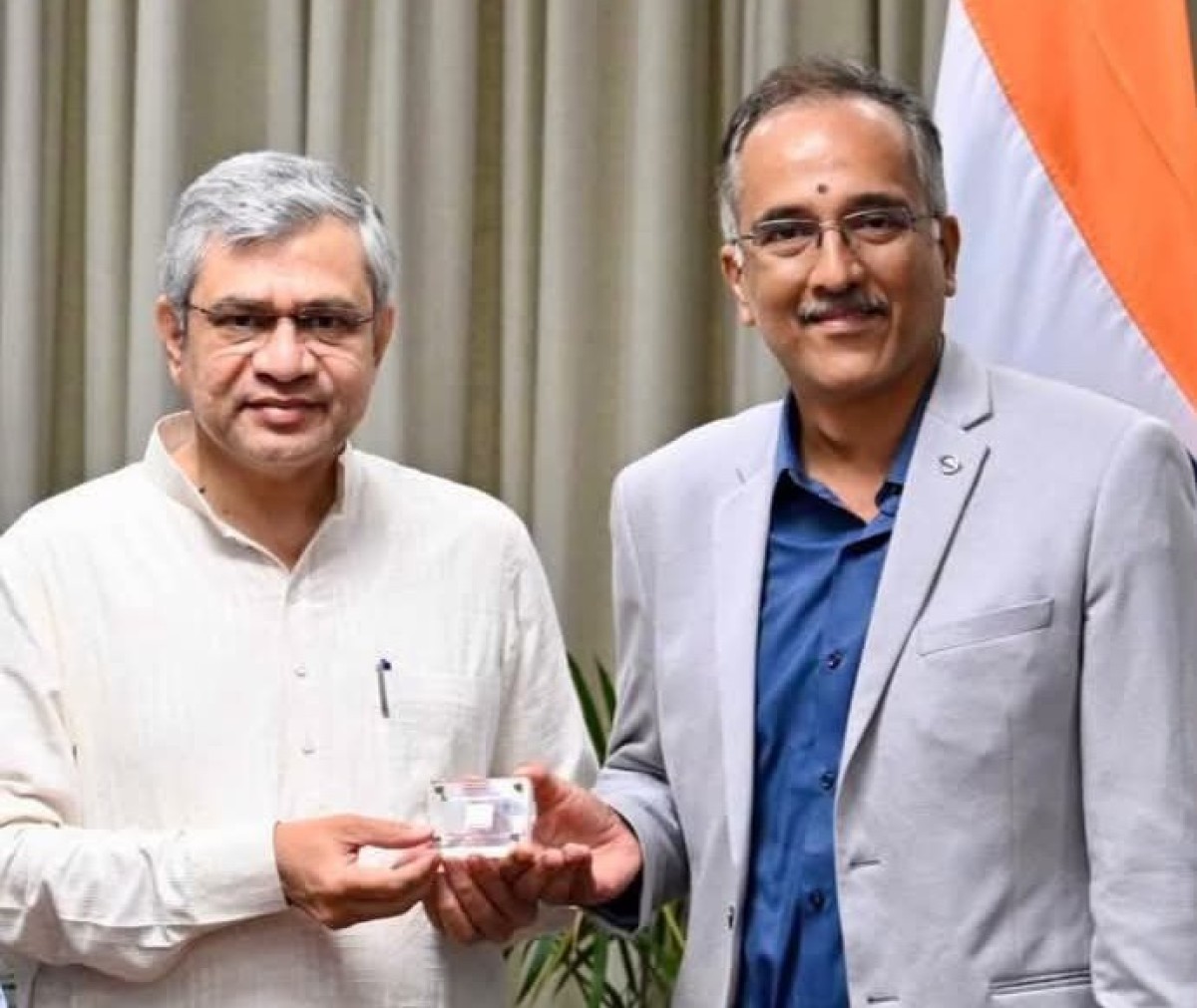
Union minister Ashwini Vaishnaw (left) and Netrasemi founder Jyothis Indirabhai launch India’s first indigenous artificial intelligence chip, the A2000. Handout photo
 By Hari Kumar, on June 02, 2026
By Hari Kumar, on June 02, 2026
By Hari Kumar, on June 02, 2026
It’s a proud moment for India's deep-tech sector that Trivandrum-based Netrasemi has launched the country’s first indigenous artificial intelligence chip, the A2000. The chip has successfully completed testing and has been declared production-ready by the company, marking India’s entry into one of the world’s most coveted technology markets.
Kerala, too, can take pride in the achievement. Netrasemi is founded by Jyothis Indirabhai, Sreejith Varma and Deepa Geetha – all from Trivandrum – and the startup is staffed largely by engineers from Kerala. Union minister Ashwini Vaishnaw hailed the announcement by Netrasemi as evidence that New Delhi's design-linked incentive programme is producing results.
The A2000, to be manufactured by Taiwan Semiconductor Manufacturing Company (TSMC), “is only the beginning” as Jyothis points out. Netrasemi is also developing the A4000, a more advanced AI server chip expected to be ready by 2027.
The startup is simultaneously working on a second track closer to home through a collaboration with the College of Engineering Trivandrum (CET) that is helping train future semiconductor engineers. It is a remarkable development that has not received attention it deserves even inside academia or among the policy makers. (More on that below).
A Clear Edge: Netrasemi is targeting one of the fastest-growing segments of the semiconductor industry. The A2000 has been designed for edge AI applications, where artificial intelligence processing takes place closer to the device rather than in distant data centres. Smart cameras, industrial monitoring systems, autonomous machines and automotive applications can all benefit from this approach.
Processing data at the edge reduces delays, lowers bandwidth requirements and can improve privacy by keeping sensitive information closer to where it is generated. As artificial intelligence becomes embedded in more products and industrial systems, demand for specialised chips designed for such applications is expected to grow rapidly.
“When Netrasemi set out to design chips, our target was overseas markets. But during the last couple of years we have seen enough interest from the domestic market and we now consider India as a big market for our chips as more manufacturers are coming up,” says Jyothis.
The company’s ambitions extend beyond a single product. Early trials are already underway in sectors such as surveillance and automotive technology, while its broader roadmap suggests an intention to build a family of AI chips addressing different market segments.
Different Path: Such ambitions require patience and persistence because chip design is very different from software development. A software application can be updated repeatedly after release. A semiconductor chip cannot. Once a design is sent to a fabrication plant, it is effectively frozen. Engineers must then wait months for manufactured silicon to return before they can verify whether the design performs exactly as intended.
This stage, known as silicon bring-up, is often described as the moment of truth in semiconductor development. Many companies never successfully reach it. Netrasemi has crossed that hurdle, placing it among a select group of Indian startups that have demonstrated the capability to take a sophisticated chip from concept to working silicon.
Today, the company employs more than 90 people, most recruited locally and trained in specialised semiconductor skills. That number could double in the coming years as new projects get underway.
Training Ground: Yet the company’s significance extends beyond a single product launch.
Alongside the A2000, Netrasemi has been working with the College of Engineering Trivandrum (CET) on the R1000 AI and machine learning microcontroller aimed at the rapidly growing Internet of Things market. Developed under the Chip-to-Startup programme, the R1000 is set to become the first chip completed by an academic institution under the initiative, ahead of several better-known institutions in the country.
The project has given engineering students direct exposure to semiconductor design, an area that remains largely absent from standard university curricula. According to Jyothis, even with limited resources, the CET initiative has already helped produce hundreds of engineers who have gone on to find jobs in the semiconductor sector, including at companies such as Texas Instruments, Synopsys and AMD.
That experience may become increasingly valuable. Chips power everything from automobiles and medical equipment to satellites and defence systems, while the artificial intelligence boom is driving demand for specialised semiconductor talent around the world.
Wider Net: This assumes added significance as NITI Aayog’s recently unveiled semiconductor roadmap targets a semiconductor ecosystem worth 150 billion US dollars by 2035. One of its key goals is the creation of more than 100 advanced semiconductor design IPs over the coming decade, with talent development identified as a critical priority.
The R1000 – designed by Netrasemi together with CET students – offers a glimpse of the type of institution-industry collaboration that policymakers hope to encourage at a larger scale.
It also reconnects Kerala with a story that began decades ago at ER&DC, later known as C-DAC, where some of India’s earliest indigenous semiconductor efforts took shape.
Kerala’s Choice: Netrasemi’s achievement does not mean India has solved its semiconductor challenge. Building a complete semiconductor ecosystem remains a long and complex journey. But milestones matter.
The startup has demonstrated that a company built in Trivandrum can design sophisticated AI chips, take them through silicon validation and prepare them for production in one of the world’s most competitive technology sectors.
For Kerala, the implications are difficult to miss.
Huawei bets beyond Moore
The race for chip supremacy between the US and China continues unabated. Washington’s clampdown on the sale of extreme ultraviolet (EUV) lithography machines, which are crucial for advanced chip manufacturing, is now forcing a technological rethink in China. Huawei says it is looking at a new principle, noting that the industry can no longer rely on shrinking transistors for computing breakthroughs, a pattern known as Moore’s Law. It is looking at the Tau Scaling Law, which focuses on cutting the time it takes for signals and data to move through chips and computing systems. “Before winter 2026, we will bring the surprise … [a] big leap ahead,” says He Tingbo, chairwoman of the Huawei Scientists Committee.
The Huawei claim has not shaken Nvidia chief Jensen Huang, who remains confident that the company’s advanced chips will continue to rule the roost. He believes that TSMC's established market position and advanced manufacturing processes will continue to keep it ahead of competitors, including Huawei. But the fact that Chinese companies are yet to place orders for high-end Nvidia chips such as H200 must be bugging him.
A slam dunk for sports tech in Kerala
It is great to see Basketball League Kerala, which kicks off in Cochin on June 4, giving sports tech its due, something that is largely absent in India except in cricket and, to a degree, football. All 72 matches in the inaugural season will be broadcast through a professional five-camera setup with live commentary, powered by Wizsports.ai. The league is also building a digital performance archive by capturing detailed match statistics throughout the tournament. Those numbers are meant to help coaches spot player trends, understand team patterns, and support evidence-based development. The organisers say they will use video review and analytics, including a detailed breakdown of the finals, to show coaches how to study offensive and defensive systems, transition play, player movement, and decision-making. A slam dunk idea, we say.
China steals Tokyo spotlight
If you want proof of China’s growing dominance in robotics, look no further than the recent Humanoid Summit in Tokyo. Chinese companies stole the show despite Japan's long-standing reputation for technological excellence. Even the much-publicised air cargo handling humanoid unveiled in Japan recently was built by China’s Unitree. One notable exception at the summit was Honda, which returned to the spotlight 25 years after unveiling its Asimo humanoid. At the summit, it showcased a highly dexterous robotic hand capable of delicate tasks such as threading a needle and tightening bolts, underlining Japan’s enduring strengths in precision engineering. With an ageing population and chronic labour shortages, Japan is increasingly turning to robotics as a practical solution.
Monet triggers AI meltdown
Artist SHL0MS recently posted an image on X, claiming it was AI-generated in the style of Monet. Predictably, the comments filled with complaints about AI ruining art, creativity and humanity itself. There was just one catch: the image was an actual Monet. The artist later revealed the truth, having used it as an experiment to test people’s knee-jerk reactions to anything labelled “AI”. The moral of the story? Before declaring the end of civilisation, it might be worth checking whether you’re arguing with a machine – or a 19th-century French painter.
