
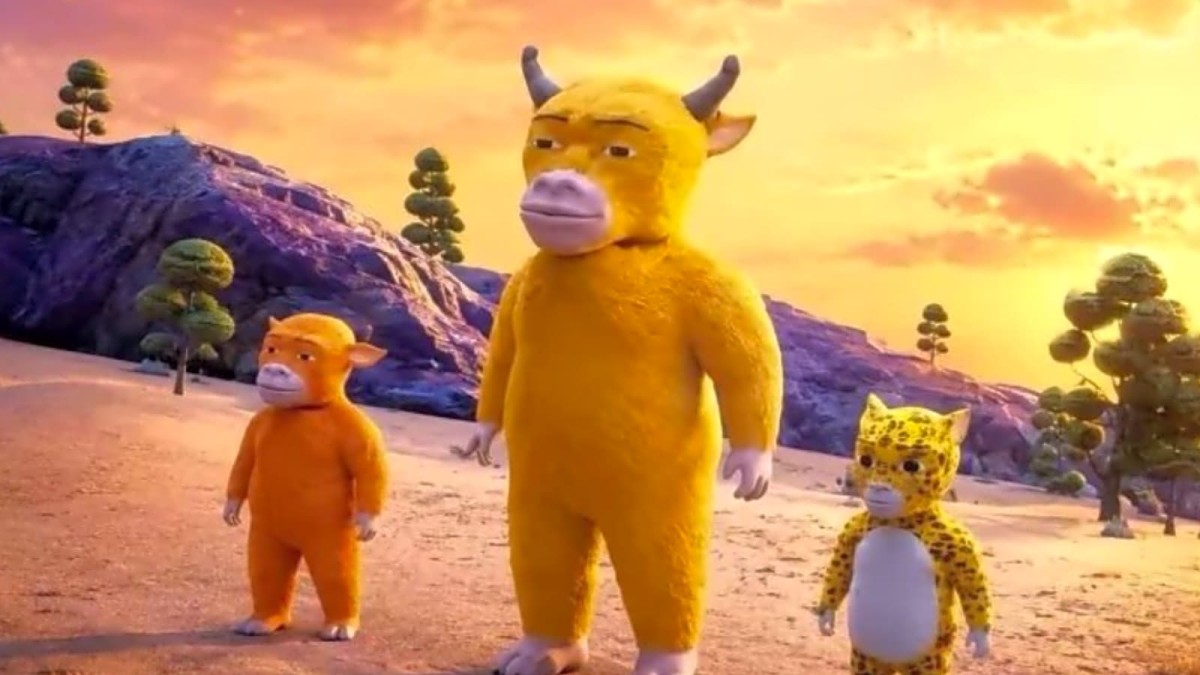
A clumsy homemade movie is a surprise hit in China, where AI and high-tech productions are dominating the entertainment sector. Social media image
 By Editorial Desk, on August 25, 2026
By Editorial Desk, on August 25, 2026
By Editorial Desk, on August 25, 2026
At a time when technology and artificial intelligence are drastically changing movie production, a crudely animated homemade film called Niu Lai (The Bull Comes) is smashing a few concepts and creating some unlikely box-office records in China.
Reports estimate the film was produced for less than 1,000 US dollars, although the exact figure is disputed. Everyone agrees it was a shoestring operation, made on second-hand equipment with no budget for promotion.
Its opening run was a disaster. It took in just 342 yuan (about 47 US dollars) on its first day and 7,700 yuan over its first ten days, from just a few hundred ticket buyers in a country of 1.4 billion people.
Then everything flipped. Memes about the movie started appearing on Chinese social media and it went viral. The movie’s box office has now surpassed 30 million yuan. Ticketing platforms predict it could reach 135 million yuan, making it one of the most profitable films ever made relative to its budget.
Family Project: Created over five years, the 86-minute 3D animated film – a simple story about a young calf finding its courage – was made by Xin Yumeng, a landscape architecture graduate, and his mother, Sun Lifang, who self taught the craft to help her son.
They registered the script in 2021 but didn’t get a public screening permit until 2024. After seeing the completed film, even their own distributor friend advised them not to release it in theatres.
Unlike standard blockbusters where credits roll for minutes, theirs are the only two names on screen – something that is now often greeted with applause in theatres.
Initial Shock: Early reviews didn’t just dislike it, they buried it. On Weibo, one reviewer wrote, “It’s not even a movie”, while another declared, “To call it bad is an insult to bad movies.”
Normally, a tiny film would simply vanish. Instead, about a week later, people started posting online about how bad it was – and the story flipped. Audiences initially bought tickets to laugh at the pixelated animation and clunky dialogue. Then they stayed to embrace it.
As the movie went viral, more theatres started screening Niu Lai. But they ran into a problem. The film’s only poster, a delicate ink-wash painting, had never been distributed to cinemas.
With no copies to display, theatres and moviegoers began drawing their own scribbly versions to match the film’s rough-hewn style, handing them out alongside professionally made posters for Christopher Nolan’s Odyssey and the new Spiderman movie playing in the same halls.
Audience Support: Going to see Niu Lai became a collective act of solidarity with an underdog – and perhaps with a growing resentment towards AI slop.
The film stands out in a Chinese entertainment market increasingly dominated by slick AI tools. Michael Berry, a professor of Chinese literature and cinema at the University of California, also links its viral success to China’s “lying flat” movement – a rejection of the country’s hyper-competitive rat race, where young people have pushed back against the pressure to constantly work, compete and achieve.
Commentators on WeChat have noted that despite its flaws, the movie offers a kind of “clumsy sincerity” that polished AI productions would struggle to replicate.
There is also a touch of financial superstition. Because “niu” means both cow and bull, Chinese stock-market investors have been buying tickets as good-luck charms for an upcoming bull market.
And the meme has found its way into tech culture too. In one viral AI-generated parody, baby Niu Lai trips over a stone and cries to his mother, who replies, “Silly child, that’s semiconductors. Even dogs won’t touch them” – a jab at the struggling Shanghai STAR Board chip sector.
Imperfection Sells: Niu Lai is more than a meme movie. It offers a snapshot of a generation craving authentic, handmade human effort in an era overwhelmed by digital perfection. As one popular online phrase puts it: “AI can never make a movie like this.”
Its reach beyond China also echoes last year’s Labubu phenomenon, when a mischievous plush toy became a global sensation far outside its original context. The Niu Lai meme has similarly begun travelling beyond China, with the state-funded Global Times reporting that organisations outside the country have picked it up.
In Malaysia, a blood donation centre in Johor Bahru used the story of Niu Lai in a humorous and inspirational social media message encouraging people to donate blood. The official TikTok account of Dutch railway operator Nederlandse Spoorwegen also joined the trend, using the meme in one of its posts.
Ripples Outside: These cultural tremors are unlikely to remain confined to China. The country has rapidly become a testing ground for AI-driven entertainment. ByteDance’s Seedance 2.0 and competing models are already flooding algorithms with hyper-efficient, machine-generated content.
Meanwhile, AI generatedmicrodramas have grown into a billion-dollar sector in China and are now reshaping Hollywood production strategies. Video giant Bilibili has also announced plans to expand globally with an English-language platform to challenge YouTube.
Against this backdrop, the grassroots explosion of Niu Lai may offer an early preview of the viewer fatigue that follows when entertainment becomes too automated.
As entertainment becomes increasingly automated worldwide, audiences may start craving the one thing all that technology finds hardest to manufacture – messy, unpolished human sincerity.
India’s space sector enters new orbit
The recent announcement by In-Space chairman Pawan Goenka that the Indian Space Research Organisation (Isro) is moving launch vehicle and satellite production to industry has set off a debate on the merits of the move. Goenka said the transition is already underway and will allow Isro to focus on research, advanced technologies, scientific missions and infrastructure that private companies may not be able to build on their own. But former Isro chief Madhavan Nair blasted the move, calling it “foolish.” He warned that handing over a launch centre to a private company would be like “jumping into a sea without knowing its depth.”
This comes as reports say a company founded by Elon Musk has again approached New Delhi for permission to operate a constellation of nearly 30,000 satellites at an altitude of 340–615 km in low Earth orbit. An earlier bid for such a constellation was rejected by India on technical grounds. The new constellation is expected to support newer technologies, including direct-to-device, or D2D, connectivity. India has been looking to open additional spectrum bands for satellite communications, prompting Starlink to submit a fresh application, the report said.
This AI gadget takes on potholes
A Bengaluru-based engineer, Gaurav Sen, has come up with a gadget that can locate potholes on the city roads, give you details about them and even identify the contractor responsible for the work, allowing you to take further action. The system combines a dashcam, GPS, an accelerometer and AI vision models, while also checking 2,900 government contracts to connect each pothole with the relevant road project. Gaurav Sen demonstrated the system in a video shared on Instagram in collaboration with ChatGPT India. Guess every city in India can use one.
Brain gadget from Zomato founder gets ready
Zomato founder Deepinder Goyal says his startup, which is making a device that monitors activity and oxygenation inside the brain, is ready to take orders. He says the device will be shipped before the end of 2026 as part of a limited launch edition. The gadget, named Temple, first became a talking point when Goel appeared with a small metallic wearable on his head during a podcast in January 2026. A month later, the project raised 54 million US dollars in its first funding round at a post-money valuation of approximately 190 million US dollars. Reports now say the gadget will be priced at around 75,000 rupees.
Robot beats Bolt and then goes nuts
China is flexing its robotics muscle again, this time by holding the World Humanoid Robot Games. The top performer so far has been Chinese smartphone maker Honor’s Lightning robot, which ran the 100m in 9.32 seconds, beating Usain Bolt’s human world record of 9.58 seconds. But clips of the race show Lightning running straight into a barrier and crashing back. That sort of takes the shine off the performance – although the tennis-playing robots looked pretty cool.
