
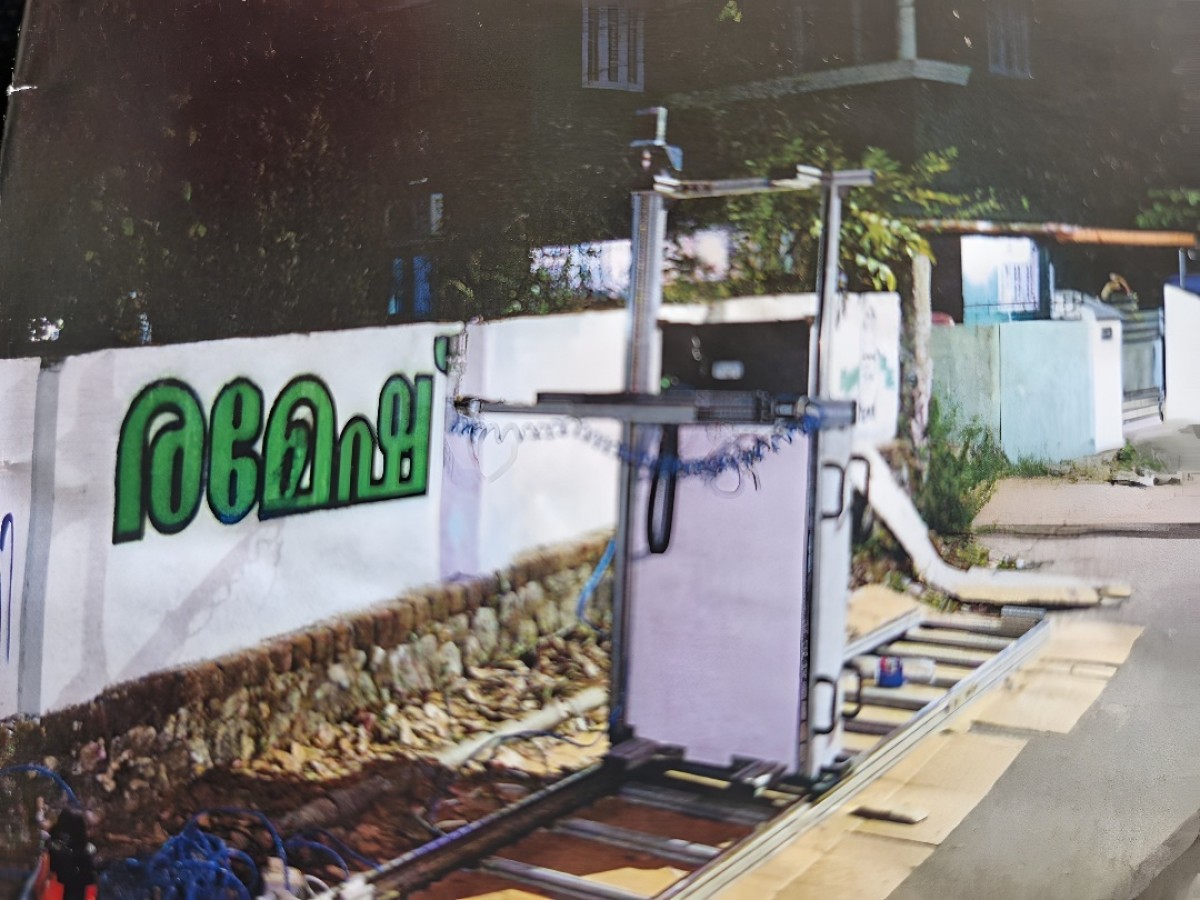
The 2026 Kerala Assembly election brought Tevanova Techtrade national attention. Handout photo
 By Hari Kumar, on May 26, 2026
By Hari Kumar, on May 26, 2026
By Hari Kumar, on May 26, 2026
In Kerala’s towns and highways, fading painted walls are reminders of another era. Before flex banners and giant digital hoardings took over public spaces, walls were among the most powerful advertising mediums in the state. Political slogans, jewellery advertisements, cement brands and tuition centre promotions once appeared not through printers, but through the hands of skilled painters who used prominent walls as their medium.
That world has been steadily disappearing. Flex printing transformed outdoor publicity by making banners faster, cheaper and easier to mass produce. At the same time, fewer young people were willing to enter the physically demanding profession of wall painting. Skilled artists became scarce, and for many it seemed only a matter of time before traditional painted advertisements vanished entirely.
But a startup from Palakkad believes the writing is not yet on the wall for the sector. Instead of accepting the decline of wall painting, TevanovaTechtrade is attempting to revive it through robotics, software and automation. Their argument is simple: the walls and the economics behind them never really disappeared.
The company has developed a robotic wall-painting machine called Chuvarbot, a system designed to automate large-scale outdoor spray painting. The startup says the idea emerged from the widening gap between demand for painted advertisements and the shrinking number of skilled painters available to execute them.
The machine briefly entered the national spotlight during the 2026 Kerala Assembly elections when Congress candidate Ramesh Pisharody used Chuvarbot for his campaign in Palakkad. Videos of the robotic painter quickly spread across television channels and social media, bringing Tevanova unexpected attention from across the country.
Yet the founders insist that elections are not the real market they are chasing. Political wall writing, they argue, is seasonal work and often handled by amateur painters where perfect precision is not essential. Commercial advertising, however, is an entirely different ecosystem.
Precise Market: Unlike political slogans, advertising campaigns require strict consistency in fonts, colours, proportions and logo placement. A slight distortion may be acceptable in an election symbol painted overnight, but commercial brands demand uniformity. That need for precision is where Tevanova believes automation can make a difference.
“Ads written on walls still play a key role in brand building in India, and the current crop of wall painters are unable to meet even a fraction of Kerala’s total demand,” says Shakib Geethanjali, CEO of TevanovaTechtrade. “Painted ads also bring revenue to the wall owner because advertising agencies pay for the space. So this becomes a win-win situation for everyone.”
Chuvarbot operates using Computer Numerical Control, or CNC, a system in which the movement of the spray mechanism is guided by software rather than by hand. The process begins with a digital design created on a computer and approved by the client. The file is then fed into the robot, which moves along a rail-mounted structure while spraying paint with controlled precision.
Green Touch: The founders say the robotic system reduces paint wastage, improves consistency and finishes work faster than conventional manual painting. More importantly, they believe it could make painted advertising economically viable again at a time when flex banners dominate outdoor publicity.
Tevanova is also positioning the technology as an environmental alternative to flex printing. Kerala’s roadsides and towns generate enormous quantities of flex waste during elections, festivals and commercial campaigns. Since many banners are non-recyclable, they often end up dumped in open spaces and road sides.
The startup argues that paint-based advertising offers a more sustainable option. By lowering the cost and increasing the speed of wall painting through robotics, the company hopes more organisations will return to painted walls instead of disposable banners.
Open Market: According to Tevanova’s own survey, nearly 60 percent of Kerala’s available wall space currently remains vacant, suggesting a market far larger than what the present workforce of painters can serve. The company sees potential clients not only in advertising agencies, but also in hospitals, schools, and religious organisations that continue to use wall communication to reach the public.
Tevanova believes the technology could especially help small and medium enterprises that may not have the budget for expensive outdoor campaigns. If robotic wall painting becomes scalable, painted publicity could become both affordable and widely accessible again.
Shakib says the closest comparable technology currently available is UV wall-printing systems used in countries like China. However, those machines are largely designed for indoor use on smooth surfaces and struggle with rough outdoor walls exposed to rain, heat and dust. Chuvarbot, by contrast, has been developed specifically for outdoor Indian conditions.
Challenge Ahead: Like many hardware startups in India, however, Tevanova now faces the challenge of moving from prototype to scale. Building a working machine is one achievement; manufacturing multiple commercial units is another. The founders say their next step is to raise funds to produce more robots and expand operations through a franchise-based model.
“We already know there is a market,” says Shakib. “But it is not going to be easy because we are trying to sell something that has not really been developed elsewhere before.”
Meanwhile, the company’s research facility in Palakkad continues to experiment with newer ideas and improvements to the machine. The founders have also opened the lab to students interested in unconventional engineering projects, hoping to encourage young innovators willing to challenge existing systems.
In many ways, Chuvarbot represents more than just an advertising machine. It is an attempt to modernise one of Kerala’s oldest public art forms – not by preserving it unchanged, but by rebuilding it with rails, motors, software and robotics.
Kerala techies find the right path
It is always encouraging to hear of researchers and innovators coming up with solutions that benefit society. The ‘layer pavement load testing system’ developed by a team in College of Engineering, Trivandrum (CET) fits that bill, as the patented technology can keep track of the condition of roads and pavements. Project lead R Padmakumar, Associate Professor at CET’s Department of Civil Engineering, and co-developer Vignesh Dhurai, a former doctoral scholar at CET, may have created a handy solution for Kerala’s perennial road condition problems. The report says the new technology can assess bituminous block pavements, conventional flexible and rigid pavements, and interlocking concrete block systems.
Team Evide from Malappuram is another group that won our hearts when they appeared on the Manorama Elevate programme to pitch their bus-tracking app. Hopefully, after winning the judges’ nod, their app will start appearing in more cities, giving bus commuters a way to track when their bus is arriving instead of enduring the helpless wait they are often condemned to now. It is interesting to note that Tata Consultancy Services has put up a digital board in Technopark displaying walk-in interview details. Pity that neither companies nor the authorities in the tech park thought of a similar idea to help the hundreds of bus commuters who stand outside the park entrance every day.
Two AI hubs for Kerala
Kerala is set to get two new Artificial Intelligence Centres of Excellence under the India AI Mission, with one focused on Bio-AI in Kochi and another general-purpose AI centre in Trivandrum. Backed by 20 crore rupees each, the projects will be led by Kerala Startup Mission and Digital University Kerala respectively. The Bio-AI centre plans to combine Kerala’s biodiversity, Ayurveda heritage and genomics research using high-performance computing infrastructure, including the ‘Tejaswi’ supercomputer at the Cochin University. The Trivandrum centre will focus on AI research, training, startup support and industry collaboration, signalling Kerala’s growing ambitions in the AI sector.
India’s missing implant trail
Once in a while, you come across reports that simply jump at you. Medical Buyer’s story on the lack of records of imported implants in India is one such revelation. Apparently, India implants more than a million high-risk medical devices every year – including cardiac stents, knee replacements and spinal implants – yet we have no reliable way to trace them once they are inside a patient. If something goes wrong and a company recalls a product, nobody even knows for certain which hospital implanted it. An interesting point raised in the report is that a National Implant Registry would not only improve patient safety, but also give India one of the world’s largest real-world implant performance datasets once it is created.
Maid In Silicon Valley
May 14, 2025 may someday be remembered as the day humanoid robots officially entered the house-cleaning business. San Francisco startup Gatsby says it deployed a “humanoid as a service” robot that spent hours scrubbing an apartment booked through its app. The company charges a flat 150 US dollars per cleaning and hopes to build an Uber-style on-demand robot maid service. China is already experimenting with similar domestic robot cleaning models, though humans still accompany the machines there – perhaps just in case the robot decides the dishes are beneath its pay grade.
