
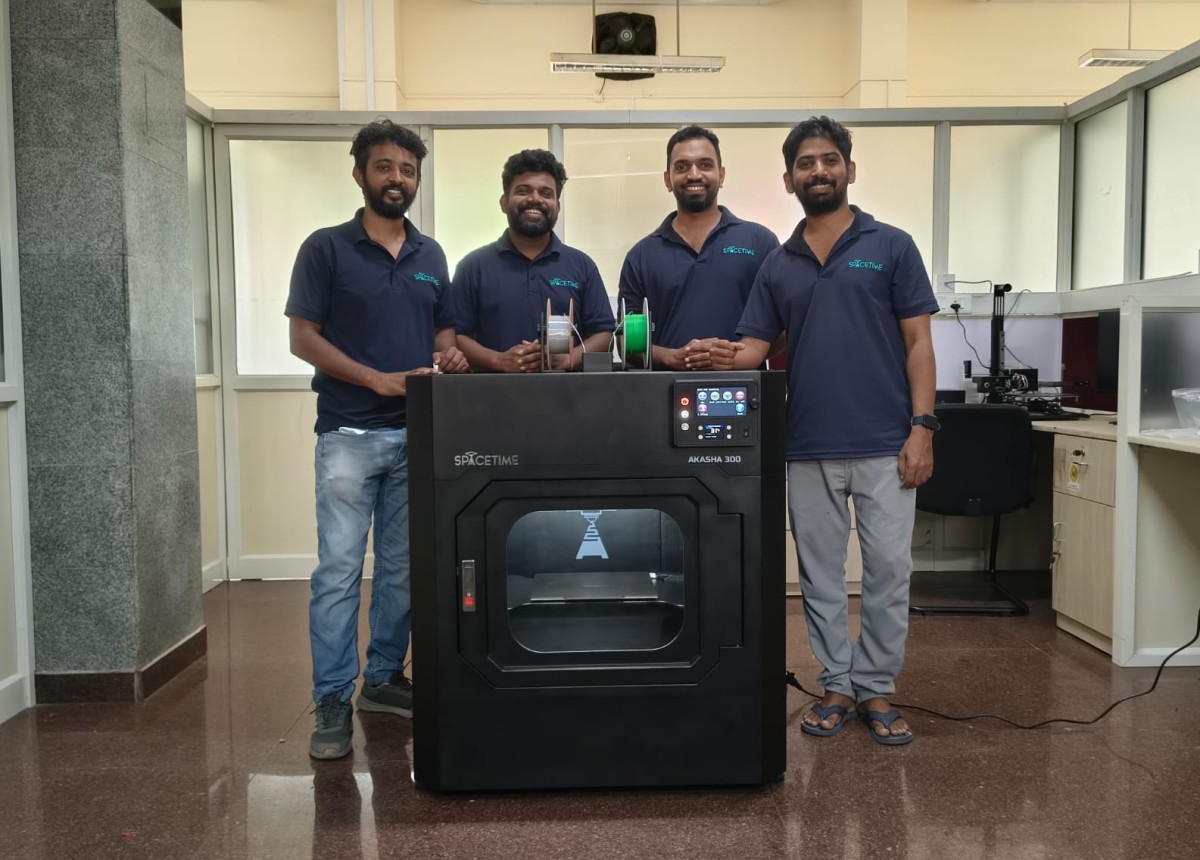
The team behind Spacetime 4D Printing – (from left) Akhil Madhavan, Prathyush T, Jithin V and Amal Ashokan – with the Akasha300 printer they built. Image: Handout photo
 By Hari Kumar, on June 30, 2026
By Hari Kumar, on June 30, 2026
By Hari Kumar, on June 30, 2026
“Our office is opposite Mannurkonam LPS School, the government school with the giant tortoise statue in front. You won’t miss it. We’re just across the road.”
That was the only direction Akhil Madhavan, chief executive of Spacetime 4D Printing, gave over the phone. He was right. The oversized tortoise by the roadside was impossible to miss.
The office itself was far less remarkable. It occupies a rented room above a row of shops in a modest two-storey building in rural Nedumangad, on the outskirts of Trivandrum.
A decade ago, you might have expected the upstairs tenants to be a tailor, a photo studio or a document writer. Instead, they house a startup that has developed an industrial 3D printer for India’s space sector at less than half the cost of an imported machine.
The contrast says something about how Kerala’s startup ecosystem is quietly changing. Innovation is no longer confined to Technopark or Kochi’s business districts. Increasingly, deep-tech companies are emerging from ordinary neighbourhoods, choosing proximity to research institutions over prestigious office addresses.
Nedumangad still looks like a typical Kerala town, with grocery stores, tea shops, textile marts and hardware stores lining its streets. Yet tucked among them is a company designing specialised 3D printers and creating complicated models for researchers and space scientists.
False Starts: After graduating from Government College of Engineering, Kannur, Akhil spent brief periods as a lecturer and researcher before co-founding Spacetime 4D Printing with an initial investment of just 30,000 rupees. Today, Jithin V, Prathyush T and Amal Ashokan form the company’s core engineering team. Five years later, annual revenue has crossed 22 lakh rupees.
The journey, however, was anything but straightforward.
Like many engineering graduates, Akhil’s first entrepreneurial idea revolved around robotics. He even registered a startup, but the venture failed to gain momentum. A later stint at Maker Village also failed to produce the breakthrough he and his friends had hoped for.
“We kept discussing what to do next,” Akhil recalls. “Nobody wanted to give up completely.” The breakthrough came almost by accident.
Akhil bought a desktop 3D printer for a project. Instead of simply using it, he dismantled the machine, studied its design and began modifying components.
“Once we understood the machine properly, we realised we could build something much better ourselves.” That insight led to the launch of Spacetime 4D Printing in 2020.
The founders chose Nedumangad partly because of its proximity to the Liquid Propulsion Systems Centre (LPSC), the Indian Institute of Space Science and Technology (IIST) and the growing cluster of organisations that make up Kerala’s space ecosystem.
Difficult Projects: Like many young startups, Spacetime initially accepted almost every assignment that came its way.
Each project stretched the team’s abilities a little further.
One request came from a doctor associated with AIIMS Delhi, who needed a highly detailed cross-sectional model of the human abdomen for research. Several larger 3D-printing firms had declined the work because of the complexity involved.
“When those kinds of jobs came in, we had no option except to figure out how to deliver,” Akhil says. “Every difficult project made us more confident.”
The company also showcased its work at events such as Global Huddle, where visitors were often impressed by the sophisticated engineering work that was emerging from a small office in Nedumangad. That generated enquiries from across the country.
Space Ambitions: A turning point came from an assignment that initially appeared fairly routine.
IIST wanted replica models of India’s launch vehicles as commemorative mementoes. Traditionally, such models were produced in brass. Spacetime proposed something different.
“We told them we could make them using 3D printing with much greater detail and the actual colours of the rocket.”
The proposal was accepted. The first order was for around a hundred models. Soon, more requests arrived from LPSC and other ISRO centres.
Next Challenge: The revenue itself was modest, but it gave the founders something equally valuable – a steady stream of work that allowed them to reinvest almost every rupee into better equipment.
“We have always ploughed back most of what we earn into buying machines,” Akhil says. “That has been our way of growing.”
Working closely with space scientists also exposed another opportunity.
Researchers at LPSC needed an advanced industrial 3D printer capable of working with engineering-grade materials and high temperatures. Imported systems were available, but they were expensive and offered limited flexibility.
“We knew technically we could attempt it,” Akhil says. “The only question was whether we would have the money to build it.”
Helping Hand: That opportunity arrived in 2024 when Kerala Startup Mission (KSUM) selected Spacetime for a 10 lakh rupee grant under Nidhi Prayas programme.
Instead of using the money to expand operations, the founders treated it as a research fund.
The result was the Akasha300, an industrial 3D printer designed and manufactured entirely in-house.Eventually, the machine was delivered to LPSC at Valiyamala, becoming the company’s biggest milestone so far.
“An imported machine like this would cost around 20 to 22 lakh rupees,” Akhil says. “We built ours for less than half that cost. More importantly, we designed it so it could work with different printing materials, making it more versatile than many established international brands.”
For the founders, the achievement went beyond cost savings.
“Our biggest gain isn’t just the revenue,” he says. “It’s the confidence we’ve built. We now know our team can deliver when complicated design orders come to us.”
More Than Location: From an initial investment of 30,000 rupees, the company has grown into a specialist manufacturer serving customers across the country.
While Kerala still has relatively few organisations that require advanced industrial 3D printing, enquiries are increasingly arriving from Bengaluru, Hyderabad, Delhi and other technology hubs.
“We don’t think being in Nedumangad is a disadvantage anymore,” Akhil says. “If you can build something people need, they will find you.”
His optimism reflects a broader shift taking place across Kerala.
The state may not yet match Bengaluru or Hyderabad in startup scale, but it possesses many of the ingredients needed to build advanced manufacturing companies – engineering talent, research institutions, supportive government programmes and a growing community of entrepreneurs willing to take risks.
Slow and Steady: Standing outside the office at the end of the visit, the giant tortoise across the road no longer felt like an odd roadside landmark.
It seemed to symbolise Kerala’s spacetech ecosystem itself.
It may not be racing ahead like India’s larger technology hubs. Perhaps, like the tortoise in the old fable, Kerala’s spacetech ecosystem still has a few surprises left.
The secret sauce behind Chinese innovation
Innovation is one area where Chinese tech companies are renowned. The latest example, though it sounds like a pie-in-the-sky idea, is a start-up developing an AI-powered laser mosquito zapper. Photon Matrix Lab, based in Changzhou in eastern China, set out to raise 20,000 US dollars through crowdfunding. Instead, it has raised more than 2.7 million US dollars on the Indiegogo platform, backed by over 4,000 supporters from more than 50 countries. Its pitch was simple: anyone who pledged about 630 US dollars would secure the right to receive one of the devices once it enters mass production.
The story itself was an amusing read. But one quote deserves attention. Photon Matrix CTO Li Ran says China’s mature local supply chains allow grassroots innovators to repurpose military and industrial technologies – such as low-cost lidar and edge computing – for everyday consumer products. “In Silicon Valley, it’s hard to find a supplier who can prototype a high-precision fibre laser module in two weeks,” Li said. “But in Changzhou, the supply chain is right downstairs.”
Women’s College lands patent
News about patents usually comes from engineering colleges in Kerala. So it was a pleasant surprise to see one emerge from Trivandrum College for Women. A team led by Associate Professor S Shyamkumar of the Department of Botany has secured a patent for an antibacterial body wash made from seaweed. The product was developed under a project of the State Biodiversity Board. Shyamkumar says the team also distributed the soap, named Samudri, to students and faculty, including the college principal, and the response has been very encouraging. The larger goal is even more interesting: to create technology-driven livelihood opportunities for people living in Kerala’s coastal communities.
Chola game unleashes the urumi
The Indian gaming world is buzzing again as clips of Son of Thanjai, an action-adventure game set in 11th-century South India, circulate online. As Abraham K, Studio Head and Creative Director at Eyelet Studio, wrote on Xbox Wire, the game blends Tamil history, cultural storytelling and modern game design. Its combat is inspired by Kalaripayattu, bringing fluid movement to every encounter. Another highlight is the surulvaal – known as the urumi in Malayalam. Wielded by the game’s antagonist, the flexible sword proved so complex that the studio had to work hard to recreate its movements realistically.
A plum assignment for investors
Forget AI chips. This week’s hottest AI investment turned out to be… plums. A Chinese plum snack maker found itself at the centre of an investor frenzy because its name Lilium gave its ticker symbol as LLM. The IPO was oversubscribed 6,586 times, and the shares jumped more than 180 per cent on debut. Shows how anything linked to AI can trigger an investor stampede. No wonder Beijing is cracking down on companies trying to sprinkle a little AI magic into their names.
