
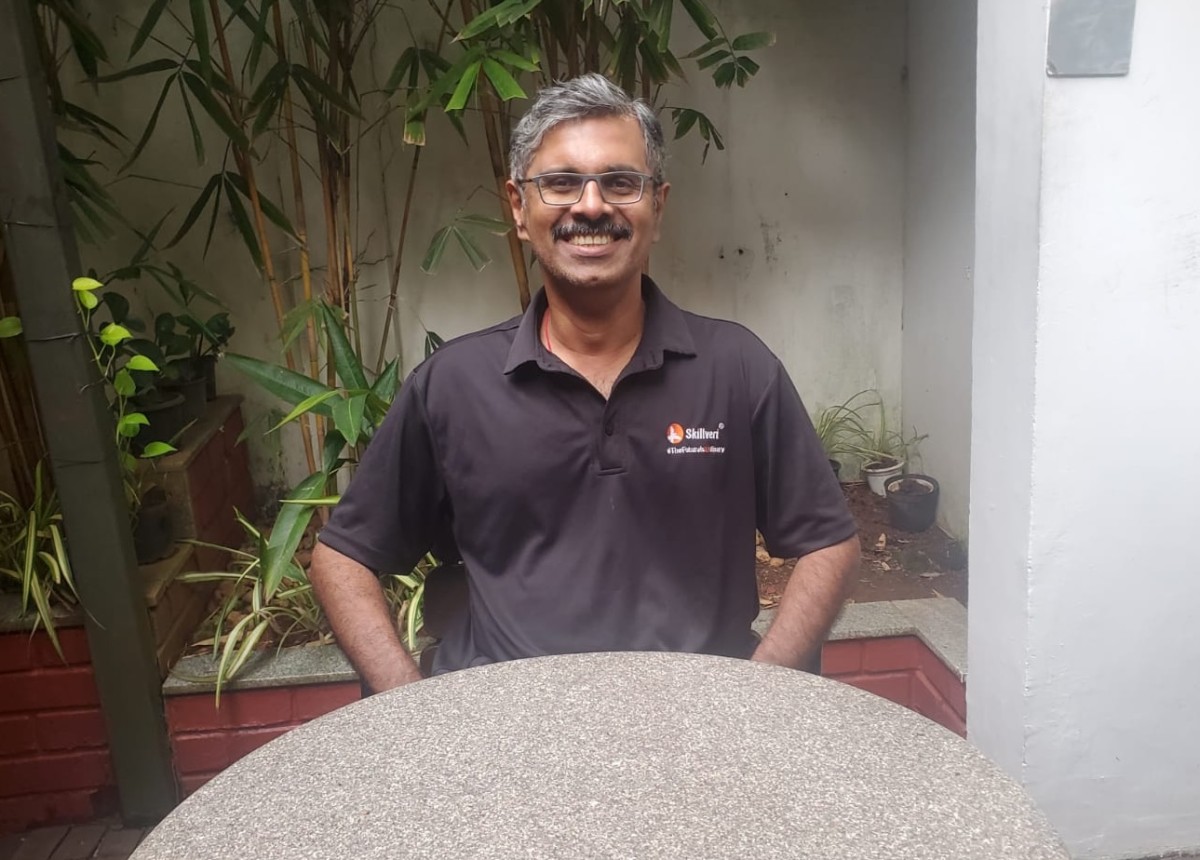
Sabarinath Nair says Skillveri has the expertise to develop medical devices. Photo: TikTalk News
 By Hari Kumar, on October 20, 2026
A virtual reality game that asks you to pop balloons sounds mindless. Put on the headset and watch balloons drift into view. Reach out, and they burst. But for someone recovering from a stroke, each reach is meant to be a carefully chosen repetition. Watching the balloon drift in front of you and guiding the hand towards it is exactly the eye-hand coordination that therapy tries to rebuild.
The virtual reality game is one of 19 activities in Skillveri XTend, a portable, upper-limb rehabilitation program that the Chennai startup Skillveri is developing with the Sree Chitra Tirunal Institute for Medical Sciences and Technology (SCTIMST) in Trivandrum.
The activities look like a dull games, but they are being shaped with inputs from SCTIMST experts to ensure the right regions of the upper body are activated as imprecise repetition can lead to complications.
This is the kind of precision that Skillveri has developed as the startup has spent more than a decade teaching people to weld, spray-paint, repair air conditioners and install solar panels.
Its cofounder, Sabarinath C Nair, a Kariavattom Engineering College graduate, says that expertise opens up a wide array of opportunities for the firm in the healthcare sector.
Drawing Inspiration: Sabarinath's road to skilling began in another industry. He graduated in 2000 and soon found work in Chennai, then took an MBA and joined Vortex Engineering, which made ATMs for rural India.
“It is when I saw the real impact that engineering products can make in the life of real people,” he says. The wish to help society led him to look for ways to give people skills they could build a life and career on.
Earlier when his cofounder Kannan Lakshminarayan, a practising professor at IIT Madras, asked him to explore taking training to vocational centres like ITIs, Sabarinath was puzzled. “I thought to myself why someone in IIT was looking at areas like this in vocational schools.”
The answer became clear when in 2010 he read that workers had been flown in from China to build the third terminal of Delhi airport. India, he realised, had a skill shortage it was not talking about.
Locked Away: Skillveri was founded in 2012 out of the Rural Technology Business Incubator at IIT Madras. It began with sensors and software to help newcomers practise trades like welding and plumbing, and its customers were vocational institutions and companies that wanted to train new employees. The first centres were in Tamil Nadu and Andhra Pradesh.
Selling to institutions turned out to be harder than building the product. “Educational institutions were often hampered by lack of funds and red tape to adopt new methods and technologies,” Sabarinath says. “Some of them were running on shoestring budgets and couldn’t give a full range of training, while some others kept the machines under lock and key as they were expensive.”
The sums explain why. A VR system costs over 15 lakh rupees, while a welding machine costs about 50,000 rupees. “Most would buy the welding machine,” Sabarinath says.
“But the materials needed to train students will also cost several times that, so they keep it down and give training in a few basic steps. The companies that employ them then have to spend months training them.”
The skill itself is demanding. A welder needs to be familiar with 25 different positions, and a learner has to practise each dozens of times. “Institutes manage only a few methods, as time, resources and proper trainers are not easy to obtain,” says Sabarinath.
“Even with private sector support, centres in the United States find it hard. So Skillveri was able to provide a way out with virtual training.”
Improving headsets changed what was possible. Skillveri already had software built for such devices, and by 2017 trainees were welding and painting virtually in places that would have been impossible or hazardous for a rookie technician.
Faster in America: An online enquiry from Canada, asking whether Skillveri could provide VR training for new tradesmen, took the company across borders. It built a strong presence in the US and Canada as users started promoting it, where institutions were looking for a more economical way to teach specialised skills like high-end welding and spray painting. The Covid lockdowns pushed the numbers further and it was reflected in their revenue also.
“It took years for us to hit 100 customers in India,” Sabarinath says. “In the US we hit the number in 18 months, thanks to the lockdown. The growth was generated through word-of-mouth publicity.”
He sees a larger shift behind this. “In the United States there is a rising need for specialised trades, as other white-collar jobs are no longer attractive and high-paying, while skilled workers are in demand.
Economic opportunities are similar in India, but unlike in the West, their social status remains shackled. But that is changing.”
“Now a welder who starts as a beginner on 15,000 rupees a month can earn up to 2.5 lakh rupees a month in a few years. Sometimes the growth is faster than for a similar employee in an IT firm. Some of the top welders at the Kudankulam nuclear power plant earn over 4 lakh rupees a month.”
Trades like plumbing, painting and welding still lack the glamour of other professions, but earning potential is drawing people in. Air conditioner repair is seeing strong demand, helped by utility platforms that let customers book technicians.
Training institutions lag behind. “The syllabus was updated in 2014 after 30 years, but translating that into action takes time,” Sabarinath says. “Now the syllabus is more than a decade old, and some modern methods and machines are not there. Even if all these are made available, there are not enough qualified people at these centres to impart that skill.”
New Application: The move into healthcare began at an event at IIT Madras, where Dr Subhash Neelakantan of the Department of Medical Device Engineering at SCTIMST saw Skillveri’s technology. His conversations with the founders led to a question: could the same motion-tracking be used in medical treatment?
XTend is at a very early stage and a medical product has many regulatory steps to clear. But Skillveri see far more opportunities in health. It is incubated at SCTIMST's Technology Business Incubator, Timed, and plans to build a team of about half a dozen people for the health sector.
The move could become a significant growth engine for a company whose customers include Tata Motors and Indian Railways. Skillveri expects to close the year at around 10 crore rupees in revenue and is targeting Rs 15-20 crore next year, with overseas business contributing roughly 7 crore rupees.
Sabarinath also expects the AR/VR market to widen as hardware gets lighter. “We have done system integration well. Our programmes are compatible with all headsets. With Meta glasses and other lightweight gadgets getting popular, we see much wider adoption and an expanding horizon for us.”
It is a long road, and Sabarinath is aware of the hurdles ahead.
“If you are a startup founded by IIT or IIM graduates, or by people who have returned from the US or Europe, then you are valued more. But startups founded by local talent from other domestic institutions do not get the same kind of consideration.”
Spacetech sector flying high
Kerala-based startups are taking big strides in space tech again. Genrobotics, the Trivandrum startup best known for its Bandicoot manhole-cleaning robot, has entered space robotics. It has won a project from ISRO’s U R Rao Satellite Centre (URSC) to develop an indigenous articulated robotic boom arm. The arm will deploy reflectors on satellite decks and point them precisely. The company is building dedicated manufacturing and R&D facilities at Kinfra, Trivandrum, to support the work.
Technopark-based Hex20 is part of the UAE’s first asteroid-belt mission, making it the first private Indian company on a deep-space mission for the country. It was selected by the UAE’s Technology Innovation Institute (TII) and the UAE Space Agency in November 2024, following a design workshop, to help build the mission’s asteroid probe. The MBR Explorer launches in March 2028 and travels roughly 5 billion km over eight years to reach asteroid 269 Justitia. There the probe separates and descends on its own, with no real-time instructions from Earth.
UST races ahead in auto world
UST is making a further push into the automotive world, having completed the acquisition of a majority stake in Italdesign from the Audi Group. Headquartered in Moncalieri, Turin, the company employs more than 1,300 professionals across 10 international locations, Italdesign has helped shape some of the world’s most recognisable vehicles for nearly six decades. It had been part of the Volkswagen Group since 2010, operating under Audi’s Lamborghini subsidiary.
Jackfruit skin to filter water
Jackfruit is punching above its weight again. Researchers at NIT Rourkela have patented a low-cost material made from discarded jackfruit peel that removes excess fluoride from contaminated groundwater. The peel is turned into activated carbon and modified with zirconium to improve its fluoride-capturing ability. In lab tests, it removed over 90 per cent of fluoride within about 10 minutes at concentrations of 1-5 mg per litre. Fluoride contamination has been reported in groundwater in several parts of India, and the WHO warns that excess fluoride in drinking water harms health.
Young Chinese flock to AI hackathons
Now that vibe-coding lets even non-techies turn ideas into apps without having to learn how to code, China’s hackathons are filling up faster than a bubble tea shop. According to the Begun newsletter, hackathons are happening almost every week. ByteDance’s TRAE AI Creativity Contest attracted 37,000 sign-ups and 14,000 product submissions. At another event, the winning team averaged just 13.5 years of age. Begun says the young contestants build products around their own interests and needs, rather than worrying about textbook definitions of success.
