
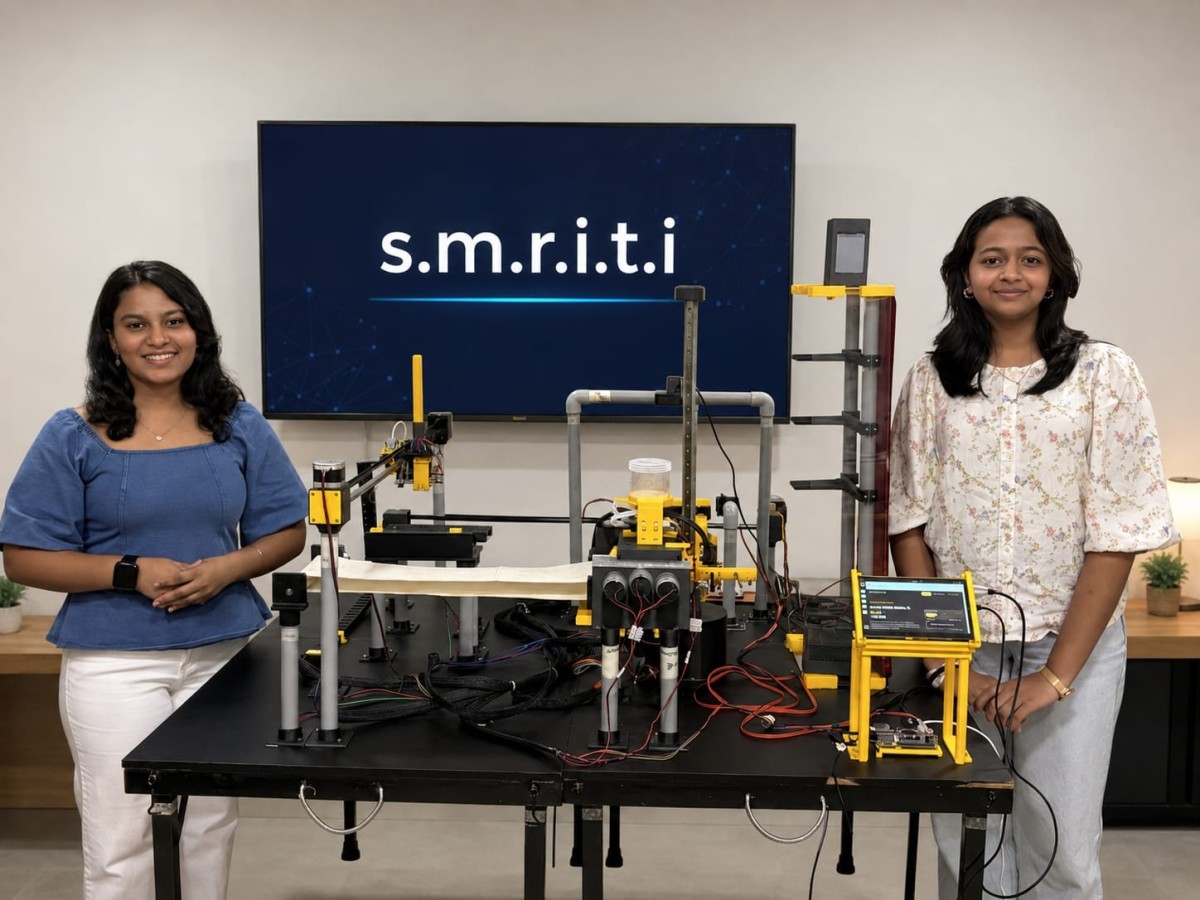
Cathlin Marie Jeesan (right) and Navika D Nair with the robot they built to help preserve palm-leaf manuscripts. Handout photo.
 By Hari Kumar, on September 08, 2026
By Hari Kumar, on September 08, 2026
By Hari Kumar, on September 08, 2026
School students Cathlin Marie Jeesan from Holy Grace Academy in Mala, Thrissur, and Navika D Nair from Naipunnya Public School, Kakkanad, Kochi, recently built a robot with an unusually thoughtful mission: to preserve fragile palm-leaf manuscripts.
The idea was to use the robot to clean fragile leaves and apply the required chemicals and oil to preserve them. That process is now done manually, takes a long time, and is expensive. The students' innovation also scans the contents and digitises them for future generations.
Their prototype, Smriti 1.0, won the All India Contest held in Hyderabad, securing them a spot to represent India at the international finals in Puerto Rico. Supporting their initiative is Unique World Robotics (UWR), a robotics education institute based in Kochi.
The public reaction was predictable: media coverage, social media praise, and a wave of pride. It's the kind of story that makes people say, “Look at what our kids can do.” It is also a remarkably precise snapshot of where Kerala's hardware innovation stands right now: full of promise, thin on backing.
In an ideal ecosystem, government authorities would immediately step in with institutional grants, industry leaders would offer technical guidance, and mentors would lay out a roadmap to scale.
The reality on the ground is far from it. The two ninth-grade students are currently juggling academic demands and exam schedules while working on their passion project. Meanwhile, their families are scrambling to secure sponsorships and rally various agencies for funding, with round-trip flight tickets to Puerto Rico alone running close to 5 lakh rupees.
Inspiring Research: Navika and Cathlin were inspired after learning about Professor Litty Chacko, Head of Department at St Joseph's College, Irinjalakuda, who has spent years researching and recovering the works of Sangamagrama Madhava (Madhavan in Malayalam), the legendary 14th-century Kerala mathematician and astronomer.
Considered the founder of the Kerala School of Mathematics, Madhava discovered infinite series methods long before Western calculus scholars. He recorded his discoveries on palm leaves, but efforts to recover his complete legacy are constantly hampered by brittle physical records and the immense difficulty of deciphering ancient scripts.
Under the guidance of mentors at UWR, the duo developed their manuscript-preservation robot and are now awaiting patent approval. Early tests on local palm-leaf samples produced encouraging results: the machine successfully digitised text written in older Malayalam scripts with high accuracy.
Professor Litty Chacko said the two 14-year-olds routinely reached out multiple times for academic guidance and were passionate about their idea. But taking the technology to the next level, she said, will require significantly more sophistication. “Their initial prototype was built for tougher palm leaves, and it worked,” says Professor Litty Chacko. “But to preserve ancient manuscripts on thinner, degraded leaves, the robot needs advanced engineering upgrades. Moreover, to decipher ancient scripts we need more comprehensive systems that are trained on Sanskrit and other scripts that were in use at that time.”
Falling Short: This highlights a recurring pattern when young innovators in Kerala attempt to build real-world solutions rather than simple school science projects. Navika and Cathlin looked beyond physical preservation; their aim was to make ancient scientific knowledge digitally accessible to the modern world.
While the state government frequently promotes technological innovation through policy schemes, a stark gap remains between that intent and on-ground readiness. Nurturing hardware builders requires more than throwing money at problems.
That is not the only piece missing. There are different efforts happening in both the private and public sectors, but most of them work in silos. There is no repository of such projects, and young innovators are not made aware of what is already available in their domain of interest.
Bright Embers: Yet the most hopeful signals in Kerala are not coming from corridors of power or company boardrooms. They are coming from students. Even without formal pathways, young builders across the state are actively seeking out practical problems to solve. But good mentorship is often missing, given the state of the Indian education sector. The rare breed of faculty who seek out such bright talent is often handicapped by management attitudes and red tape.
A recent engineering conclave at the Institution of Engineers in Trivandrum highlighted this talent pool. Students presented practical prototypes designed for local needs: from an automated rubber-tapping solution developed by St Gits College of Engineering, Kottayam, to a basketball-feeding machine built by Mar Baselios College of Engineering and Technology, Trivandrum.
The grassroots energy is real, but the cycle remains painfully familiar in Kerala: most of these solutions never make it past the college project phase. They earn applause at exhibitions and quietly fade away: not from a lack of talent, but due to a missing support structure.
Rugged Path: UWR’s Akhila R Gomez, who has watched the process up close with Navika and Cathlin, noted that the girls displayed a level of persistence that many faint-hearted innovators lack. Young innovators need that kind of persistence as they rarely get enough support to sustain it, she says.
Moving a working prototype into a deployment-ready product requires sustained research facilities, dedicated testing labs, industry partnerships, and patient mentorship. Kerala currently offers none of this at any scale for its young hardware builders. Only when such an ecosystem exists can young builders like Navika and Cathlin turn their projects into lasting technology.
Isro finally gets its eye sky-high
India has now managed to put an “eye in the sky” for itself, with the Indian Space Research Organisation (Isro) successfully placing the EOS-5 satellite in geosynchronous orbit at 36,000 kilometres above Earth. Weighing over 2,300 kilograms, it is the heaviest satellite ever carried by a GSLV. The deployment comes after a few hiccups for Isro. The satellite will keep watch over the country and provide continuous updates that will help with defence, maritime security, disaster management and monitoring climate impacts.
India’s aerospace and defence sector continues to see ambitious startups come up with ideas that border on audacious dreams. Bengaluru-based Alteon says it is planning to create an autonomous aircraft designed to remain airborne for months by extracting energy from winds over the ocean. The idea is to use something known as dynamic soaring, a technique used by birds such as albatrosses. It involves repeatedly moving between layers of air travelling at different speeds. This allows an aircraft to gain energy as it climbs, turns and dives. The startup recently attracted 2.5 million US dollars in funding, according to a Times of India report.
SCTIMST develops a lighter heart stent
Trivandrum-based Sree Chitra Tirunal Institute for Medical Sciences and Technology (SCTIMST) says it has developed a heart stent that is a world first. The device is made with a cobalt-chromium alloy and is drug-coated. It has been designed with 30-40 percent less metal than conventional coronary stents, aiming to cause less damage to blood vessels and reduce other complications. The technology was transferred to Invasive Technologies in 2024, the same year the project was selected as one of the top three health innovations at the 2024 Aegis Graham Bell Awards.
Football talent hunting goes digital
Apps that help football fans connect with their stars and favourite clubs are nothing new. Now clubs are looking to find talent far and wide through mobile apps. Like the Swiss company’s Footbao app, Australian app Spotivo lets players upload videos showcasing their skills, which are then made available to clubs and academies. Sydney Olympic stalwart Will Angel has got on board with the app, saying it could prevent talent from slipping through the cracks. It will open up opportunities for players in a digital age while also benefiting clubs by providing a free discovery tool that connects players, parents and clubs more efficiently.
Cockroaches milk the Ig Nobel prizes
Not sure if this will become the subject of political screaming matches on Indian television networks, but researchers say cockroach milk is more nutritious than cow’s milk. Trust the Ig Nobel Prize committee to fish out such hidden gems from the science world. This year, the chemistry prize went to researchers who found that Moroccan cockroach milk contains three times as much energy as cow’s milk. But our favourite was the economics prize, awarded to researchers who found that upper-class people are more likely to snatch candy from children and engage in other kinds of unethical behaviour. Here’s the full report on this year’s Ig Nobel Awards.
