
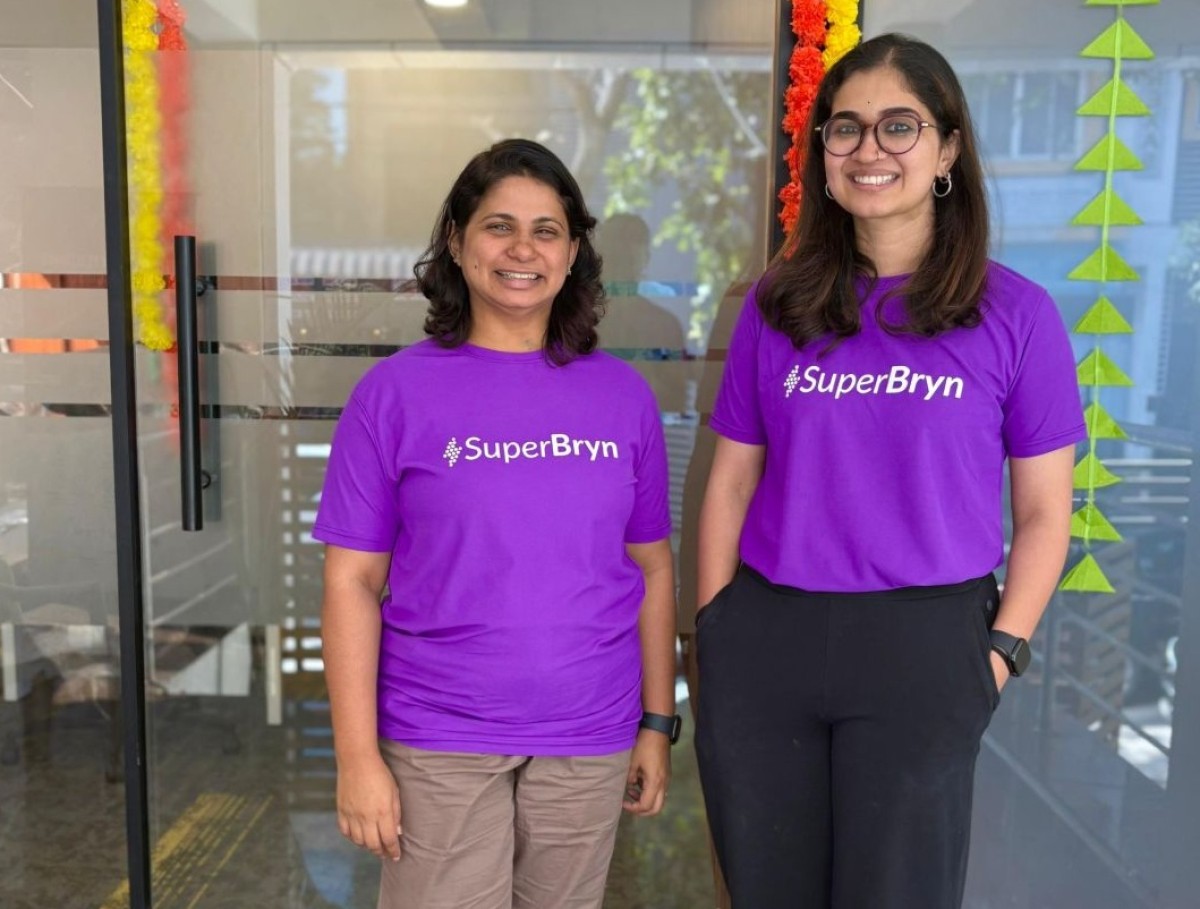
SuperBryn, the first Kerala-based AI startup to win investment was founded by Neethu Mariam Joy and Nikkitha Shankar. Handout photo
 By Hari Kumar, on January 20, 2026
By Hari Kumar, on January 20, 2026
By Hari Kumar, on January 20, 2026
Mix the best ingredients, brew them carefully, and pour them out – the result can still be flat. That was the lesson learned by the women cofounders of AI startup SuperBryn, Neethu Mariam Joy and Nikkitha Shankar, when their first prototype went live.
On paper, everything had looked right. The technology worked. Test results were reassuring. But once their AI agent system moved into the messy reality of real users, accents, interruptions and expectations, things began to fall apart.
Calls dropped. Conversations stalled. Patients got stuck mid-interaction. What had appeared robust during demos struggled under real-world pressure. “It was impossible to go through thousands of calls and examine them individually to identify what was going wrong,” the founders recall. The failure was not dramatic, but it was decisive.
That failure exposed a technical flaw, but Kochi-based SuperBryn’s response revealed its real strength. In hindsight, the combination of Neethu and Nikkitha – and their backgrounds – explains why they reacted the way they did.
Different Paths: Neethu’s academic record is formidable. A first rank in both BTech and MTech, she went on to become the first woman to earn a PhD in Artificial Intelligence from IIT Madras, followed by a postdoctoral stint at King’s College London. Long before ChatGPT entered the chatroom, she was already deep into voice and audio signal processing.
Nikkitha took a very different route. A 2012 graduate of NIT Calicut, she stepped away from the conventional career track early. After a couple of attempts at the civil services examination, she decided it was not for her. Instead, in 2017, she co-founded an online fashion platform. Within two years, Shoppre had reached an annual recurring revenue of 2 million US dollars.
While running that e-commerce business, Nikkitha noticed something that stayed with her. Older customers struggled with long forms and complex interfaces. Typing was friction. Talking was not. What if ordering could be done orally, without navigating screens and fields?
That question eventually led her back to Neethu, a childhood connection from Kottayam.
Learning Curve: Their chemistry worked and SuperBryn was born in February 2025. When a healthcare organisation approached them for a voice AI agent, they built one quickly. The experience was exhilarating – and deceptive. The system performed beautifully in test environments. Then it met reality.
What collapsed was not just a prototype, but an assumption shared by much of the industry: that building a chatbot was the hard part. Human conversations are not neat. People interrupt. Background noise intrudes. Language shifts mid-sentence. Anxiety distorts speech. Under those conditions, bots fail in small but consequential ways.
That failure revealed a larger problem. Millions of enterprises already run voice-based interactions using chatbots – in healthcare, finance, insurance and customer support. Many more are preparing to deploy them. But the real challenge was not creating these systems. It was ensuring they worked reliably once they faced real users.
In countries like India, this gap matters more. Digital literacy remains uneven despite a booming technology sector. Voice interfaces have the potential to widen access, but a single failed conversation can carry real consequences. A missed diagnosis. A compliance violation. A claim that never gets processed.
This was the space SuperBryn chose to focus on.
Magic Prop: When the AI boom gathered momentum after ChatGPT’s release, the ecosystem moved at breakneck speed. Chatbots appeared everywhere. Everyone, it seemed, had a product powered by AI. If you were clever enough to create a social media handle, you could claim magic.
Instead of becoming yet another company offering AI chatbots in multiple languages, the founders decided to work on the layer beneath the interface – continuously monitoring conversations, identifying where and why they fail, and improving performance automatically over time.
In effect, they asked a quieter, harder question: how do you make AI systems behave less like impressive demos and more like dependable employees?
“We’re building the layer that surfaces what’s breaking, why it’s breaking, and automatically makes the agent better – without human intervention,” says Nikkitha. “Monitoring and evaluation are non-negotiable in industries like healthcare, finance and insurance, where one failed conversation can have serious consequences.”
Neethu puts it more bluntly. “Most platforms test for narrow conditions, not for the messy reality of human speech. SuperBryn exists to fix this. We’re building intelligent evaluation and feedback systems that ensure voice agents don’t just work on day one, but keep improving every single day.”
New Playbook: Their approach has begun to resonate. SuperBryn has raised 1.2 million US dollars through Kalaari Capital’s initiative supporting women entrepreneurs, with participation from angel investors including Arjun Pillai and actor Nivin Pauly.
While both founders are women, their entrepreneurial journeys could not be more different.And that contrast continues to shape the company.
Nikkitha represents a generation of founders willing to abandon inherited playbooks and carve out their own paths. “Getting involved in a startup opened up a new world. My family had no business background, but my parents never stopped me from chasing what I wanted to do.”
Shoppre emerged from a simple observation: Indians living abroad were not getting the same e-commerce experience as customers in India. The platform found traction quickly, validating her instinct for identifying overlooked friction.
Surviving Pressure: Neethu’s journey has unfolded under very different pressures. For her, the idea that systems must perform under imperfect, high-stress conditions is deeply personal.
Among them: pursuing a postdoctoral career in the UK with a four-month-old child, navigating miscarriages, job loss during pregnancy, and the challenge of raising four children, including twins – all while building a company. “I prepared for fundraising until the very last day before delivery,” she wrote recently. “I held my baby for the first time while still pitching.”
Her husband, Senu Sam – himself a startup founder building Mykare – was navigating his own entrepreneurial pressures at the same time. The household was not balancing a career and a company, but two startups growing in parallel.
At a time when even small setbacks can derail careers, her ability to balance work and life stands out. It is also, perhaps, no coincidence that SuperBryn is obsessed with resilience – with systems that do not collapse at the first sign of disorder.
Crystal Clear: Like many successful startups, SuperBryn did not emerge fully formed. The confidence with which Neethu and Nikkitha began was tempered by failure. But that failure clarified their direction.
Pivot, in this case, was not about abandoning a vision, but sharpening it.
SuperBryn’s journey mirrors that of its founders: ambitious, adventurous and laser-focused on what matters. What began as a chatbot experiment that broke under real-world pressure has evolved into a company quietly obsessed with reliability.
In an AI ecosystem increasingly dazzled by claims and demos, SuperBryn is betting ona different future, one where systems work when it matters most. Just like the cofounders who refused to follow the herd and carve their own paths.
Local LLMs ready for centre stage
New Delhi says a number of local language large language models (LLMs) will be unveiled during the upcoming IndiaAI Impact Summit, which will take place from February 15–20. Abhishek Singh, CEO of the IndiaAI Mission, told AIM that officials are in talks with Avataar, BharatGen, Fractal, GAN, Genloop, Gnani, Intellihealth, Sarvam, Shodh AI, Soket AI and Tech Mahindra. The report says the startups are working across diverse fields such as e-commerce, marketing, engineering simulations, material research, healthcare, medical research and more. A total of 12 start-ups and consortia have been selected in two phases under the IndiaAI Mission to develop indigenous foundational AI models, reports NewsBytes.
Meanwhile, the Tamil Nadu government has signed a pact with Sarvam to launch a full-stack AI park and says the cost will be around 10,000 crores. The park will house compute infrastructure, secure data frameworks, model-research labs, and an Institute for AI in Governance within a single, state-controlled trust boundary. But as The Ken reports, some key details about the proposed project remain vague. It also recalls that some experts had earlier argued against such big-ticket AI projects, favouring a more “frugal” approach, as Indian firms cannot compete with deep-pocketed Silicon Valley giants.
Getting ready for AI shoppers
As customers increasingly use AI tools, shopping patterns are changing, and startups are now focusing on this shift to provide product sellers with tools to keep pace. Spangle, an AI e-commerce startup founded by former Amazon veteran and ex-Bolt CEO Maju Kuruvilla, says it provides software that helps retailers personalise shopping experiences based on context as shoppers move through their sites, reports TechCrunch. The idea is to use data such as where the shopper came from, what they searched for or clicked on, and how similar visitors have behaved, to surface products, recommendations and content tailored to that moment. The company has raised 15 million US dollars in a new funding round, valuing it at 100 million US dollars post-investment.
Data and dosa goes well
The tech boom in southern India is unmistakable, and eateries in this part of the country are taking note. Filter Coffee is a Bangalore-based café chain that uses AI-powered cameras to keep an eye on all aspects of its operations. “We can take a bite of a dosa in the front end, and my team should be able to tell you what batter has been used, who’s the chef, who made the batter, what ingredients went into it, and trace it all the way to the batch,” cofounder Avinit Bagri tells YourStory. After starting with one shop in 2014, Filter Coffee now has 22 outlets in Bangalore alone and is eyeing other cities in India. Clearly, dosas and tech are a hot pair.
AI comes for the salon chair
CES in Las Vegas did what it does best – flooding the internet with cute, weird and mildly alarming AI gadgets. Amid the humanoid invasion and existential dread, one standout came from Florida startup iPolish. The company claims its gadget can whip up artificial press-on fingernails that switch between more than 300 colours – and yes, there’s a colour chart too, for anyone paralysed by too much choice. According to Tech Times, iPolish plans to sell the tech as a 95 US dollars kit that includes a Magic Wand device and a set of 24 nails. Looks like AI is carefully manicuring its way into the salon business.
