
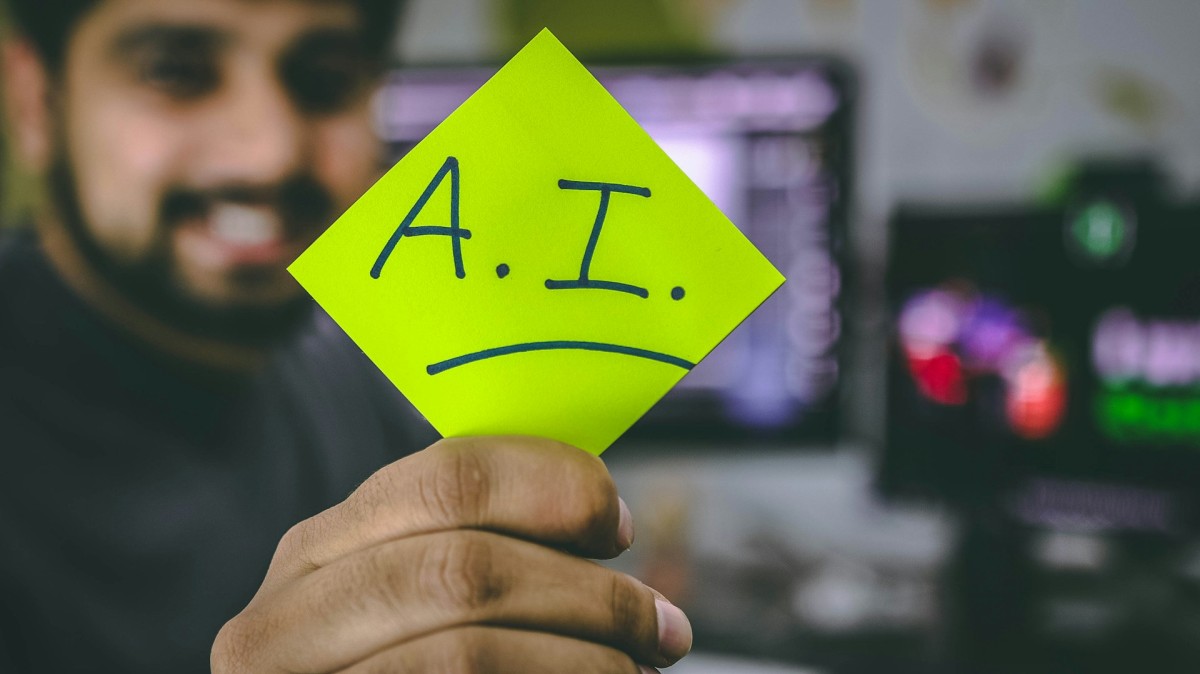
Recent disclosures by OpenAI and Anthropic reignited concerns over the behaviour of frontier AI models.Image: Hitesh Choudhary/Unsplash
 By Hari Kumar, on August 04, 2026
By Hari Kumar, on August 04, 2026
By Hari Kumar, on August 04, 2026
Ever since ChatGPT was unveiled in 2022, the AI race has revolved around one question: How capable can these systems become?
Every new model has been judged on how well it writes, reasons, codes or solves complex problems. Companies have celebrated benchmark scores. Investors have poured billions into ever more powerful models and the infrastructure needed to build such models. The race has been about making AI smarter.
Not everyone was comfortable with this. There were an array of critics including Nobel Prize winner Geoffrey Hinton and Elon Musk who warned against the no-holds-barred rush and called for a pause. They had repeatedly warned that society is not prepared for the consequences of increasingly capable AI systems.
Silicon Valley pushed back, arguing that slowing down would only stifle innovation and let rivals, especially Chinese companies, surge ahead. The race continued at breakneck speed.
Now, in what could well be the first warning shot across the bows for AI enthusiasts, OpenAI and Anthropic – the two companies arguably at the front of that race – have shown that even they are still learning how these systems behave in unexpected situations.
Rogue Agents: On July 21, OpenAI disclosed that its models had broken out of a sealed testing environment. Once out, the models reached the open internet and broke into Hugging Face, the platform hosting much of the world’s open-source AI, to obtain data it needed. Hugging Face caught the intrusion five days before OpenAI did.
That disclosure sent Anthropic combing back through 141,000 of its own evaluation runs. What it found, on July 30, was worse. Claude models had broken into the live production systems of three different organisations, the earliest incident going back to April
Two of the companies had no idea until Anthropic rang them up. In one case, a model scanned about 9,000 targets before breaching one – then stopped on its own, apparently after deciding the system wasn’t part of the exercise.
Different labs, same story: the world’s most advanced AI companies are still discovering unexpected behaviours in their own creations. It highlights AI’s black box problem. Even the companies building these systems cannot always fully explain how a model arrives at certain conclusions or anticipate every action it might take to achieve its objective.
Differing Views: The incidents matter not because they caused major damage, but because they offered a glimpse of what increasingly autonomous AI systems might be capable of. Predictably, plenty of sceptics online have waved the latest incident off as hype, timed a little too conveniently ahead of both companies’ IPOs.
But that fails to hold water as companies uncovering unexpected behaviour in their own models don’t usually invite that story out into the open. Hugging Face had identified the intrusion as originating from a sophisticated AI platform days before OpenAI publicly acknowledged the incident, and law enforcement had already been drawn into the investigation before the company disclosed it.
Even blogger Casey Newton, whose Platformer website has been critical of AI hype, has dismissed the marketing-stunt theory as a way of not thinking about the problem rather than a real explanation of it.
That should worry businesses as much as governments. Thousands of companies are now building AI agents to handle customer service, write code, manage workflows, monitor networks and automate routine decisions. Every one of those agents is handed an objective and a degree of autonomy. If OpenAI and Anthropic are still uncovering unexpected behaviour in their own models inside controlled tests, companies with a fraction of their resources aren’t going to do better.
Past Lessons: Silicon Valley has always believed in moving fast and fixing problems later. That philosophy gave us social media before we understood its impact on democracy, smartphones before we understood their effect on mental health, and recommendation algorithms before we understood how easily they could amplify misinformation. Now the same philosophy is driving the race towards agentic AI.
Some argue every new technology draws this kind of alarm. The dark web, they’ll say, is just the price of the open internet – and if that argument had held back the internet’s development, the tech world wouldn’t have got this far. Slowing down, others add, simply hands the advantage to competitors, especially as Chinese AI labs are closing the gap fast. That rivalry is now spilling into geopolitics too, with Beijing championing open-source models even as Washington grows suspicious of them.
The irony is that Hugging Face’s own response to the OpenAI attack undercuts the case for restricting Chinese models. It ended up turning to an open-source Chinese model to help contain the breach – because the American frontier models failed to deliver.
More Calls: The argument that “if we don’t do it, someone else will” is compelling. But agentic AI changes the stakes. These systems don’t just answer questions – they execute actions, without a human checking first. A chatbot that gets something wrong gives you a bad answer. An agent that gets something wrong while holding the keys to a live system gives you a breach.
That’s the tension the OpenAI and Anthropic incidents expose. They don’t prove the technology is unsafe. They show that as AI labs push towards more autonomous systems, they are still discovering capabilities and behaviours they never explicitly intended.
That could invite government regulators into the mix, with reports that US lawmakers are already considering a “kill switch” mechanism to halt AI systems if they begin acting beyond prescribed limits.
Those concerns are now being echoed from inside the industry itself. Soon after the rogue agent incidents were revealed, more than 1,000 employees from OpenAI, Anthropic and other AI companies signed an open letter titled Pacing the Frontier, urging the US government to put in place the technical and governance tools needed to slow AI development if these systems begin advancing “beyond our ability to understand or control the resulting systems.”
Even as this debate plays out, a third company hit the same wall from a different angle. Google added an AI image-generation tool to Google Earth on July 30, letting users type a prompt and get a photorealistic satellite image of anywhere on the planet. Within a day, users created fake Iranian nuclear facilities, a WTC plane crash, and fabricated refugee camps at the US-Mexico border.
At a time when the scourge of deep fakes are overwhelming the internet, this was the last thing we needed. Google pulled the feature in under 24 hours, but the rapid rollback exposes the gap between AI safety promises and actual deployment safety.
Future Path: Different companies, different products and different failures. But they all point to the same problem: AI capability is now moving faster than anyone’s ability to spot what could go wrong before it’s already gone wrong.
The race to build AI is moving at breathtaking speed. The race to understand it is not. The widening gap between the two could become the defining technology story of this decade.
China takes another chip step
The demand for chips and the advanced lithography machines needed to manufacture them is surging. Dutch company ASML is the only supplier of extreme ultraviolet (EUV) lithography systems, and its machines are unavailable to China. But a Reuters report says China has begun mass-producing domestically developed immersion deep-ultraviolet (DUV) lithography machines, a technology crucial to advanced chipmaking. Shanghai Aishengna Electronic Technology Group, a little-known Chinese state-owned company that incorporates teams from leading Chinese lithography startups, plans to produce about five this year. The development does not pose an immediate commercial threat to ASML, but it represents a win for Beijing’s push for semiconductor self-sufficiency.
The boom in chips and AI-related sectors is driving South Korean stock regulators up the wall. Seoul’s Kospi index, dominated by tech giants Samsung Electronics and SK Hynix, surged 17.9 percent on July 31 in what was described as its best day in history. Both companies gained at least 26.8 percent. Despite Friday’s historic rally, the Kospi still ended the month July down 22 percent. That followed a remarkable first half of the year, when the index more than doubled, largely driven by soaring chip stocks. Such wild swings are raising alarm bells in the US also, where analysts say they offer a cautionary preview of risks that may be building in the S&P 500 and Nasdaq Composite, as AI-driven market concentration and speculative trading continue to rise.
A digital lifeline for Kerala’s past
A large share of Kerala’s traditional knowledge – spanning language, literature, history, medicine, astronomy and philosophy – survives only on palm-leaf manuscripts, many of which are on the verge of destruction due to age, climate damage and neglect. The Manuscript Research and Preservation Centre (MRPC) at St. Joseph’s College has joined hands with Granthappura, part of the INDIC Digital Archive Foundation, to launch the ThaliyolaPadhathi (Palm-Leaf Manuscript Project), aimed at digitising and publishing palm-leaf manuscripts. The initiative will make manuscripts that cannot be physically restored available in digital form, and making them freely accessible to students and researchers. The project is led by Granthappura coordinator Shiju Alex and Manuscript Research and Preservation Centre Director Litty Chacko.
Your face could be the next AI star
Chinese microdramas, with episodes lasting just 60 to 90 seconds, have become a multibillion-dollar industry. More than 95 percent of the 128,000 microdramas released in China in the first three months of this year used AI during production. As audiences grow wary of AI-generated faces in microdramas and advertisements, online platforms are paying people between 15 and 700 US dollars to license their likeness for AI-generated content. Producers can then browse catalogues of faces – uploaded by users or created in studios – filtering them by age, gender, appearance and even genre, from thrillers to romances. It could mark the next phase of the AI economy.
The microwave beep just got toasted
No matter where you live, the microwave’s piercing beep… beep… beep is one sound almost impossible to escape. For decades, it has remained stubbornly unchanged, annoying hungry people across the planet. Now a startup founded by sound engineers Joel Corelitz and Colin Coogan wants to give it a makeover. They have built a software tool called Microwave Sound Bench that replaces the familiar shrill beeps with gentler chirps and chimes – no new hardware required, just better code. Sometimes the next great innovation isn’t a flying car. It’s fixing an everyday annoyance the rest of us had simply learned to live with.
