
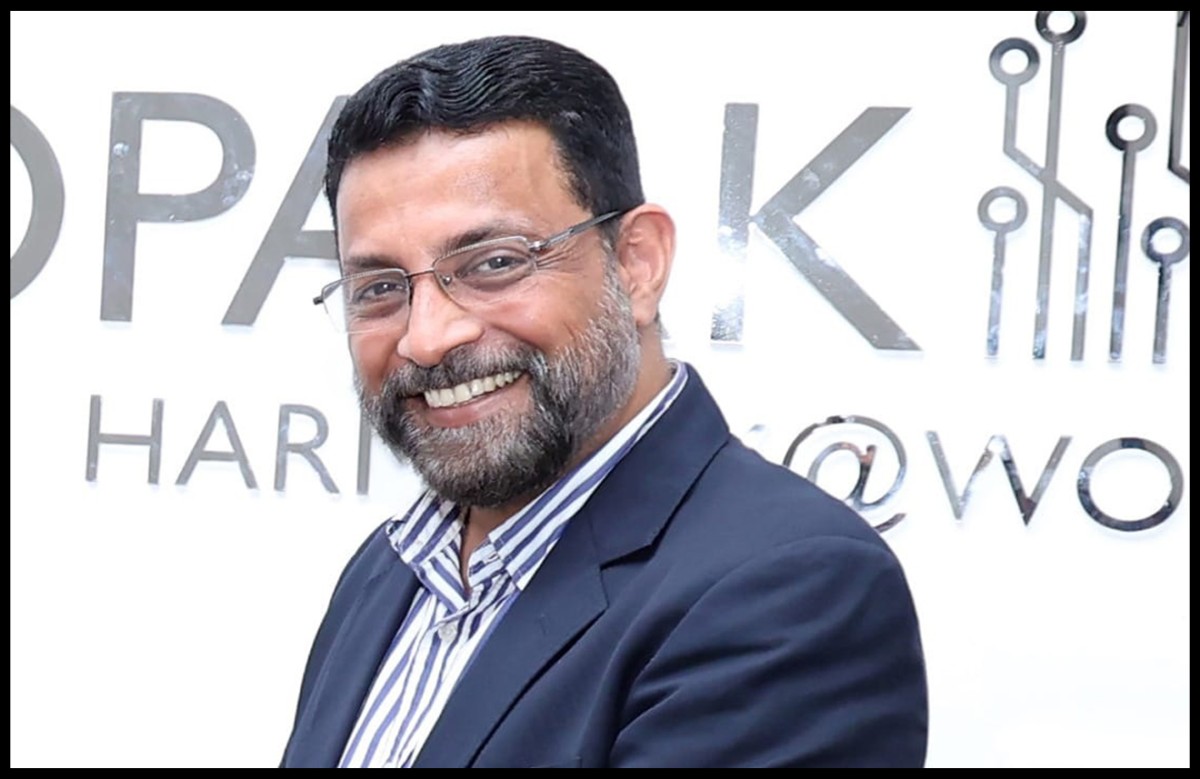
Col Sanjeev Nair says Technopark’s biggest expansion is coinciding with the rise of Trivandrum as a nationally strategic city. Photo courtesy: Kaviyoor Santhosh
 By Hari Kumar, on December 02, 2025
By Hari Kumar, on December 02, 2025
By Hari Kumar, on December 02, 2025
Trivandrum is entering a moment that has been decades in the making and evolving into one of the nation’s most strategic cities. Long anchored by ISRO, VSSC, the Southern Air Command and Pangode Military Station, the city is now adding Vizhinjam International Seaport and the Maritime Theatre Command – an integrated tri-services command of the Indian Armed Forces. For a capital that had always attracted attention nationally and internationally, this cluster of institutions is pushing it into a new tier of strategic relevance.
Alongside that rise, Technopark – the country’s first dedicated IT park – has been moving steadily through its biggest expansion cycle. Phases 1 and 3 now have expanded with projects like Caspian Techpark, WTC by Brigade Group and Al Marzooqi Holding’s Meridian Park.
“Of the 760 acres earmarked in total for the Technopark, 390 acres is in Phase 4,” says Col Sanjeev Nair (Retd), who took over as CEO in January 2023 and is now nearing the end of his tenure. “The future of Technopark lies in Technocity, which is now evolving into an integrated Global Capability Centre (GCC) and R&D hub.”
Nair isn’t someone who arrived promising sweeping reinventions. He took charge at a time when the park needed to maintain momentum while resuming on-campus operations after the pandemic. When he speaks about Phase 4, he frames it as the centrepiece that shaped his priorities.
“Phase 4 was my primary focus when I took the reins, along with strengthening the Park’s existing infrastructure to help bring the ecosystem back to campus,” he says.
Futuristic Vision: Several Phase 4 projects were already on stream before he took charge – the Digital University of Kerala, SunTec Campus and the Kabani building – while Tata Consultancy Services (TCS) hub, KSpace, Digital Science Park, MSME Technology Centre, Quad project and Unity Mall are now moving forward at varied paces. Kerala Startup Mission’s new Emerging Technology Hub will also find its place here.
“Phase 4 development is a project with a very futuristic vision and ample land availability. It is guided by a zoning framework that, in addition to these projects, earmarks areas for a GCC Cluster, an R&D Hub for emerging technologies, and green data centre.”
Nair, who is slated to end his role as the Technopark CEO in the near term, feels the park as well as city needs to evolve its narrative pitch. “Earlier the focus of Technopark was to get as many companies in, offering them facilities we built. That was the early phase. But now we are getting good co-developers who take land parcels to build world-class infrastructure.”
Profile Building: With the arrival of more strategic centres and Technocity development, he feels it is time for Trivandrum, now officially known as Thiruvananthapuram, to position itself differently.
He believes the city should work with international property consultants like Colliers, Cushman & Wakefield, or consulting firms like Deloitte or EY to create a concise document that outlines Trivandrum’s strengths and value proposition.
A detailed city profiling of Trivandrum was done by Technopark in September ’25 using the services of Colliers. It showed a few cities can match the Kerala capital in strategic relevance, vibrant startup ecosystem, innovation strength, and quality of life. This should firmly position Trivandrum on the GCC expansion map. Trivandrum’s mix of premier schools, colleges, hospitals and research centres, he says, makes it “an attractive destination.”
There is also a shift in what global companies expect. “Companies are not too keen to build exclusive campuses on their own,” he says. “Most don’t want to get land on lease and build their own campuses. Instead, they now hire international property consultants to assess city-level strengths and then decide. That puts the onus on the cities to showcase their story with greater impact.”
Core Strengths: Kerala, in his view, has always been slow to showcase its strengths. “I always say this thing – we shy away from projecting them. We sometimes take our progress for granted. As the first e-governed state in the country, even simple initiatives like electronic file movement are already a reality in Kerala, something I did not witness in Delhi. There are many such pioneering and outstanding initiatives, and it is essential to showcase them.”
There is, he insists, “clear intent and purpose at the highest levels of the government,” but the challenge lies in navigating the usual bottlenecks. “Implementation often gets bogged down as it still has to go through the clogged pipeline of the government machinery,” he says.
Red tape isn’t unique to Kerala, but the culture of over-verification is something he noticed immediately. “Everybody in the chain wants to show their competence (in some way) by marking something on the file.” His years in the armed services made that contrast sharper. “Coming from the armed services where things move at a faster pace, this was a bit difficult to come to grips with.”
Needed Changes: He isn’t calling for an unrestrained system – only a more proportionate one. “It doesn’t mean that it should be a cakewalk for everyone … but there should not be too many checks and queries just for the sake of it as it drags down the pace of execution. That is one thing that we should try and change in Kerala.”
He dismisses the idea that multi-directional pulls for projects within the state slows down development. He says as far as technology centres are concerned, there must be collaboration rather than competition, with no room for rivalries.
“As a fauji, I am happy whenever a development programme happens in India. I am doubly happy if it happens in Kerala and triple happy if that is in Trivandrum. But in all the three, happiness is a constant quotient.”
Defence Initiatives: As a person who played a key role during the initial phase of Indian Army’s Innovations for Defence Excellence (iDEX) Programme for startups, Nair feels there should be more defence entrepreneurs from Kerala. With Trivandrum’s longstanding association with ISRO, VSSC, BrahMos and the armed forces establishments, he thinks the city is well placed for defence-tech startups.
It was with this aim that he worked with Kerala Startup Mission to establish Kerala Defence Innovation Zone (K-DIZ) to act as a bridge between startups and the armed forces as well as national-level schemes under the defence ministry’s Technology Development Fund (TDF) and iDEX. He says after discussions, the Pangode Military Station has already started a Technology Hub, which aims to familiarise innovators with defence requirements and provide problem statements. Similar initiatives with the Air Force and Navy are in progress.
There are also plans to generate interest among school and college students in addressing the needs of the defence forces that goes well beyond just weapons and ammunition. “It would be great if the authorities can include such subjects in the curriculum itself. We should be able to attract young minds just like what the Indian space missions have done.”
Call of Duty: As a soldier during his early days, it was not unusual for Nair to be deployed in different roles during his career. The same script seems to repeat now as after three years at Technopark, he is preparing for a new duty, this time to his family to ensure a work–life balance. His mother lives in Mavelikkara, and the distance has been weighing on him. “My intention of moving to Kerala from New Delhi was to be close to my family,” he says.
“As head of Technopark, it was important to be in Trivandrum most of the time. Now, I am planning to enter a phase that will allow me the flexibility to spend a few days a week in Mavelikkara and the rest of the time here.” He plans to ease into a mentor or consultancy role with defence-sector enterprises in the state, though only after taking a couple of months’ break.
India enters a new orbit
If there is one sector that is on high velocity, it is space tech. The latest milestone is the establishment of Skyroot’s MaxQ campus in Hyderabad. Inaugurated by the Prime Minister, the 2-lakh sq ft facility will be equipped to design, develop, integrate and test multiple launch vehicles. The startup also unveiled its carbon fibre launch vehicle, Vikram-1, which will deploy multiple satellites in low Earth orbit. Skyroot Aerospace co-founder Pawan Chandana says Vikram-1 has been fully designed and built in India, and will be ready for launch in the next two months.
Another area where India is trying to build global presence is quantum computing. The National Quantum Mission recently announced that Quantum Fabrication and Central Facilities will be established at different centres. A sum of 720 crore rupees has been earmarked for the facilities that will come up at the IITs in Bombay, Delhi and Kanpur, and at IISc Bengaluru, though the amount pales in comparison when compared to what other countries spend on such facilities. There is also a plan to establish quantum study centres worth one crore rupees each at 100 engineering colleges.
YC nets big with Meesho IPO
Meesho is set to open its share sale on December 3, becoming one of the first Indian e-commerce platform to go public after proving its mettle in a market dominated by Amazon and Walmart-owned Flipkart. The Bangalore-based company is seeking a valuation of up to 501 billion rupees (5.6 billion US dollars) through its IPO next week. According to Reuters calculations, the shares are poised to fetch the top end of the price range, set at 105–111 rupees. While the co-founders – CEO Vidit Aatrey and CTO Sanjeev Barnwal – gain the most, early investor Y Combinator, which got 7.20 million shares at just 1.02 rupees per share, stands to get a staggering ~109× return, putting YC among the highest-multiple winners in the company’s cap table, reports YourStory.
Mobile drone killer unveiled
As drones become a major weapon on battlefields, countries are racing to build defence against these lethal systems. Hyderabad-based Indrajaal Drone Defence has unveiled a mobile vehicle which it calls India’s first AI-powered Anti-Drone Patrol Vehicle (ADPV), capable of detecting, tracking and neutralising hostile drones. Indrajaal Ranger has been developed by Grene Robotics and operates on an all-terrain 4×4 chassis equipped with multiple detection and mitigation systems, reports Indian Startup News. The company says the vehicle can detect and neutralise enemy drones within a few seconds.
Space for more maths
Buckle up for some cosmic calculations. Nasa’s Voyager 1, launched in 1977, is cruising at 61,000 km/h – and after almost half a century, it’s barely reached a “light day” (the distance light covers in a day). Nasa says it will hit that milestone by late 2026. At this pace, Voyager 1 would take 20,000–25,000 Earth years to cover a single light-year. At that speed, a trip to the nearest star system to us, Alpha Centauri would take 70,000–80,000 Earth years. Guess some dreams really are light-years away.
