
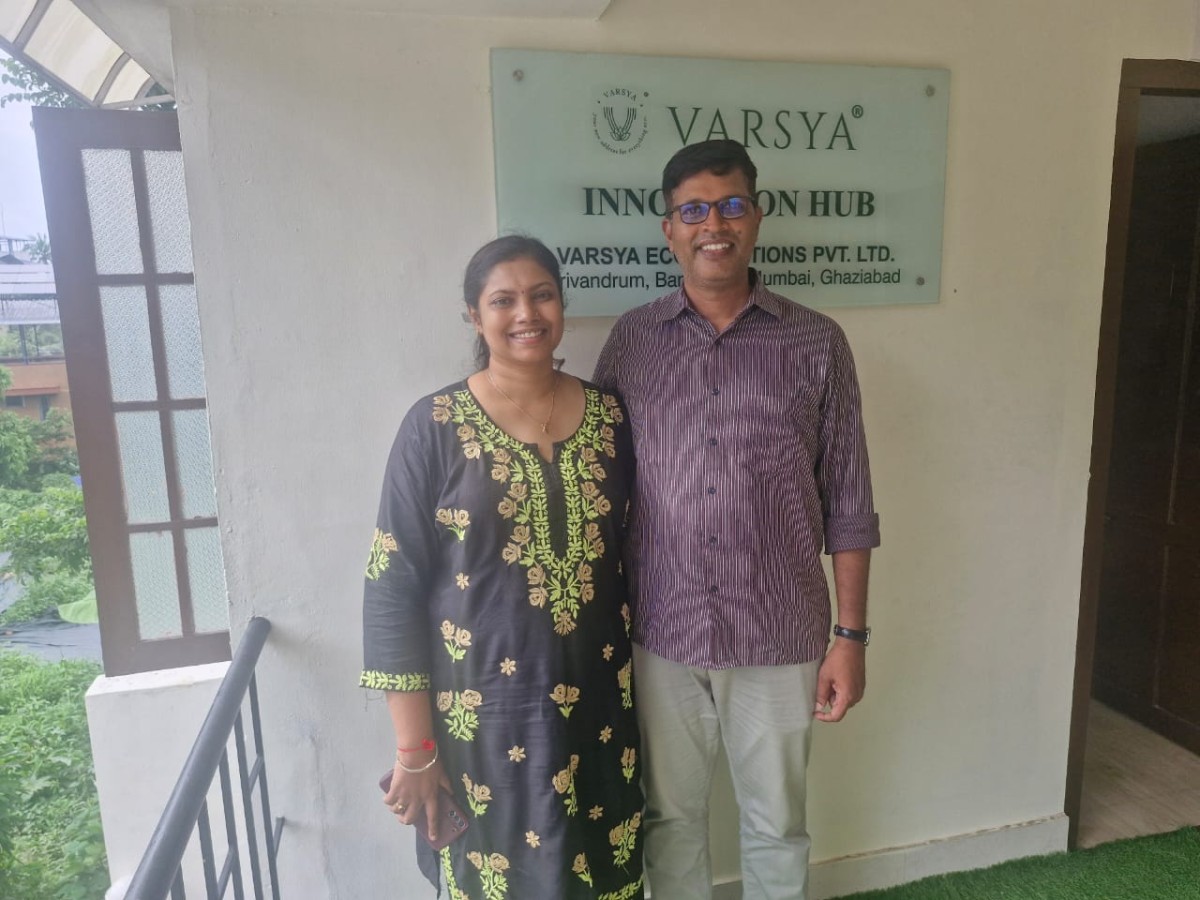
Cofounders of Varsya, Anu Asok and Nitheesh Sundaresan, say their aim is to cut plastic waste. Photo: TikTalk News
 By Hari Kumar, on September 29, 2026
By Hari Kumar, on September 29, 2026
By Hari Kumar, on September 29, 2026
If you have ever ordered food online, you know the routine. The delivery person hands over a plastic bag packed with plastic containers, plastic lids, and little plastic forks. You finish your meal in twenty minutes, but those empty boxes will stick around in a landfill for the next few decades.
It is easy to see why we are buried in plastic. India generates over 9 million tonnes of plastic waste every single year. Yet, almost every restaurant and catering business still relies on it. Because plastic is cheaper than other greener alternatives, easy to stack, and keeps curry from leaking out during a bumpy scooter ride.
But such odds have not stopped the Trivandrum startup Varsya Eco Solutions, founded by Nitheesh Sundaresan and Anu Asok, from building a business with plant-based cutlery and food containers. Now their products are used in Vande Bharat trains running in Kerala and big names like Leela Hotels in Kovalam.
Its R&D team has developed new materials and applications, while a network of manufacturers across India gives it the ability to take those ideas into production. Moreover clients from Europe and the Middle East have started to place orders and collaborate in product development.
Varsya says it is now generating enough business to sustain itself and expects to reach 4 crore rupees in revenue this financial year. It is looking to raise funding not to prove that the idea works, but to expand the R&D and footprint it has already built.
“The market is yet to mature. But there is a rising awareness globally. When the demand spikes, we will be well positioned as our products have already been tested and validated,” says Nitheesh.
Lockdown Lesson: Back in 2020, during the Covid-19 lockdown, Nitheesh and Anu were stuck at home like the rest of us. With dining out off the table, they ordered a lot of food delivery. Day after day, they watched plastic containers pile up in their apartment kitchen. It felt wrong.
Instead of just feeling guilty, they decided to do something about it. They started Varsya Eco Solutions with an aim to reduce plastic waste and replace it with paper.
Even paper containers you see today are secretly lined with a thin layer of hidden plastic film to keep liquids from seeping through. The couple wanted to eliminate that hidden plastic entirely and approached CSIR-NIIST who provided them with the technology in March 2022. Timely grants from KSUM, KAU, IIM Bangalore, NSRCEL and seed loan from IIM Lucknow helped the team along with scaleup loans from KFC and KSIDC.
They spent months fine tuning it and eventually created a special bio-coating made from plant oils and vegetable materials. When applied to sturdy paper, this natural coating makes the paper behave just like plastic – without hurting the planet. Their products passed stringent tests and won awards in sustainable development sector.
Reality Check: Developing a great green product is one thing. Selling it to real-world businesses is a completely different story.
“Everyone knows plastic is bad for the environment,” says Anu. “People read about microplastics in the news all the time, but awareness alone does not automatically change what people buy.”
When a small business owners who operate on thin margins have to choose between a plastic box that costs a few rupees and a greener paper alternative that costs 30 to 40 percent more, cheap plastic wins almost every time.
But the tide may be turning, albeit slowly. Several restaurants and caterers have started using reinforced paper containers made by Varsya.
The startup got more encouragement during the last Onam festival season. They designed special plant-coated paper packaging meant specifically for delivering traditional multi-course sadya meals.
The new packaging was a hit with eco-conscious caterers as well as consumers, and Varsya sold out their entire stock quickly. The number customers who kept on calling them has reassured the startup founders that there is a rising market for their ware.
But caterers pointed out real practical issues that Varsya says they are now working on. Plastic boxes could easily be stacked on top whereas the paper boxes had to be laid out flat to avoid crushing. Caterers also noted that plastic lids snapped shut a bit tighter, making them better at stopping spills on rough roads.
These were not silly complaints; they were real everyday problems that Nitheesh says their research team is working to solve.
Network Advantage: Still, restaurants or businesses who want to move away from plastic are approaching Varsya with their ideas for new products. The startup’s R&D centre at Poojapura then work on the research and product development for the client.
Its growing network of contract manufacturers means it can identify who has the right machinery for a particular requirement. That also reduces the risk for manufacturers as they can avoid experimenting with unfamiliar materials and designs on their expensive equipment.
Nitheesh admits it is still an area that is opening up. “In India, private companies rarely invest in raw research and development,” he says. “Most just want a ready-made product off the shelf. What we do is connect the dots.”
“I think that is the ideal model for a Kerala startup. Do the brain work here and find manufacturers outside who has the ability to scale up if needed,” says Nitheesh.
In 2024, the Kerala government named Varsya the Best Startup in the Manufacturing Sector. Even bigger validation came when Indian Railways chose Varsya’s plant-reinforced cutlery to serve passengers aboard high-speed Vande Bharat trains running in the state.
But Nitheesh admits there are times when the lack of a supportive ecosystem can drive one up the wall. “Despite years of hardwork as a Kerala startup, we still have moments where we think the pastures across the border look tantalisingly green. Their offer of assistance and funding has drawn many startups away from Kerala and we are not surprised.”
Upward Curve: Six years into their journey, Varsya has moved past the survival stage. They have built a self-sustaining business that generates enough steady revenue to keep operations running smoothly on its own. Now, they are preparing for their next major chapter: pitching investors to secure growth capital.
Unlike early-stage startups selling a distant promise, Varsya founders say they will meet potential investors with a proven track record. Their team, which now consists 10 employees and three advisers, have hit every key milestone they set out to achieve, backed by a solid 4 crore rupees in revenue expected this financial year.
This concrete proof of business viability gives them the exact leverage they need to raise capital for expanding their R&D and scaling their market footprint.
They are also looking well beyond local borders. European companies who are eager to find eco-friendly suppliers outside of China, are looking to countries like India. Some of the green product developers in Europe are already in talks with Varsya for joint development of products.
Nitheesh thinks India can tap the geographical advantage to compete with cheaper products that are shipped from east Asia to European markets. “With the Vizhinjam port in Trivandrum becoming operational, Indian manufacturers get an extra edge as delivery time is cut substantially when compared with China,” says Nitheesh.
They are even exploring ways to use their plant-based coatings for sterile medical packaging. “We are looking to use the material we developed in some medical packaging, but that needs tested. At the Trivandrum R&D centre, projects like this will be the major focus,” says Nitheesh.
The market for eco-friendly packaging in India was worth 22.4 billion US dollars in 2025 and is growing at a CAGR of 6.40 percent to reach 32.51 billion by 2031, according to consultants Ken Research. Varsya founders say with their market experience and sustained R&D, they are ready to ride the wave.
AI star emerges from Kerala
A young engineer from Kasaragod is the new star on the Indian tech scene as a global debate grows over different ways to build artificial intelligence models. Nandakishor Mukhunoth, the son of daily-wage workers, developed an experimental AI model that aims to answer questions in a single step by choosing from a fixed set of possible answers and attaching a confidence score. Unlike conventional chatbots, which generate responses as full sentences and use up considerable computing power and energy, his approach seeks to reduce that requirement. Lack of funds forced Nandkishor to abandon IISER, Mohali plans and instead studied at Government Engineering College, Kannur while pursuing independent research, with little initial attention for his work.
That changed after former OpenAI researcher Diogo Almeida released JEV, a model based on a similar principle that reportedly attracted considerable interest and 40 million US dollars in funding. Nandkishor then highlighted his earlier work and released his own implementation as open-source software, bringing fresh attention to his research. His journey from independent research in Kerala to a conversation involving international AI researchers offers a glimpse of how talent can remain hidden in smaller cities and towns of India.
What we liked most was Nandkishor’s humility and research focus that came through during his interview with AIM Network. Such a refreshing change from the usual focus on valuation and funding we see among the tech whizkids.
Amazon bets big on India’s quick commerce
It was just another day at a regular Trivandrum cafe when a friend of ours decided he needed new earphones. He tapped on his phone and, within 15 minutes, they were delivered by Amazon. As the quick-commerce business expands in India, Amazon is now planning to invest another 3 billion US dollars to boost its presence in the sector, says Times of India. The investment will be used to add new dark stores, strengthen its tech stack, deploy AI tools and expand its product mix.
Robots dive into Hong Kong’s water tanks
Hong Kong is testing a robotic water-tank cleaner that can be operated remotely, avoiding the need for cleaners to enter the tank physically. Operators can see images from a camera, while the amphibious robot can enter a tank even when it is full of water. The maker, Hong Kong Center for Construction Robotics, says its system also uses artificial intelligence to analyse dirt. The company aims to begin mass production in 2026, with the goal of seeing the robots widely adopted for cleaning water tanks in apartment complexes.
Raman Effect leaves columnist perplexed
Author and columnist Sadanand Dhume is not going to be a fan of Perplexity, we can assure you. As he posted on social media, he wanted to read the contents of author Manu S Pillai’s Malayalam column about CP Ramaswami Iyer. So he uploaded an image of the column to Perplexity and asked it to translate it. First, it produced a version claiming the column was about CV Raman, complete with details about his research in physics. On the second attempt, it bizarrely started producing paragraphs about Anglican priest and Indian independence champion CF Andrews. One for the “lost in translation” file.
