
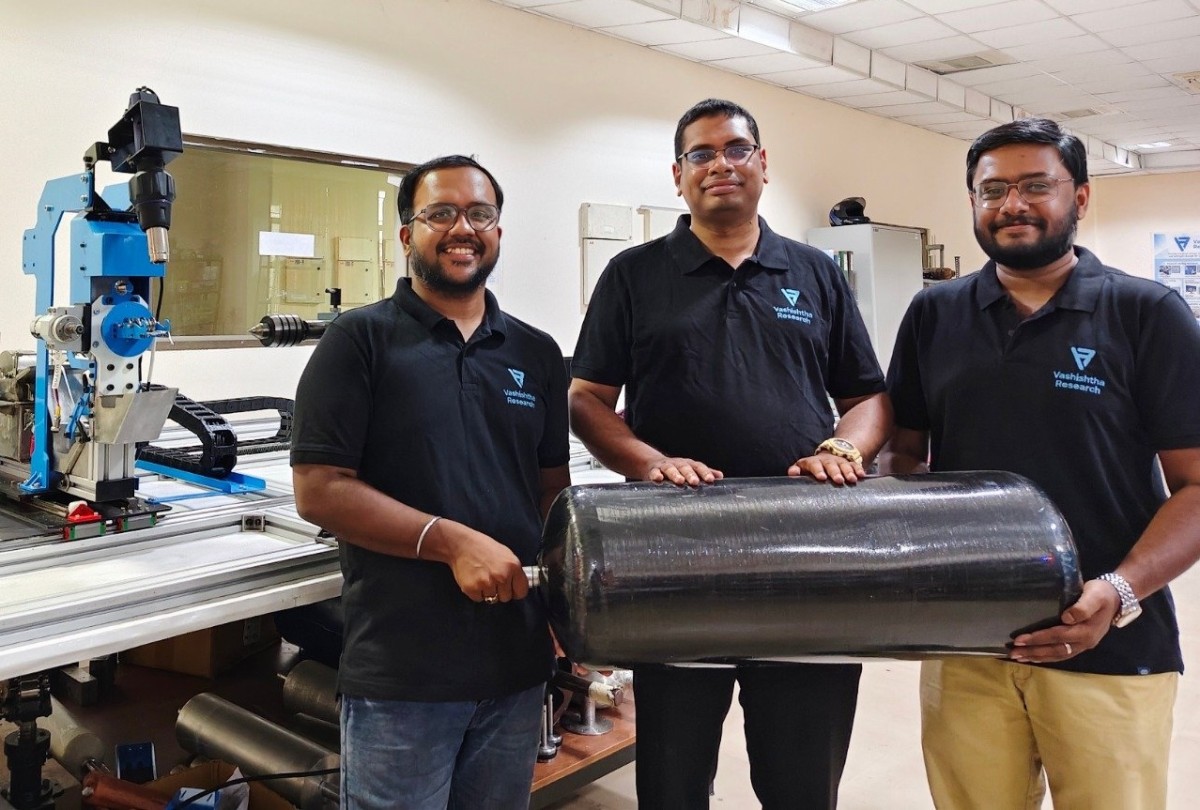
The cofounders of Vashishtha Research (from left) Vignesh KC, Saurabh Chatterjee and Jeevan Philip, with one of the cylinders they produced. Handout photo
 By Hari Kumar, on September 15, 2026
By Hari Kumar, on September 15, 2026
By Hari Kumar, on September 15, 2026
One of the ideas behind launching this newsletter was to spot the bright little nuggets we find in Kerala and highlight their potential. Trivandrum-based Vashishtha Research is one such find that has proved us right. When we wrote about the fledgling spacetech startup in February 2023, it was still finding its feet.
Three years on, it has grown into a deep-tech venture that has developed indigenous hardware, software and know-how for composite pressure vessels (the cylinders used to store high-pressure gas), a technology that could become increasingly important as India and the world embrace hydrogen and other clean-energy sources. Vashishtha’s revenue is poised to clock a revenue of 2 crore rupees this financial year – a meaningful marker for a hardware deep-tech startup at this stage.
Vashishtha’s founders, Saurabh Chatterjee, Vignesh KC and Jeevan Philip, were driven by a desire to develop critical technologies indigenously and reduce India’s dependence on foreign suppliers for hardware and software.
That journey has brought them close to their goal. The company now has indigenously developed technology and locally built alternatives to equipment India has long imported.
A recent 5-crore-rupee tie-up with Supreme Industries, one of India’s largest plastic product manufacturers, could help take its work from a Trivandrum lab to large-scale manufacturers – and from there, to a much bigger market at home and abroad.
Early Trajectory: Their initial idea was to develop non-destructive testing of composite materials used in space technology, using thermal techniques to detect cracks and other defects.
Their incubation at the Indian Institute of Space Science and Technology (IIST) gave them more than laboratory space. It also connected them to a network of Indian Space Research Organisation (Isro) experts and IIST researchers who could offer technical advice and help them understand the demanding requirements of space technology. That network has remained an important part of Vashishtha’s journey.
One of the side projects the startup took up as a potential revenue generator was filament winding. Soon Vashishtha developed its own desktop filament-winding machine, Carbon Chakra, and Winding Guru, the software that controls the sophisticated process.
Their first commercial delivery went to IIT Jammu, followed by an order from a Spanish research institute. Getting there wasn’t easy. Cofounder Vignesh KC recalls a four-month sprint to build, test and ship the product.
He says the team virtually spent day and night on the product, testing it and completing every check before shipping it. After IIT Jammu’s experts tested it and gave them the thumbs up, the founders were thrilled.
Crucial Pivot: Positive feedback from customers in India and Spain gave the founders confidence that they were building something people were willing to pay for. It also convinced them that the technology could take them beyond their original space-tech ambitions.
Most high-pressure gas cylinders are made from metal. They are strong, but they are also heavy and vulnerable to corrosion. Composite pressure vessels replace much of that heavy metal with strong fibres and polymer materials. They can hold gases at very high pressure while weighing much less and avoiding the corrosion that affects metal cylinders.
That becomes particularly significant as hydrogen moves from being a laboratory concept to an increasingly important clean-energy fuel. Hydrogen has to be stored and transported under high pressure, and lighter cylinders can allow more gas to be carried on each truck and potentially reduce transportation costs.
The advantages extend beyond hydrogen. Composite cylinders can be used for high-pressure gases, while their resistance to corrosion and lighter weight makes them particularly attractive for marine and other demanding environments. The upfront cost is a real barrier – Vignesh says composite cylinders can cost around three times as much as their metal counterparts.
But he argues metal cylinders used for gases like CNG wear out faster from corrosion and need more frequent replacement, which tilts the long-term economics in composite’s favour. Vignesh also says the combination of enhanced safety and lighter weight makes composite the default choice for hydrogen storage, rather than just the better one.
Hardware Hardships: But making one is not as simple as swapping metal for fibre. Every part of the cylinder has to be worked out – how the fibres are laid, how many layers are needed, what goes inside the cylinder, how it is manufactured and, crucially, how it is tested to make sure it can withstand the pressure.
Vashishtha’s bet is that developing much of this technology in-house and continuing research will give it an engineering advantage and better control over costs.
To reach this point, they had to travel along a very rocky path. Deep-tech companies have a particularly awkward funding problem as most investors shy away at the long gestation period. Their technology can take years to develop, while equipment, prototypes, testing and specialised talent require money long before large revenues arrive.
Vashishtha’s founders spent years knocking on doors for funding and industrial partnerships. Government grants and support programmes helped along the way, including Kerala Startup Mission’s productisation and R&D support and the DRDO Technology Development Fund. It also received USHUS grant from IIMK Live and CSL and Impact grant from IPTIF, IIT Palakkad.
Vashishtha also raised an early angel investment from Trivandrum-based Faiz Mohammed Haneef, CEO of Neoito Technologies. But the real breakthrough came in January 2026, with Mumbai-headquartered Supreme Industries Limited.
Ideal Partnership: Supreme has agreed to invest 5 crore rupees in Vashishtha Research. The arrangement brings together two very different strengths. Vashishtha brings the research, engineering and technology development; Supreme brings industrial manufacturing experience and the ability to scale.
“Our vision is to develop globally competitive pressure vessels designed, engineered, and manufactured entirely in India,” says Saurabh Chatterjee.
For a startup that spent years struggling to finance hardware development, the significance of the deal goes well beyond the 5 crore rupees. It gives Vashishtha a potential route from prototype to industrial production and, through Supreme’s manufacturing and market presence, a path towards customers beyond India.
Vashishtha is now building the infrastructure it needs for the next stage, including a prototype-development factory and R&D centre at Nedumangad, just outside Trivandrum city. It is also continuing to upgrade its filament-winding technology. The Carbon Chakra Pro is a more advanced version of the original desktop machine, designed to handle more spools and heavier workloads.
The company is on a path towards its ambition of developing the machines and software needed to establish advanced composite manufacturing in India rather than relying entirely on imported technology.
Green Shoots: Vashishtha’s journey also points to a bigger shift. India’s better-known technology hubs have built formidable software companies and digital businesses.
But cities such as Trivandrum are producing startups tackling a different, more capital-intensive and technically demanding set of problems – building the machines, semiconductors and other physical technologies that India needs to make for itself.
Our 2023 piece ended by noting how the pioneering work of Isro founder Vikram Sarabhai and former President APJ Abdul Kalam had stoked embers that continued to burn beyond their generations.
Vashishtha Research is one example of what can happen when those embers find their way into a new generation of engineers and into a small laboratory in Trivandrum, the very city from which India’s space journey took off in the 1960s.
Twin boosts for Kerala tech sector
Kerala’s tech sector has had a good week. First, ARC, a startup cofounded by Kerala-based Jobin Joseph, and Kaustubh K Jadhav announced that it has received 10.5 crore rupees in early funding, putting the company on course to mass-produce its portable gaming device, the ARC X1. The market is currently dominated by big players such as Nintendo Switch and Steam Deck. But the startup says its pocket-friendly video game player is built specifically for Indian gamers. ARC created its own hardware and operating system, OWL OS, customised from the ground up to make games run faster and look better on the handheld device. The company has crossed 50,000 waitlist sign-ups and collaborated with Qualcomm ahead of its commercial launch.
Another shot in the arm for Kerala startups came during the Brics summit in New Delhi, when two companies from the state were chosen among the 37 showcased at the event: Cochin-based EyeROV and Trivandrum-based Netrasemi. EyeROV was also among the five companies chosen to present their products to the heads of state who toured the exhibition area. A picture of EyeROV founder Johns T Mathai showing the company’s underwater drone, Trout, to leaders including Indian Prime Minister Narendra Modi, Chinese President Xi Jinping, Russian President Vladimir Putin and South African President Cyril Ramaphosa was also featured in the local media.
Goyal turns tables on pharma
Usually, it is the private sector we hear complaining about a lack of government support. But the tables were turned recently when Union commerce and industry minister Piyush Goyal lamented that no pharma company had stepped forward to take up government funding offered to boost the Indian pharmaceutical sector. “The Government of India will fund the acquisition of testing equipment for testing labs. But you ask first, there is not a single proposal from the industry yet,” Goyal said at the Pharma Machinery and LabNext Expo organised by EEPC India. Moneycontrol reports that Goyal was referring to the Bureau of Indian Standards’ existing mechanism to provide financial support to laboratories in critical areas.
Dyson’s new brush with technology
From bladeless fans to high-tech hair dryers, Dyson has always attracted attention with its innovations. It has now launched a new electric toothbrush that uses a tiny camera to give you the perfect brush. The British multinational technology company, now headquartered in Singapore, has put a tiny macro camera and a strobe light inside the toothbrush handle. While you’re brushing, the camera takes 28 pictures a second, while onboard software analyses the images in real time to find the exact gaps between your teeth and direct the water. An app tracks your brushing habits and gives feedback. To make all this happen, the company employed 661 engineers and generated 38 patents from the project. No wonder it costs 500 US dollars.
The 80,000-year space project
It is usually governments in India that have projects with no end in sight. But a US-based non-profit organisation called the Fermi Explorer Mission has left them eons behind. It plans to launch a spacecraft in 2029 to Alpha Centauri, the closest star system to us, which is 4.4 light years away. The spacecraft could take up to 80,000 years to get there, but the team behind the project is not worried that they, or any of us, will be around to receive the news. They say the idea is to push the envelope in space research.
