
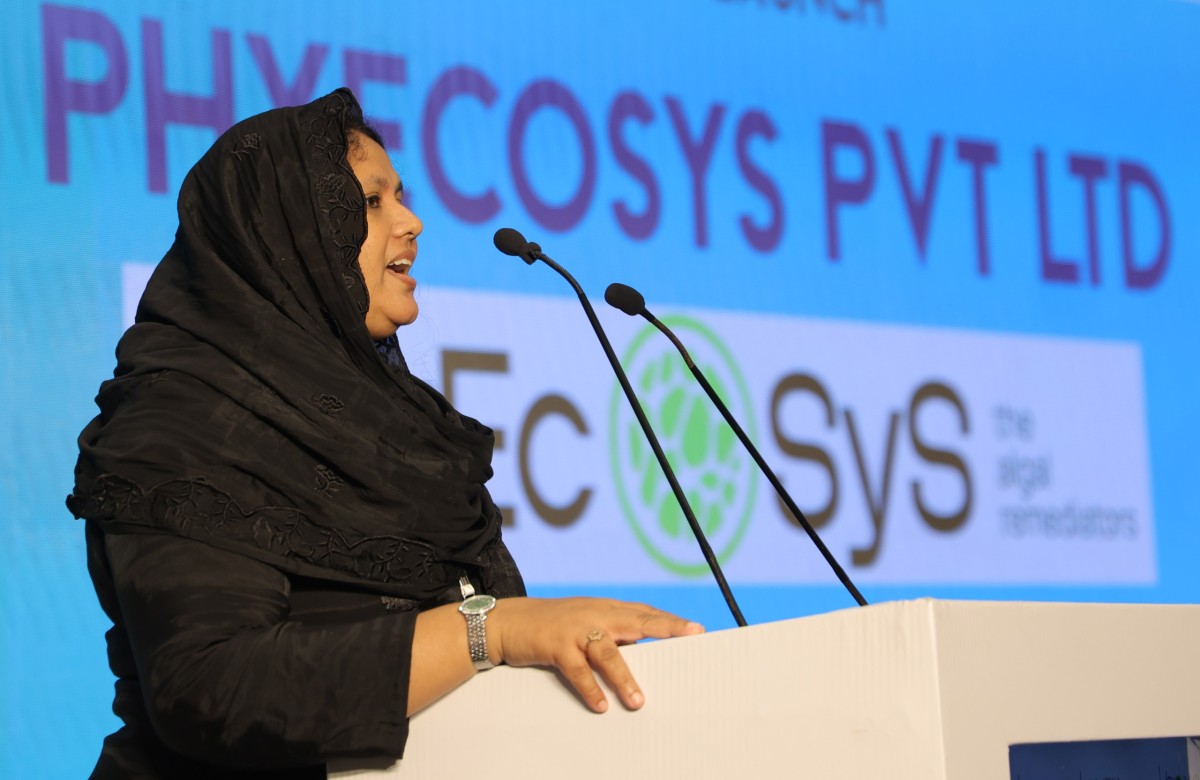
PhyEcoSyS CEO KA Jasmin sees vast potential in microorganisms such as algae. Photo courtesy: Kaviyoor Santosh
 By Hari Kumar, on November 03, 2026
Algae, or payal in Malayalam, is something we usually try to get rid of as soon as we spot it, whether on walls, around swimming pools or inside containers. But not all algae are the same. While some can cause health problems and affect the ecosystems, others offer promising ways to tackle serious environmental challenges, from air and water purification to maintaining ecological balance.
KA Jasmin, founder and chief scientific officer of Cochin-based startup PhyEcoSyS, believes these tiny organisms punch well above their weight in sustaining ecosystems. Her mission is to harness their potential to develop sustainable environmental solutions through microalgal biotechnology.
For Jasmin, this is more than a business proposition. It is the culmination of years of studying microorganisms and exploring their applications. A PhD holder in marine sciences from Cochin University of Science and Technology (CUSAT), she is now on a mission to introduce the world of algae to the public and make people aware of their potential.
Along with offering internships to biotechnology students and sharing her expertise with aspiring researchers, her startup has developed a living wellness lamp called Zivara. Jasmin sees the product as a way to demonstrate the potential of microalgae and bring the science into people’s homes.
But getting people to appreciate the possibilities of these microscopic organisms is only one part of her challenge. Turning scientific research into commercially viable environmental solutions has proved considerably harder.
Real-world Problems: Hurdles are nothing new for Jasmin, whose journey has not followed a conventional path. At a time when balancing career and family responsibilities can be challenging, she married at 18, during the first year of her undergraduate studies. Her elder daughter was born while she was pursuing her postgraduate degree and her younger daughter during her doctorate.
Inspired by her mother Jameela AM, who continued working professionally into her sixties as a Mahila Pradhan, Jasmin persisted with her education and research while balancing family responsibilities.
She went on to teach at St Albert’s College before moving into research at Cusat. After her PhD, she worked as a microalgal cultivation scientist for two firms based out of Germany. It was then that she began to appreciate the wider value of her expertise. Initially, she offered consultancy services for free. Soon, people from different parts of the world began approaching her online for advice.
The experience helped her recognise that her knowledge of microalgae could be applied to problems far beyond the laboratory. That realisation eventually led to PhyEcoSyS in 2025, which works on microalgae-based solutionsand circular water systems.
Clear Target: One of its projects is a floating bio-island designed to help treat polluted water bodies. The concept uses floating structures made from upcycled materials, such as plastic boats, barrels or tanks, containing aquatic plants such as duckweed and beneficial microalgae.
The project offers a potential alternative to treatment methods that rely heavily on machinery or chemicals. It was recognised by the Waste Free ’23 Technical Repository, a platform highlighting grassroots innovations in sustainability. Now she is involved in projects like water hyacinth reutilisation in Ethiopia and a slaughterhouse waste treatment in Cameroon.
For Jasmin, such applications demonstrate why microalgae deserve greater attention. They offer possibilities across several environmental applications, although each requires research, testing and refinement according to the situation.
Her inputs on water-body purification, from ponds to rivers, have found mention in some study reports compiled in Kerala, but few initiatives have been put to the test.
Jasmin says the technology developed by her startup can help maintain the balance between beneficial and harmful microorganisms in water bodies. With local participation, she believes, these water bodies can be monitored and maintained better, reducing the risks associated with microbial contamination.
This has particular relevance in Kerala, which reported infections caused by Naegleria fowleri, an amoeba associated with contaminated water, in 2026.
Time and Money: Environmental research requires time, experimentation and money. A promising idea may take years to develop into a product that customers are willing to pay for. This makes it difficult for startups to attract investors looking for quicker returns.
Jasmin has experienced this first-hand. As PhyEcoSyS devoted more time to research and development, consultancy assignments slipped down its list of priorities. Revenue came under pressure even as the need for further research grew.
Some of the advice she received from potential backers was discouraging. One reportedly told her that a company seeking to clean the air or water had little future. Others wanted as much as 50 percent equity in exchange for backing a venture whose gestation period could stretch to five years.
“Someone once told me, even within my own family, that if this company were led by a man, it would have gone miles ahead,” she says. “Maybe, but looking back at the record so far, I realised one thing: my solution was to work harder every time I came to a juncture like this.”
Her experience highlights a challenge for research-driven startups. The social value of a proposed solution does not automatically translate into a viable business. Research needs funding, products need testing and customers must be persuaded to pay for them.
Jasmin has continued to pursue her research despite these difficulties. Zivara is one attempt to bridge the gap between scientific knowledge and public awareness.
Home Advantage: Launched at the Bio Connect event in Trivandrum in October, Zivara is designed to introduce microalgae into everyday life. The primary function of the gadget is to absorb carbon from the air and emit oxygen, while a dial continuously displays the air quality.
The product combines an algal culture with lighting designed to change colour, matching the circadian cycle. The company describes it as an exploration of the relationship between living biological systems, light and the indoor environment.
The product also offers a possible use for the algal culture. Users can harvest it periodically, with the resulting material intended for applications such as plant nutrition or fish feed.
Jasmin sees Zivara as more than another air purifier. She wants it to offer a distinctive indoor experience inspired by her years of working with microalgae.
Her interest in light and biological systems also acquired a wider scientific context when the 2026 Nobel Prize in Physiology or Medicine recognised work associated with optogenetics, a field that uses light to control nerve-cell activity. The research builds on discoveries involving light-sensitive proteins found in microorganisms.
The connection illustrates how studying biological systems can open up unexpected avenues of scientific research.
A larger Ambition: Zivara is only one part of Jasmin’s ambition for PhyEcoSyS. The company wants to continue developing microalgae-based approaches to environmental problems, including wastewater treatment and industrial waste management.
Industries such as rubber processing and textile manufacturing generate waste streams that can be difficult and expensive to treat. Jasmin sees opportunities to investigate biological approaches that could make such processes more effective or economical.
For her, the goal is not merely to sell a product. It is to find practical uses for organisms that could contribute to solving environmental problems, while opening the world of microorganism to young students through internships.
The science may be microscopic. The challenge of turning it into a business is anything but.
New Delhi plans a push for sports tech
India has approved a Khelo India Sports Goods Manufacturing Scheme with a total outlay of 1,856 crore rupees (194 million US dollars) to promote investment, manufacturing and innovation in the sports goods sector. The idea is to create Sports Goods Manufacturing Zones (SGMZs) to promote cluster-based manufacturing. One focus area is research, design and innovation in the sports goods sector, with dedicated support for startups. From data analysis to material science, the policy covers a wide area. Hopefully, we will see some advancement in this area soon.
A KPMG report released recently says India’s sports economy is estimated at 1.99 lakh crore rupees (21 billion US dollars) in FY26 and is expanding at an annual rate of 12–14 per cent. Yet cricket continues to dominate commercial activity, accounting for nearly 75–80 percent of the sports economy, according to the report’s overview. It devotes a few pages to the possibilities for the technology sector in this area and calls for integrating sports science, digital systems and talent identification.
Ventup gets a funding boost
It is great to see Ventup, which we had featured in 2024 when they set out to develop a high-end manufacturing base in India, progressing as planned. The startup, founded in 2021 by Sandeep Nair, Wasim Ankli and Joseph Panakkal, has created a platform that brings together in-house engineering capabilities and a network of manufacturing partners to achieve this. It has now raised 3 million US dollars in a pre-Series A round led by Rainmatter by Zerodha and Unicorn India Ventures. “India’s next phase of manufacturing growth requires strong engineering capabilities that can translate complex requirements into validated, production-ready components,” said co-founder and CEO Sandeep Nair.
Singapore expert in top MIT list
The 2026 MIT Technology Review global list of 35 Innovators Under 35 has no one from India, but features three scientists and innovators of Indian origin. Singapore-based Aditya Nair (Neuroscience /Neural Systems), is recognised for his work mapping neural circuitry to understand how brain activity generates emotional states. Associated with the Lee Kong Chian School of Medicine and Nanyang Technological University (NTU), he has also won several global awards over the past two years. Ayush Chopra, a PhD student at the MIT Media Lab, and Sayash Kapoor, an assistant professor at UC Berkeley and co-author of AI Snake Oil are also on the list.
Chinese thumbs down for AI movie
Chinese audiences are happily devouring AI-made microdramas, but when it comes to a full-length AI-generated film, they seem to have had enough. Sanxingdui: Future Past, which took two years and 1.5 million US dollars to make, opened with 10,000 scheduled screenings on October 23. But the audience response was anything but blockbuster material. It collected only around 181,000 US dollars over its opening three-day weekend, barely 12 per cent of its production cost. Niu Lai, a quirky, decidedly non-AI animation made by a mother-and-son team seems to have got the last laugh. Made for less than 1,000 US dollars, it has reached a reported gross of approximately 9.7 million US dollars.
